AW-10865990051

Data Migration QA: Checksums & Audit Trails

Migration-QA-at-Scale-Reconciliation-Checksums-and-Audit-Trails

Migration QA at Scale: Reconciliation, Checksums, and Audit Trails 

📂 Did you know that during enterprise database migrations, as much as 20% of quiet data corruption goes entirely unnoticed until post-cutover operational failures occur? 

Understanding migration QA at scale 

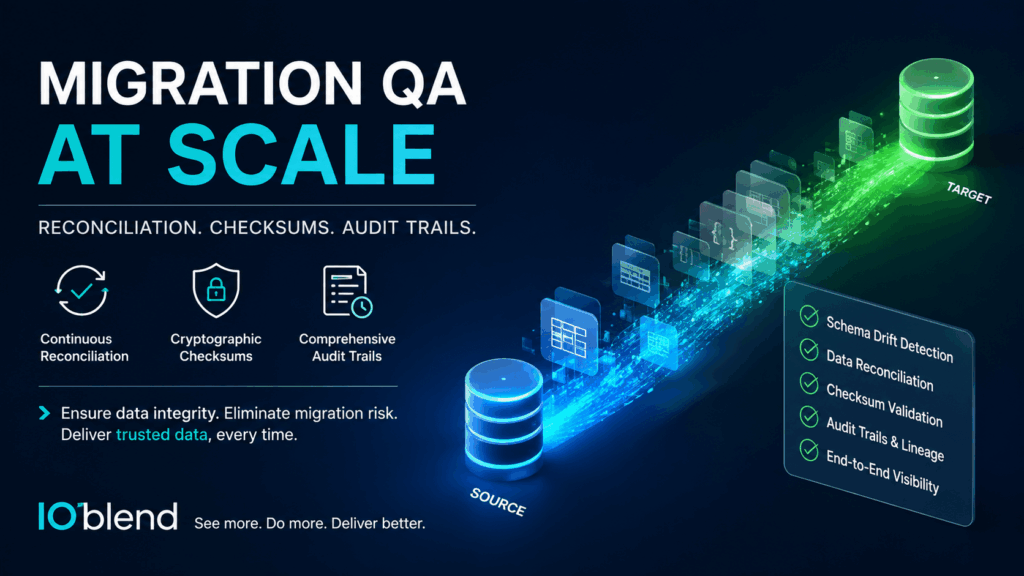
Migration QA at scale refers to the systematic validation of volume, structure, and integrity when shifting enterprise data across heterogeneous environments. Rather than relying on simple row counts, modern reconciliation demands three core pillars: continuous reconciliation to guarantee record symmetry, cryptographic checksums to verify payload fidelity down to individual byte values, and comprehensive audit trails to record end-to-end lineage and schema evolution. 

The operational bottlenecks in enterprise migrations 

Engineering teams undertaking complex migrations regularly encounter severe operational hurdles: 

  • Silent schema drift and field truncation: Unannounced schema changes or subtle precision losses (e.g. timestamp truncation or numeric overflow) in active source pipelines corrupt target datasets quietly without throwing fatal job errors. 
  • Prohibitive compute overhead: Executing full-table hashing or cell-by-cell row comparisons across billions of records introduces unsustainable latency and spikes warehouse consumption costs. 
  • Lack of record-level lineage: When discrepancies emerge, pinpointing whether the fault stemmed from network drops, transformation logic, or late-arriving CDC records requires painstaking manual log analysis. 
  • Multi-tool stack complexity: Orchestrating separate tools for batch extracts, streaming CDC, data quality assertions, and logging creates fragile pipelines that fail unexpectedly under high throughput. 

Eliminating migration risks with IOblend 

IOblend solves these migration QA challenges by standardising production data pipelines on Apache Spark through portable JSON playbooks and native Python/SQL logic. 

  • Automated continuous reconciliation and line-level lineage: IOblend tracks schema evolution and change data capture in real time (including late-arriving data), delivering record-level lineage so you can trace, debug, and replay discrepancies instantly. 
  • Cryptographic integrity and high-throughput validation: Capable of processing over 1 million transactions per second with ultra-low P99 latency, IOblend executes validation rules and custom checksum checks directly on Spark infrastructure without heavy warehouse compute costs. 
  • Unified governance and auditability: Built-in audit trails, automated data quality controls, and drift handling ensure full end-to-end compliance from source to sink across cloud and on-premises environments. 

Eliminate migration anxiety and streamline your data pipeline testing. Supercharge your enterprise data migrations with IOblend. 

IOblend: See more. Do more. Deliver better.

Schema-Evolution-Without-Chaos-Strong-Data-Contracts-Enforced-In-Pipelines
AI
admin

Schema Evolution with Strong Data Contracts

Schema Evolution Without Chaos: Strong Data Contracts Enforced In Pipelines  📋 Did you know? In the early days of big data, a single altered column in a production database could trigger a catastrophic “data graveyard” effect.  The Concept of Schema Evolution  Schema evolution is the ability of a data platform to gracefully adapt to structural changes

Read More »
Mainframe-to-Cloud-with-CDC-IOblend
Data analytics
admin

Mainframe to Cloud: Data Migration with CDC

Mainframe to Cloud: A Practical Data Migration Playbook  💾 Did you know? An alarming 83% of data migrations fail outright or drastically overrun their budgets.  Shifting Mainframe Heavyweights to the Cloud  Mainframe-to-cloud data migration is the process of moving core legacy data assets, often stored in rigid formats like DB2, VSAM, or IMS, into modern cloud

Read More »
Real-time-CDC-pipelines-into-Delta-tables-IOblend
AI
admin

Real-Time CDC to Databricks Delta Tables

Realtime Ingestion to Databricks: From Source to Delta Tables  💽 Did you know? According to industry surveys, nearly eighty per cent of an enterprise’s data budget is consumed purely by data integration and upfront data wrangling rather than actual analytics.  Defining real-time ingestion  Real-time ingestion to Databricks represents the technical evolution from rigid scheduled batch processing

Read More »
Cloud migration de-risked with parallel runs IOblend
Data analytics
admin

De-Risk Cloud Migration with Parallel Runs

De-Risk Your Migration: Run Legacy and New Systems in Parallel  💻 Did you know? An alarming 83% of data migrations either fail outright or drastically overrun their budgets. When management loses patience with mounting technical friction, entire digital transformations are written off.  Minimising the migration gamble  To eliminate this operational hazard, running legacy and new systems in

Read More »
Governed and auditable data pipelines with IOblend
AI
admin

Compliance DataOps for Auditable Pipelines

Compliance-Friendly DataOps: Repeatable, Reviewable, Versioned Pipelines  📓 Did you know? According to industry compliance reports, nearly 70% of businesses face difficulties tracing their data back to its raw origins during regular regulatory audits.  The Concept of Compliance-Friendly DataOps  Compliance-friendly DataOps represents an operational framework that embeds strict regulatory governance directly into the data engineering lifecycle. Instead of treating data auditing

Read More »
DR-and-continuity-with-IOblend
AI
admin

Continuous Data Replication for DR and Continuity

Continuous Data Replication: for Business Continuity and DR  📝 Did you know? According to industry studies, the average cost of IT downtime is approximately £4,500 per minute. For a large enterprise, a single hour of data loss or system unavailability can translate into millions in lost revenue, legal penalties, and irreparable brand damage.  The Pulse of

Read More »
Scroll to Top