
Enterprise data integration for AI, analytics and modernisation.
IOblend is the independent production data layer for enterprises that need trusted data to move across systems without replacing the systems they already own. Use it for production analytics, cloud migration, Customer 360, real-time data, system synchronisation and AI-ready enterprise data—across cloud, on-premises and hybrid environments.
What needs to work better?
Whatever your data need, IOblend will be the most powerful tool in your war chest. Explore the wide variety of use cases that you can address with a single integration layer.
Production-ready analytics
Turn fragmented enterprise data into trusted analytical inputs.
Explore solution →CDC · reconcile · parallel runCloud migration
Move data and logic while old and new environments stay aligned.
Explore solution →MDM · dedup · SCDCustomer 360
Create and maintain a trusted customer view across operational systems.
Explore solution →stream · state · qualityReal-time data
Make streaming, event and CDC data operational without a separate stack.
Explore solution →CDC · golden record · syncSystem synchronisation
Keep ERP, CRM, databases and applications aligned as records change.
Explore solution →agent · validate · quarantineAgentic AI pipelines
Put AI reasoning inside a governed enterprise dataflow.
Explore solution →Different problem. Same production discipline.
Whether the goal is a migration, a real-time decision, a customer view or an AI workflow, IOblend keeps the same controls close to the data as it moves.
See the architecture in your operating context.
Explore different data applications by industry. One software, multiple use cases.
Manufacturing
Machine, plant, ERP and operational data.
Explore industry →IndustryTelecoms & utilities
Meters, sensors, network events and back-office systems.
Explore industry →IndustryAviation & aerospace
Flight, fuel, ground, booking and safety data.
Explore industry →IndustryProperty management
Building sensors, occupancy, utilities and commercial records.
Explore industry →IndustryFinance & insurance
Governed data across legacy, transactional and digital systems.
Explore industry →IndustryConsumer goods
Supply chain, product, customer and order data.
Explore industry →IndustryHealthcare
Device, operational, database and analytical data.
Explore industry →IndustryLogistics & transport
Planning, vehicle, edge, traffic and enterprise data.
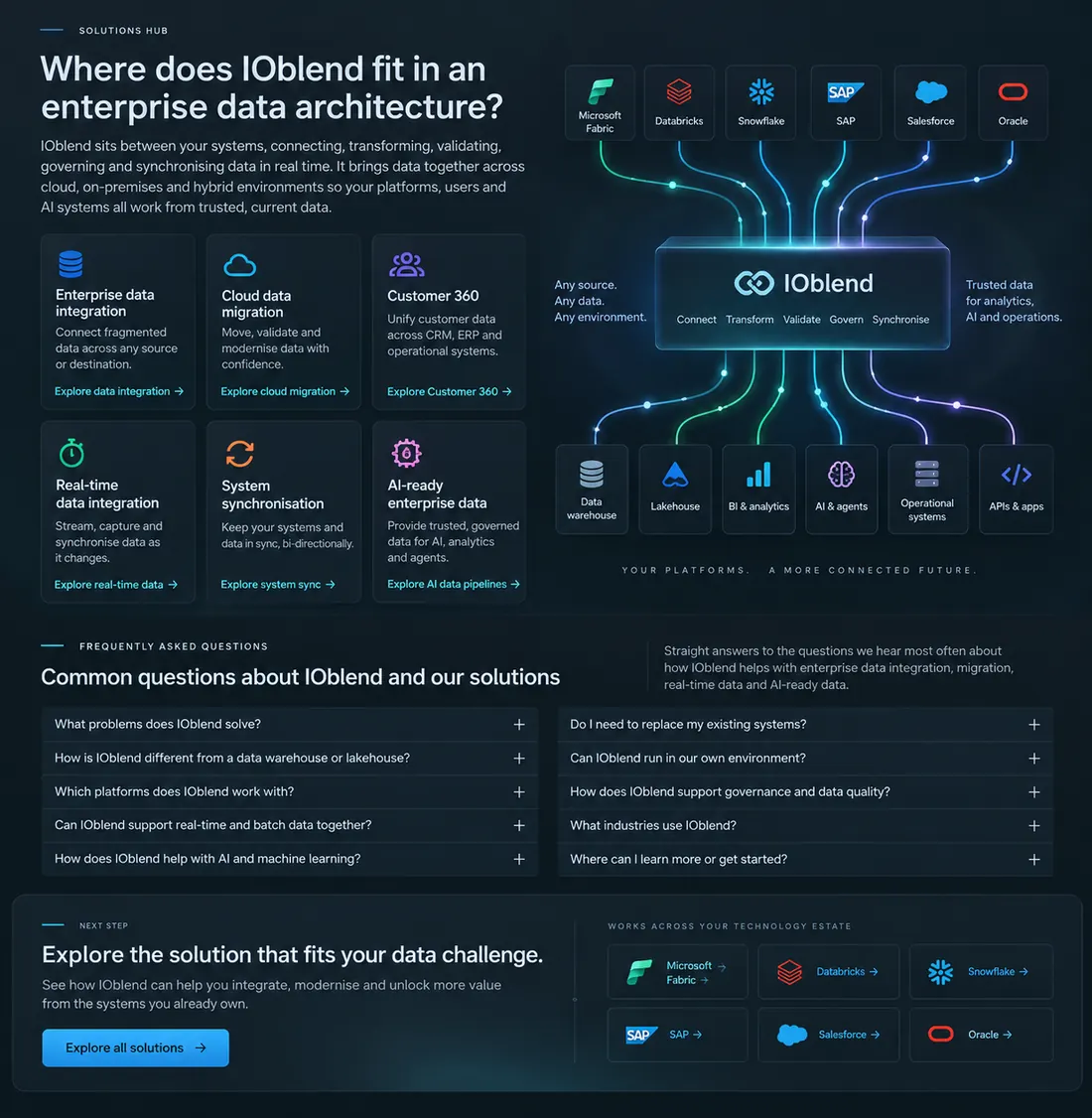
Explore industry →Where does IOblend fit in an enterprise data architecture?
IOblend is an independent production data layer for enterprise data integration, DataOps, AI and modernisation. It is best suited to situations where data must move reliably between heterogeneous systems, be transformed and governed in flight, and arrive ready for analytics, applications, operations or AI—without replacing the warehouse, lakehouse, ERP, CRM or cloud platforms already in use.
Enterprise data integration, transformation, data quality, lineage and reusable business rules across source systems.
Current, governed and analytics-ready data delivered into the warehouse, lakehouse or analytical platform already in use.
Cloud data migration using bulk history, CDC tail, transformation, reconciliation, checksums and controlled parallel running.
Legacy and target environments stay aligned while migration data is validated before cutover.
Customer 360 data integration, entity matching, deduplication, MDM and Slowly Changing Dimension patterns.
A continuously maintained customer identity and history that analytics, applications and AI can use consistently.
Real-time data integration, event processing, CDC, in-memory transformation, state and quality controls.
Live events can be combined with existing enterprise data and delivered to operational analytics, applications and automated decisions.
System synchronisation with CDC, transformation, validation, state management and controlled exception handling.
Trusted records remain aligned across multiple operational systems as business data changes.
AI-ready enterprise data, including governed structured and unstructured data flows, Python/model logic, validation and quarantine.
AI agents and applications receive current, governed enterprise context with quality and lineage around the dataflow.
Use IOblend when the problem is between systems.
IOblend is particularly relevant when the difficult part is connecting, transforming, validating, synchronising and governing data across an existing enterprise estate rather than replacing the estate itself.
IOblend is not trying to become your warehouse, ERP or AI platform.
Keep Microsoft Fabric, Databricks, Snowflake, SAP, Salesforce, operational databases and specialist AI services where they make sense. IOblend provides the independent production data layer that makes data usable across them.
Three example project shapes where IOblend simplifies data engineering.
A single data integration layer that handle all your data challenges. Stop managing stacks and start running your estate as you always intended: streamlined, cost-effective, fast and flexible to deal with any data requirements.
Move history, then keep the target current.
Load Oracle or DB2 history into Fabric or Snowflake, then switch the same migration operating model into CDC tailing with reconciliation so the legacy source can remain live until cutover.
Turn unstructured intake into governed context.
Process PDFs or emails, extract fields with an AI model, validate the structured result, enrich it against master data and route exceptions to review inside the same production workflow.
Join live events to business context in flight.
Combine IoT or telemetry events with asset, maintenance or order data and route the enriched result to operational applications, analytics and AI without building separate staging pipelines.
Common questions about IOblend and enterprise data integration.
IOblend is an independent production data layer for enterprise AI, analytics and modernisation. These answers explain where it fits, what it replaces—and what it deliberately does not replace—so you can evaluate the architecture quickly.
Questions enterprise architects, data leaders and AI teams ask most often.
What is IOblend?
IOblend is enterprise data integration and DataOps software that acts as an independent production data layer. It connects heterogeneous systems, processes batch, streaming and Change Data Capture data, applies transformation, quality, lineage and state management, and delivers trusted data into the analytics, AI, application or operational platform the business already uses.
What enterprise data problems does IOblend solve?
IOblend is designed for problems that sit between systems: fragmented data, legacy-to-cloud migration, real-time integration, system synchronisation, Customer 360, operational data pipelines, AI-ready enterprise context and production data quality. The Solutions Hub maps these needs to dedicated solution patterns.
Does IOblend replace Microsoft Fabric, Databricks or Snowflake?
No. IOblend is designed to complement those platforms. Microsoft Fabric, Databricks and Snowflake can remain analytics, lakehouse, warehouse or AI environments while IOblend handles production integration, transformation, governance and synchronisation across the wider enterprise estate.
Does IOblend replace an ERP, CRM or operational database?
No. Systems such as SAP, Salesforce, Oracle and other operational platforms remain systems of record. IOblend connects and synchronises data between them, applies business rules in flight and delivers consistent data to downstream consumers.
Can IOblend process batch, streaming and CDC data together?
Yes. IOblend supports batch processing, real-time streaming and Change Data Capture within the same production pipeline model. This lets teams combine historical data, live events and changing operational records without maintaining separate integration architectures for each mode.
How does IOblend support enterprise AI?
IOblend prepares and maintains the fresh, governed enterprise context AI systems need. Structured and unstructured data can be transformed, validated and enriched before being delivered to AI applications or agents, with lineage, data quality and exception handling around the production flow. See the Agentic AI solution →
How does IOblend handle data quality and governance?
Production controls are applied inside the pipeline rather than as a separate after-the-fact process. IOblend supports schema validation, data contracts, quality rules, exception isolation, record-level lineage, metadata, reconciliation and audit patterns while valid data continues through the flow.
Can IOblend run in our own cloud or on-premises environment?
Yes. IOblend is designed for customer-controlled cloud, on-premises, hybrid and edge environments. The execution model is based on Apache Spark, while IOblend Designer and Engine provide the pipeline development and production operating model around it.
What is the difference between IOblend and a data warehouse or lakehouse?
A warehouse or lakehouse primarily stores and analyses data. IOblend focuses on moving, transforming, validating, synchronising and governing data between systems. It can deliver into a warehouse or lakehouse without requiring that storage platform to become the integration layer for the entire enterprise.
When is IOblend a strong fit?
IOblend is a strong fit when an organisation has multiple operational systems, hybrid or multi-platform infrastructure, demanding migration or synchronisation requirements, real-time data needs, or AI initiatives that depend on current, governed business context. It is especially relevant when replacing the entire existing stack would create more cost and risk than value.
Can IOblend support MLOps and feature engineering?
Yes. IOblend can build governed feature pipelines from batch, streaming and CDC data, maintain state and point-in-time history, and materialise feature data into the warehouse, lake or serving target already used by the ML estate. See the MLOps solution →
How is IOblend different from conventional point-to-point integration?
IOblend separates reusable pipeline logic from the underlying infrastructure. Portable playbooks, SQL and Python logic, built-in validation, lineage, state and testing allow teams to reuse patterns rather than rebuilding bespoke integration logic for every pair of systems.
Bring the data problem that is slowing everything else down.
Six systems that will not stay aligned. A migration that cannot tolerate downtime. Live data trapped in batch architecture. AI waiting for trusted enterprise context. Start there.
