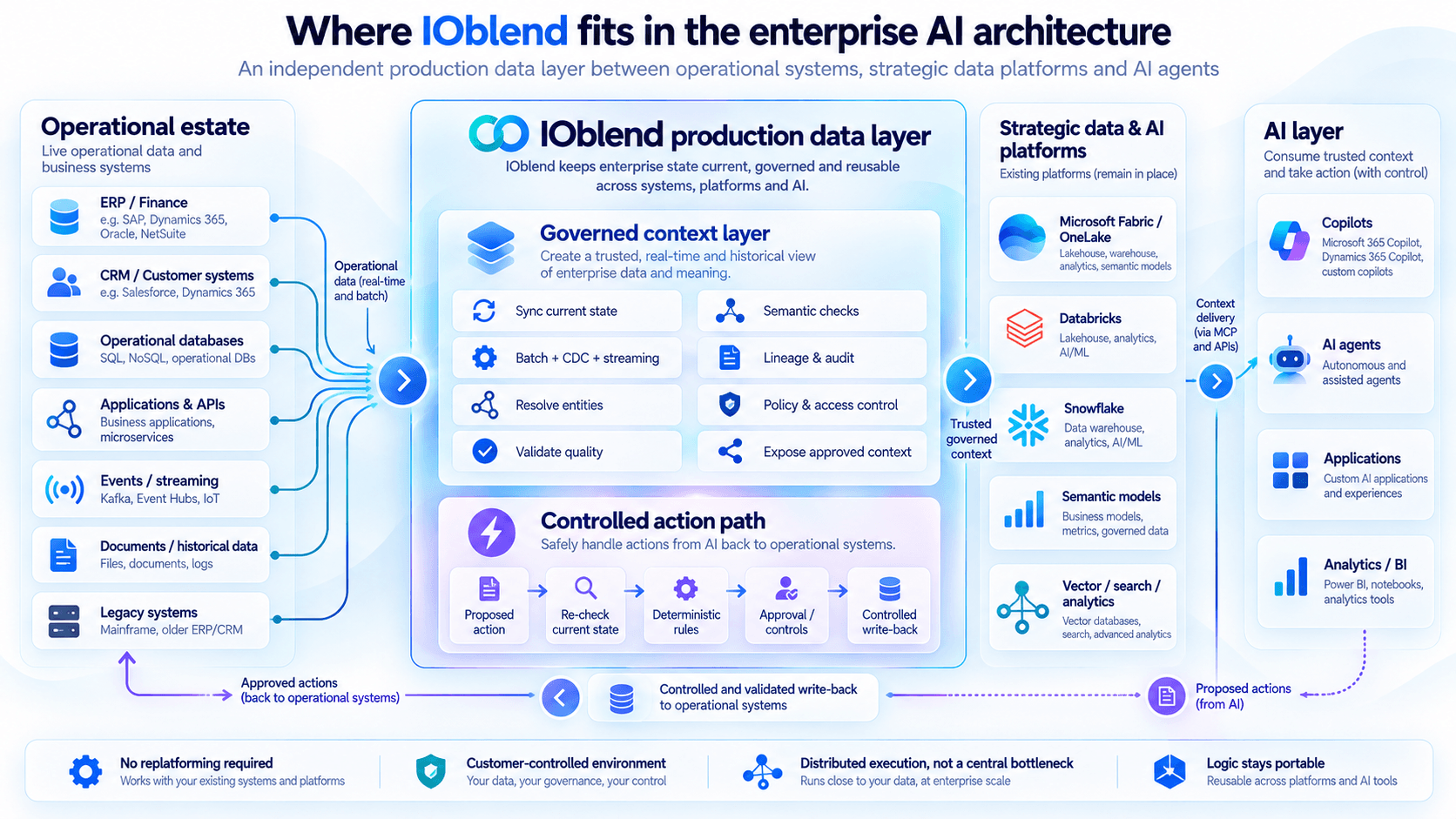
Make the data stack you already own work together. Batch, CDC, streaming and DataOps on Apache Spark.
IOblend is an independent production data integration layer. It connects, transforms, governs and synchronises enterprise data across cloud, on-premises, SaaS, databases, APIs, events and legacy systems.
Deliver trusted data into Microsoft Fabric, Databricks, Snowflake, analytics, AI and operational applications without rebuilding the integration layer whenever the destination changes.
Keep the integration logic reusable.
Connect, transform, validate, govern, synchronise and maintain state without tying the production data layer to one destination.
Enterprise data integration and DataOps software for production batch, CDC and streaming pipelines on Apache Spark.
IOblend gives enterprises one reusable production layer for connecting heterogeneous systems, transforming and validating data, maintaining state, tracking lineage and delivering governed data into strategic platforms and applications.
A single data engineer building real-time production pipelines across six systems in five days, including transformation, data quality and governance.
Run locally, on-premises, in customer-controlled cloud Spark environments or across hybrid enterprise estates.
Use IOblend Designer, standard SQL, Python and portable JSON playbooks so engineers retain control over production logic.
More than ELT. More than connectors. More than ingestion.
Moving data from A to B is only one part of the production problem. IOblend handles the broader work required to make enterprise data usable and dependable across systems, including transformation, state, quality, lineage, exception handling, synchronisation and delivery.
IOblend manages what happens between the source and the outcome.
A connector can establish a route. An ingestion tool can move records. ELT can load data into a destination for transformation. IOblend goes further across the production lifecycle.
A connection is the beginning, not the architecture.
IOblend combines connectivity with transformation, validation, state and operational controls so data can move through a governed production path.
Loading data is not the same as operating data.
IOblend supports CDC, streaming, deduplication, upserts, SCD, MDM and system synchronisation where downstream state must remain correct over time.
The target platform does not have to own the logic.
IOblend can transform and govern data before delivery, keeping SQL, Python and reusable metadata independent of one warehouse or lakehouse.
The flow carries its own production evidence.
Lineage, schema, quality, exceptions and replay are part of the production model, not separate tasks that only happen after a job succeeds or fails.
IOblend is not simply an ELT, connector or ingestion product. It is an independent enterprise data integration and DataOps layer for building and operating production data pipelines across heterogeneous systems, data speeds and destination platforms.
One production layer across the problems that keep repeating.
Start with the business outcome. Each path below leads into a deeper solution page with architecture, delivery patterns and the specific data problems IOblend helps solve.
Use one production model across AI, analytics, migration, real-time integration and system synchronisation.
AI-ready enterprise data
Give models and agents fresh, governed operational context instead of stale extracts and disconnected copies.
Trusted data for analytics
Feed warehouses and lakehouses with transformed, governed production data that is ready for reporting and insight.
Lower-risk modernisation
Move history, maintain CDC and reconcile old and new environments before the final cutover decision.
Operational streaming data
Combine events, IoT and CDC with historical context so operational decisions can reflect what is happening now.
Keep systems aligned
Synchronise ERP, CRM, databases and applications as records change without locking the logic into one destination.
Customer 360
Resolve identity, maintain customer history and unify fragmented operational records across business systems.
From pipeline intent to distributed execution, without hiding the engineering.
IOblend separates what the pipeline should do from the infrastructure used to run it. Engineers design the dataflow, keep specialist logic in SQL and Python, retain the pipeline as portable metadata, then execute it through IOblend Engine on Apache Spark.
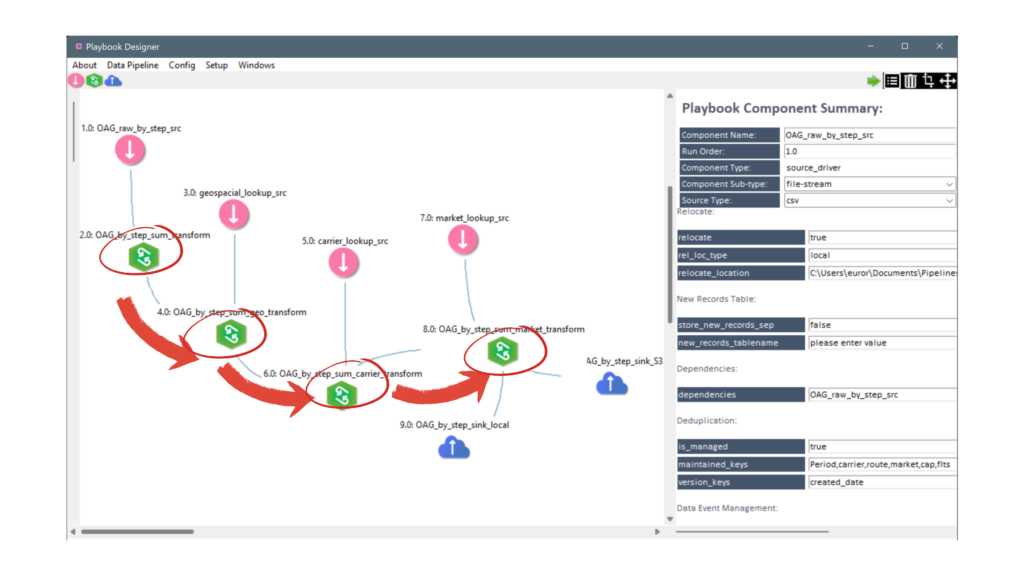
Separate design intent from execution infrastructure so the same production pattern remains reusable as platforms change.
Use the visual DAG for structure and inspection while retaining SQL and Python for transformations and specialist rules.
IOblend manages the pipeline model and production controls above Spark rather than replacing the distributed engine underneath it.
Build once as a production pattern, then reuse the architecture.
The result is a pipeline that is easier to inspect, test, version, deploy and operate across local development, cloud, on-premises and hybrid environments without rewriting the business logic around each new destination.
Trusted enterprise data needs visible controls while it moves.
IOblend keeps production evidence close to the flow with schema, quality, lineage, state and exception handling built into the pipeline model, not left behind as afterthoughts.
AI becomes useful when it receives fresh, governed enterprise context.
IOblend can supply structured and unstructured business data to AI applications and can invoke Python-based model or agent logic inside a controlled data flow, while leaving model choice and organisational AI governance where they belong.
Your strategic platforms stay strategic. IOblend standardises the production data layer between them.
IOblend is designed for heterogeneous enterprise estates. It sits between systems of record, operational sources and the platforms that consume trusted data, so integration logic, state and production controls do not have to be rebuilt around every destination.
Independent production data integration + DataOps layer
Connect, transform, validate, synchronise and maintain state across systems while keeping production logic reusable and independent of the destination platform.
Use IOblend for hybrid connectivity, legacy integration, CDC and reusable production controls before data reaches Fabric analytics and AI workloads.
Architecture view →Use IOblend where operational sources, legacy systems, state management and cross-platform synchronisation sit outside the Databricks workload itself.
Engineering view →Keep source-side integration, transformation and production controls portable while Snowflake remains focused on its data platform role.
Data leadership view →Keep ERP, CRM, databases and legacy systems useful while the architecture changes around them instead of forcing a single-platform rewrite.
Explore solutions →IOblend does not ask the enterprise to replace its strategic platforms. It modernises and standardises the production data work between them, including connectivity, transformation, state, quality, lineage, synchronisation and exception handling.
Where does IOblend fit, and what does it actually take responsibility for?
IOblend sits in the production data path. It is designed for organisations that need to connect complex systems, transform and govern data as it moves, maintain state across batch and real-time workloads, and keep that logic reusable across platforms.
What is IOblend?
IOblend is an independent enterprise data integration and DataOps layer for building and operating production batch, Change Data Capture and streaming pipelines on Apache Spark across cloud, on-premises and hybrid estates.
Is IOblend just another ELT platform?
No. ELT is one pattern. IOblend also handles in-flow transformation, CDC, streaming, state, synchronisation, quality, lineage, exception handling and replay across operational and analytical systems.
Is it just a connector or ingestion layer?
No. Connectivity gets data onto the path. IOblend continues through transformation, validation, state management, governance and delivery so the production pipeline carries more than records from A to B.
Does IOblend replace Fabric, Databricks or Snowflake?
No. Those platforms remain strategic destinations and processing environments. IOblend standardises the integration and production data work between source systems and those platforms.
Can one pipeline handle batch, CDC and streaming?
Yes. IOblend supports historical loads, database change and live events within one production model, with common transformation, state, quality, lineage and exception controls.
Do engineers lose control behind a visual interface?
No. The Designer makes pipeline structure visible, while SQL and Python remain available for transformations, specialist logic and engineering work that belongs in code.
Where can IOblend run?
In customer-controlled infrastructure. That includes local development, cloud Spark environments, on-premises deployments and hybrid estates, without requiring IOblend to become the system that owns your enterprise data.
What problem is IOblend designed to remove?
The repeated production plumbing between enterprise systems: connectivity, transformation, state, data quality, lineage, synchronisation, exceptions and delivery. Instead of rebuilding that layer around every migration, platform, dashboard, AI project or operational application, IOblend makes it reusable.
Bring us the integration your current stack makes hardest.
You do not need another generic platform demo. Bring the migration, legacy system, real-time requirement, AI data problem or pipeline estate that is consuming too much engineering time. We can work from the architecture you already own and show where IOblend changes the production data layer.