
One application. Production data pipelines by design.
Build, test, deploy and govern enterprise data flows without building another integration stack. IOblend combines visual development, portable metadata, Apache Spark execution and production DataOps in one operating model.
The production data layer between your systems and everything that needs trusted data.
IOblend is designed for organisations that already have databases, ERP, CRM, cloud platforms, lakehouses, analytics tools and AI services, but still need a reliable way to connect, transform, validate, synchronise and govern data across the estate.
Enterprise data integration and DataOps software built on Apache Spark.
Teams use IOblend Designer to build and validate pipelines, preserve the pipeline intent as portable metadata, and execute it through IOblend Engine on infrastructure they control.
Move
Connect databases, ERP, CRM, files, APIs, event streams, lakehouses and operational applications.
Transform
Apply SQL, Python, mappings and reusable business rules while data moves through the pipeline.
Govern
Keep quality, schema controls, metadata, lineage and exception handling inside the production flow.
Operate
Run locally, on-premises, in cloud, at the edge or across hybrid environments.
An independent production integration layer.
IOblend sits between enterprise systems and the platforms, applications, analytics or AI workloads that need current, governed data.
Not another mandatory data platform.
It complements platforms such as Microsoft Fabric, Databricks and Snowflake instead of requiring wholesale replacement of the existing stack.
Separate pipeline intent from the infrastructure underneath it.
IOblend uses a metadata-driven architecture. Engineers design and validate a dataflow once, keep its intent as portable metadata, and execute it through IOblend Engine on Apache Spark infrastructure controlled by the customer.
IOblend Designer
Build DAGs, configure sources and sinks, add SQL or Python logic, attach quality rules and test components while the pipeline is being created.
Portable JSON playbooks
Configuration, mappings, runtime parameters and business rules are stored as metadata that can be versioned and promoted like software.
IOblend Engine
The Engine reads the playbook, creates the required Spark processing and applies production controls for state, quality, lineage and exceptions.
Your infrastructure
Run locally, on-premises, in cloud, at the edge or across hybrid environments without moving enterprise data through an IOblend-hosted data plane.
Portable JSON playbooks fit naturally into normal repository and promotion practices.
Use visual composition for the graph while retaining SQL and Python for specialised logic.
Keep the controls with the flow, not in a separate afterthought stack.
The value is not a long checklist of features. It is that the same production context can carry change capture, validation, lineage, schema awareness, state and exception handling as data moves through the pipeline.
Know what the data is and what happened to it.
Apply schema and business-rule checks before problematic data reaches downstream systems.
Quality context: Great Expectations ↗Retain source, transformation and destination context around individual records for debugging and auditability.
Lineage context: OpenLineage ↗Make structural change and pipeline metadata visible rather than discovering it through broken downstream assets.
IOblend data contracts →Keep systems current without repeatedly moving everything.
Capture inserts and updates using the mechanism appropriate to the source and process only what changed.
CDC context: Debezium ↗Maintain current and historical representations inside the normal processing model.
IOblend CDC overview →Resolve duplicates and apply mastered-entity rules while data is being integrated rather than after the fact.
Production features →Turn failures and revisions into manageable production behaviour.
Separate problematic records with operational context while healthy records continue where the pipeline design allows.
Quality gates →Test components and block invalid logic earlier in the development lifecycle.
Implementation guides →Retain revisions and move portable playbooks through controlled development workflows.
Version control context: Git ↗Batch, event streams, CDC and AI can share the same production discipline.
Different processing patterns still need the same enterprise concerns: transformation, quality, context, exceptions, lineage and controlled delivery. IOblend keeps those concerns in one pipeline model.
One pipeline can move at more than one speed.
Historical data, live events and source-system changes can be combined with reference data and transformed through the same production model.
Put intelligence where enterprise context already moves.
Use Python-based AI logic to inspect unstructured content, enrich data, validate model output and route exceptions alongside conventional processing.
Watch the pipeline construction.
The IOblend video library shows project setup, production pipeline creation, transformations, sinks, event handling and JDBC delivery.
Use live enterprise data without exposing live systems.
Not every use case needs another copy of the data. IOblend can virtualise current enterprise data for real-time use or maintain a synchronised isolation layer for AI that exposes only the context an agent is allowed to see.
Keep the business context current.
Use the data without moving it first.
Provide a current, governed view for applications, analytics and real-time workloads without requiring another physical copy for every use case.
Give agents safe business context.
Maintain a synchronised layer containing only approved data, apply semantic validation, then serve that context to MCP and downstream AI agents.
Move data when you need to. Use it in place when you don't.
The architecture can follow the workload. IOblend supports physical movement, synchronisation and transformation, but does not require every consumer to create another destination copy.
Let AI see the business. Not the business systems.
AI agents can work with current enterprise context without being given unrestricted direct access to operational systems or everything those systems contain.
Visual enough to understand. Technical enough to trust.
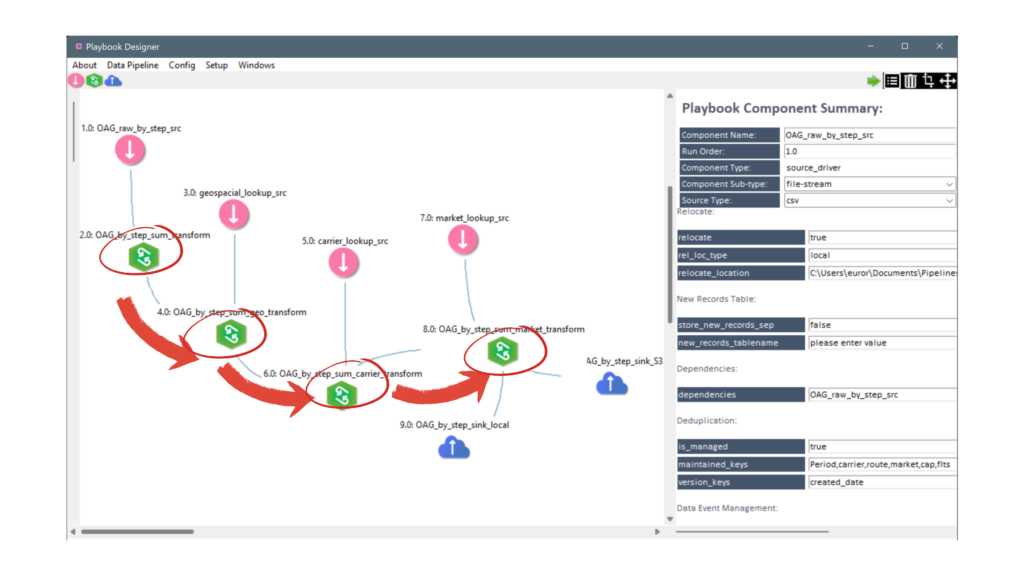
IOblend Designer makes the structure of a production dataflow visible without pretending enterprise data engineering is just drag and drop. Engineers can inspect dependencies, test components, use SQL and Python, and preserve the result as portable pipeline metadata.
The diagram is not the deliverable.
The deliverable is a tested, versionable production pipeline with explicit dependencies, executable logic and runtime controls. The visual graph makes the flow easier to understand while the playbook preserves the actual pipeline intent.
Compose the graph
See sources, transformations, sinks, dependencies and run order in one development surface. Complex flows become easier to inspect without hiding how the pipeline is assembled.
Keep SQL + Python
Use code where specialised transformations, enrichment or business rules require it. The visual model supports engineering logic rather than replacing it with a closed abstraction.
Validate before deployment
Run components during development, inspect intermediate results and catch invalid pipeline logic or SQL/Python syntax before it becomes a production problem.
Visual development should reduce friction, not remove engineering control.
IOblend uses the Designer to make pipeline construction, testing and debugging easier while keeping transformation logic, metadata and runtime behaviour explicit.
From first component to production without changing mental models.
The same pipeline definition moves through design, validation, version control, deployment and operation. The workflow stays recognisable from a developer laptop to enterprise execution.
Build once. Validate early. Promote the same pipeline intent.
IOblend keeps the production pipeline as the central unit of work. The visual model, transformation logic, metadata and runtime behaviour remain connected as the pipeline moves through the engineering lifecycle.
Design
Assemble sources, transformations, business rules, quality checks and sinks in IOblend Designer.
Validate
Run components, inspect intermediate data and catch invalid pipeline logic before deployment.
Version
Store portable JSON playbooks in a normal repository and retain revisions for comparison or rollback.
Deploy
Move the same pipeline intent to customer-controlled Spark infrastructure for production execution.
Operate
Run with lineage, quality, metadata, state and exception behaviour already attached to the flow.
Portable JSON fits normal software practice.
Pipeline definitions can be retained, reviewed and promoted through familiar repository workflows instead of living only inside a closed project store.
Keep the orchestration tooling you already trust.
Production run files can be scheduled through enterprise orchestration software rather than forcing a separate IOblend-only scheduling layer into the estate.
Keep the pipeline portable. Put execution where the data belongs.
IOblend Engine is designed to run inside customer-controlled infrastructure. The pipeline definition stays portable while execution can sit where architecture, security, latency, regulation and economics require it.
One development model from laptop to enterprise runtime.
Engineers can build and validate locally, retain the pipeline definition as portable metadata, then execute the same intent through IOblend Engine on production Spark infrastructure. The business logic does not need to be rewritten simply because the runtime environment changes.
Local development
Build, test and evaluate pipelines on a developer workstation using a local Spark environment before promoting the playbook further.
On-premises
Run close to regulated data, legacy platforms or operational systems that are not moving to public cloud.
Cloud
Execute on compatible cloud Spark infrastructure while connecting modern platforms to the enterprise systems around them.
Hybrid + edge
Process and synchronise data across mixed environments without forcing every workload into one platform or one physical location.
IOblend separates the pipeline definition from the runtime location so teams can keep development consistent while placing production execution where governance, performance and infrastructure requirements make sense.
Standardise the production pattern, not just the connector.
A reusable production pipeline can carry change capture, transformation, data quality, lineage, exception handling and target delivery together. The result is a repeatable integration pattern rather than a new engineering project for every source and destination.
Oracle CDC → IOblend → Microsoft Fabric
Capture operational changes from Oracle, process and govern them through IOblend, then deliver trusted data into Microsoft Fabric for downstream analytics and AI use.
Oracle
Inserts and updates become the change stream that starts the integration flow.
IOblend
Apply CDC handling, transformation, validation, state, exception isolation and record-level lineage in one pipeline.
Microsoft Fabric
Receive governed, transformed data ready for analytics, engineering and AI workloads.
Move what changed.
CDC and state handling allow the pipeline to process inserts and updates incrementally instead of repeatedly moving unchanged source data.
Validate once, execute at scale.
Build and inspect the pipeline during development, then execute the same portable pipeline intent through IOblend Engine on the production Spark runtime.
One production layer. Different enterprise problems.
IOblend is most useful where data has to move reliably across a mixed estate and the organisation wants to keep the platforms it already owns rather than replace them to solve integration.
Cloud + platform modernisation
Connect modern cloud and lakehouse platforms to legacy and operational systems that still run the business.
Explore modernisation →System synchronisation
Keep CRM, ERP, applications and downstream systems aligned while preserving transformation and quality rules.
Explore synchronisation →Production AI data
Feed models and agents with current, validated context and integrate model output into governed operational workflows.
Explore Agentic AI →MLOps + feature engineering
Create, refresh and govern model features in the pipeline while continuing to use the lake or warehouse already in place.
Feature Store without the Store →Real-time operations + IoT
Combine event streams with reference and historical data for live operational analytics and decision workflows.
Explore real-time patterns →Trusted analytics data
Move analytics-ready data with quality, lineage, history and schema controls already embedded in the production flow.
Explore DataOps features →Designed to complement the data platforms already in the estate.
What is IOblend?
IOblend is enterprise data integration and DataOps software. Teams build and validate pipelines in IOblend Designer, retain the pipeline definition as portable metadata, and execute it through IOblend Engine on Apache Spark infrastructure.
Does IOblend support ETL, ELT, batch, streaming and CDC?
Yes. IOblend supports historical batch processing, real-time streaming, Change Data Capture, synchronisation and transformation within the same production data architecture.
Do we need to replace Fabric, Databricks, Snowflake or our existing systems?
No. IOblend is intended to complement the existing estate. It can sit between legacy systems, operational applications, databases, cloud platforms, lakehouses, analytics tools and AI services.
See the IOblend Solutions hub.
Do data engineers need to write Apache Spark code?
No Spark coding is required for standard IOblend pipeline development. IOblend Engine creates the distributed Spark processing from the playbook, while SQL and Python remain available for specialised business logic.
Where does IOblend run?
Development can run locally, while production execution can run on customer-controlled cloud, on-premises, edge or hybrid Spark infrastructure. IOblend does not require enterprise data to pass through an IOblend-hosted data plane.
How does IOblend handle data quality, lineage and exceptions?
Those controls are part of the pipeline model. Flows can validate data, isolate exceptions, retain metadata and preserve record-level lineage context around what happened during processing.
How are pipeline definitions versioned?
Pipeline definitions are stored as portable JSON playbooks. They can be kept in normal code repositories, compared across revisions and promoted through controlled development workflows.
Can IOblend use AI inside an ETL pipeline?
Yes. Python-based AI logic can inspect unstructured content, extract or enrich information, validate results and route exceptions alongside conventional data processing.
Can IOblend synchronise operational systems as well as feed analytics?
Yes. IOblend can keep ERP, CRM, operational applications, databases, lakehouses and downstream systems aligned using CDC, transformations, state and quality rules.
Can we try IOblend before an enterprise deployment?
Yes. IOblend provides a free Developer Edition for development and evaluation use.
Bring the source and target systems, processing pattern, quality requirements and deployment constraints. A real workload is the fastest way to understand product fit.
Bring us the pipeline you do not want to build the old way.
A migration that is dragging on. A Fabric programme blocked by legacy integration. Systems that need to stay in sync. Streaming data nobody fully trusts. An AI use case waiting for production-grade context. Give us the real problem and we will show you where IOblend changes the architecture.