Enterprise AI is crossing an important boundary.
Until recently, most enterprise AI systems were primarily asked to read information and produce an answer. They could summarise a contract, explain a report, find customer information or draft a response.
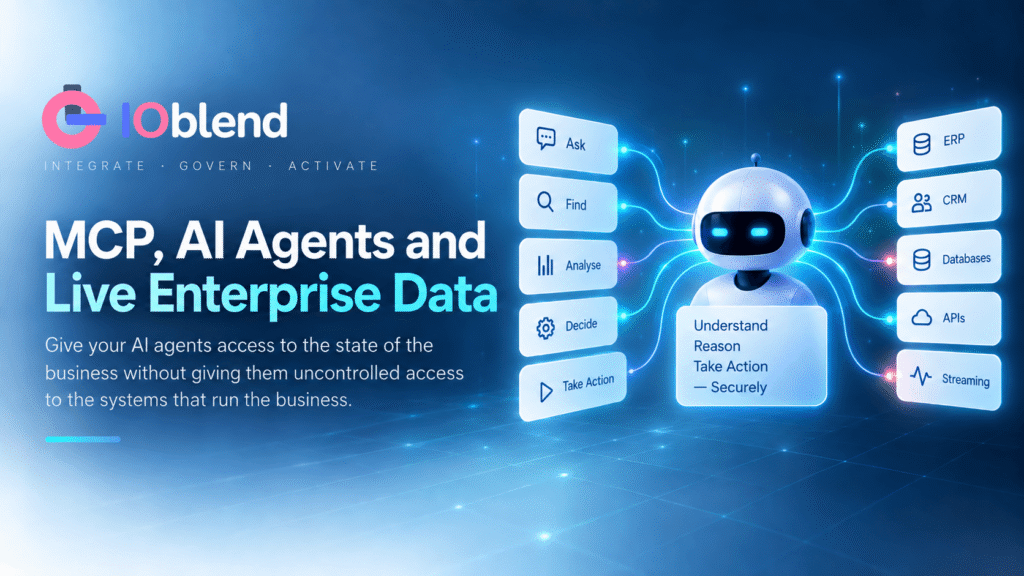
Agentic AI changes that relationship. An agent can retrieve information from several systems, reason across it, choose a tool and potentially take an action.
That makes AI considerably more useful, but it also changes the engineering problem.
How do we let AI work with the live state of the business without giving it uncontrolled access to the systems that run the business?
That question becomes increasingly important as organisations move beyond AI demonstrations and start connecting agents to operational applications, databases, APIs and production services.
MCP makes connecting agents easier
The Model Context Protocol is becoming an important part of this emerging architecture.
MCP gives AI applications a standard mechanism for discovering and interacting with external tools, resources and services. Instead of creating a proprietary integration for every combination of AI agent and enterprise application, capabilities can be exposed through MCP servers and consumed by compatible AI clients.
That solves an important interoperability problem.
But it only solves part of the enterprise problem.
MCP can help an agent reach a capability. It does not automatically determine whether the data behind that capability is correct, current, consistent, appropriate for that agent or safe to act upon.
Those remain enterprise data and operational governance problems.
Connectivity is not the same as governed context
Consider a fairly normal enterprise environment.
Customer information might exist in Salesforce. Orders may be held in SAP. Payments could be managed in Oracle. Inventory might sit in another operational database. Product information may come from a PIM, while operational events arrive continuously from applications, databases or IoT systems.
Giving an AI agent access to all of those sources does not necessarily give it a coherent understanding of the business.
It may simply give it several different versions of reality.
The problems are familiar to data engineering teams:
- A customer may have different identifiers across several systems.
- An order may have changed seconds ago.
- Payment status may disagree with the CRM.
- Two records may actually describe the same customer or supplier.
- An upstream schema may have changed.
- Some fields may be appropriate for the agent while others should never be exposed.
- Different systems may disagree about the current state.
At that point the AI agent has inherited a data integration problem.
That is probably not a problem we should ask the agent to solve while it is also trying to make a business decision.
Integrate the enterprise before the agent reasons about it
There is another architectural approach.
Instead of exposing production systems directly to the AI environment, the organisation can create a controlled data boundary between the operational estate and the agents.
Conceptually:
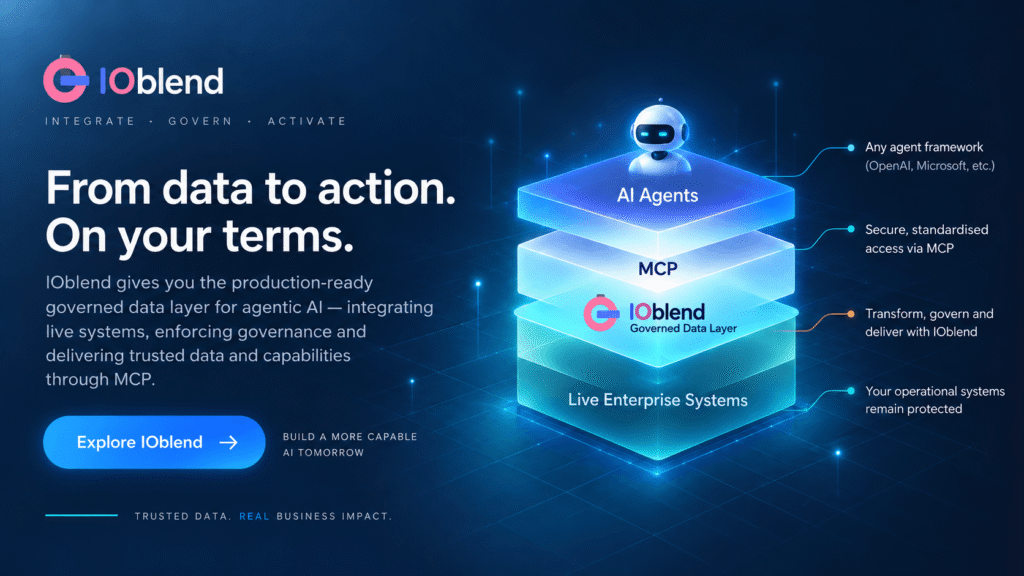
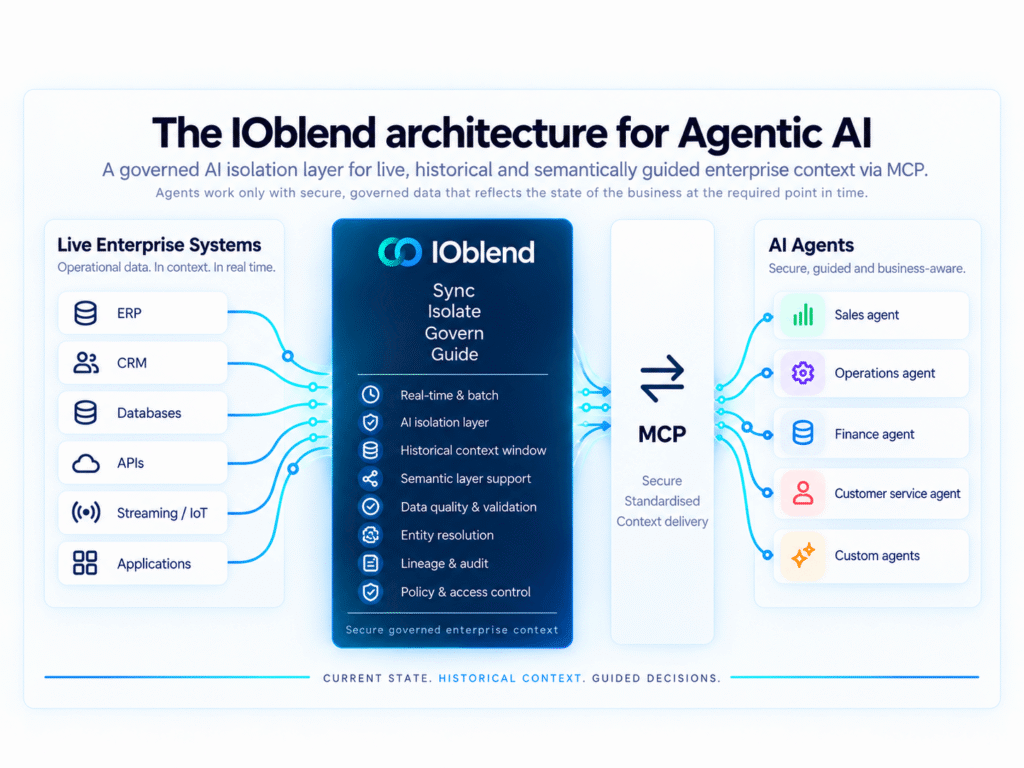
Operational systems → IOblend governed AI isolation layer → MCP → AI agents
rather than:
Operational systems → MCP → AI agents
The difference looks quite small on a diagram.
Operationally, it is significant.
The agent no longer needs to determine how customer identity should be resolved between CRM and ERP. It does not need to decide which system owns a particular attribute, reconcile conflicting records or determine whether a source schema has changed.
Those rules can remain deterministic and engineered.
The agent receives the business context after those problems have already been addressed.
That is where the idea of an AI isolation layer becomes useful.
Create a synchronised isolation layer for AI
An enterprise does not necessarily need to give an AI agent direct access to its operational systems simply because the agent needs current information from them.
IOblend can maintain a synchronised virtual representation of the data required by the AI use case.
Changes from the operational environment can flow into this isolated layer using techniques such as Change Data Capture, streaming, APIs and conventional batch integration.
The isolation layer can therefore remain closely synchronised with the systems of record while still creating a deliberate boundary between AI and production.
The agent works with the governed representation.
The operational systems remain behind it.
That means an agent might see:
- the current customer state
- current order position
- available inventory
- current account restrictions
- recent transactions
- relevant operational events
without needing credentials into every system that produced those values.
The important distinction is that this is not merely a stale analytical copy.
The isolated context can remain synchronised with changes occurring in the operational estate, allowing the information available to the agent to reflect the state of the business as it changes.
Current state is useful. History can be just as important.
Not every AI question is about what is happening right now.
Sometimes the agent needs to understand how the business arrived at its current state.
For example:
- How has this customer’s payment behaviour changed over the last twelve months?
- What normally happens before this machine fails?
- Has this supplier repeatedly missed delivery commitments?
- How often has an order entered this exception state?
- What was the customer’s position when the original decision was made?
For these use cases, IOblend can also maintain a secure historical repository on infrastructure controlled by the customer.
The customer can determine how much history to retain according to the use case, governance requirements and infrastructure available.
That may be days, months or years of operational history.
The important part is that the agent does not need to return to unrestricted production systems every time it needs historical context.
It can work against a governed history window that has already passed through the same integration, validation, filtering and security controls.
This creates two useful views of the enterprise for AI:
Live operational state
What is happening now?
and:
Governed historical state
What happened before?
Both remain inside the customer’s controlled environment.
The agent can see the business at a point in time
This also creates an interesting capability for enterprise AI.
An agent does not always need to reason only about today’s state.
If sufficient history is retained, it can reason about the state of the business at a particular point in time.
That is useful when investigating operational incidents, analysing customer decisions, understanding process changes or reconstructing why a particular outcome occurred.
Instead of simply asking:
What is this customer’s status?
the question might become:
What did we know about this customer when this order was approved?
That is a much richer enterprise AI use case.
The data presented to the agent can still be governed and isolated, but it can represent either the current operational state or an historical state depending on what the task requires.
Govern the data before the agent sees it
Before information enters this AI isolation layer, IOblend can apply the production controls already used within its data pipelines.
Data can be:
- captured from live systems
- normalised into consistent structures
- transformed using deterministic business logic
- joined across multiple systems
- deduplicated
- entity-resolved
- validated against schemas and contracts
- checked against business rules
- filtered according to the use case
- tracked through lineage
- quarantined when validation fails
This is important because an isolation layer is only useful if the data inside it can actually be trusted.
The objective is not to create another copy of everything.
It is to expose the smallest useful representation of the enterprise that an AI workflow actually needs.
Structure is not the same as meaning
There is another problem.
Even perfectly clean data does not automatically give an AI agent the right business context.
Consider a field called:
customer_status = HOLD
Technically, that value may be perfectly valid.
But what does HOLD actually mean?
Does it mean:
- credit hold
- legal hold
- fulfilment hold
- temporary review
- customer-requested suspension
And what should the agent be allowed to infer from it?
Enterprise systems contain thousands of examples like this.
The data may be structurally correct while the business meaning remains unclear.
This is where the semantic layer becomes important.
Give agents a guided semantic context
Before governed data is presented to the agent, IOblend can pass it through a semantic layer.
That semantic layer may be implemented within the IOblend flow or provided by an external semantic platform already used by the organisation.
Its role is to add business meaning to the governed data.
For example, it can help define:
- what an entity represents
- relationships between entities
- which terminology the business uses
- how important fields should be interpreted
- which values have specific business meaning
- which business rules are relevant to a particular context
- which relationships the agent should consider when reasoning
This means the agent receives more than a collection of technically valid fields.
It receives governed data with guided business context.
The distinction matters.
An agent should ideally not have to invent the meaning of enterprise data from column names and prompts.
Where the business already knows what the data means, that knowledge can be supplied explicitly.
Data first. Meaning second. Reasoning third.
This gives us a useful way of thinking about enterprise AI architecture.
The process is not simply:
Data → Agent
It becomes:
Operational data → governed data → semantic context → agent reasoning
Each layer has a different responsibility.
IOblend makes the underlying operational state current, controlled and dependable.
The semantic layer provides business meaning.
The AI agent uses that controlled context to reason.
This separation becomes particularly useful as organisations deploy multiple agents.
Instead of every agent independently learning that CREDIT_HOLD = Y means orders above a certain threshold require finance approval, that meaning can be supplied consistently through the semantic context.
The business definition remains outside the individual agent.
That makes the architecture easier to govern and easier to change.
A governed view of the live business
Imagine an AI sales agent trying to understand a customer.
The underlying information may originate from CRM, ERP, finance and inventory systems.
The AI isolation layer might present something like:
ACME Ltd
- Customer identity: resolved
- Account status: active
- Credit status: hold
- Outstanding balance: £430,000
- Open order: 2,400 units
- Inventory position: current
- Account owner: Sarah
- Operational state timestamp: current
- Source lineage: available
The semantic context could then add:
Credit hold
Orders may be reviewed, but new credit commitments require finance approval.
Now the agent is not merely seeing a field.
It understands what that field means in the context of the business process.
And importantly, it is learning that meaning without needing direct access to every system that produced the underlying data.
Where IOblend fits
This is a natural extension of the role IOblend already performs.
IOblend is an independent enterprise data integration and DataOps production layer.
It can connect operational systems using batch processing, CDC, streaming, APIs and other integration methods while applying transformation, state management, data quality, lineage and production controls as the data moves.
For Agentic AI, that production layer can support three closely related functions.
1. Live AI isolation
Maintain a synchronised, governed representation of the operational state required by AI agents.
2. Historical AI context
Retain a customer-controlled history window so agents can reason across previous states without querying production systems directly.
3. Semantic context
Pass governed data through an internal or external semantic layer so the agent receives both trusted data and the business meaning required to interpret it.
The result is not simply an AI-accessible database.
It becomes a controlled enterprise context designed specifically for AI consumption.
Freshness matters as much as correctness
AI context has a time problem.
A perfectly accurate customer profile from yesterday may be wrong today.
A warehouse snapshot might show inventory that has already been allocated. A supplier may have been approved when an analytical copy was generated but suspended ten minutes ago.
For conventional analytics, some delay may be acceptable.
For an agent recommending or initiating an operational decision, it may not be.
This is why CDC and streaming become important within the isolation architecture.
IOblend can continuously process changes from operational systems and update the governed state exposed to the AI environment.
Explore IOblend real-time data integration
The objective is not to make every enterprise dataset real time.
It is to make the information relevant to an AI decision sufficiently current for the decision being made.
Isolation also reduces unnecessary exposure
There is a security benefit to this architecture that goes beyond authentication.
An agent does not necessarily need access to every field in a customer database simply because it needs customer information.
The isolation layer can contain only the data required by the use case.
For example, the production CRM may contain:
- contact information
- internal notes
- contractual information
- financial details
- personal information
- historical interactions
- sales data
A particular agent might only require:
- customer ID
- organisation
- account status
- order position
- approved product entitlement
The agent works with that governed subset.
Everything else remains outside its working environment.
That is a very different security model from giving the agent broad access and relying on prompts to tell it what not to use.
Reading is one problem. Acting is another.
The distinction becomes even more important when an agent moves from retrieving information to changing something.
An agent may be allowed to propose an action.
That does not mean it should necessarily control how that action reaches the production system.
A direct architecture could look like:
Agent → MCP tool → ERP
A more governed architecture could be:
Agent → MCP → IOblend → current-state validation → semantic/business policy → approval if required → controlled write
The agent contributes judgement.
The production layer controls execution.
Before an action reaches the system of record, the architecture can check things such as:
- Is the record still current?
- Has its state changed since the agent saw it?
- Is the proposed action valid?
- Is it consistent with business policy?
- Does it require human approval?
- Is the destination available?
- Did the target system accept the change?
- Did dependent systems converge afterwards?
- Can the action be reconstructed from lineage later?
These are normal production engineering questions.
Agentic AI does not remove them.
It makes them more important.
Put deterministic controls around probabilistic agents
This principle already exists in the way IOblend approaches Agentic AI in production data pipelines.
AI is useful where interpretation, classification or judgement is required.
Deterministic code remains useful where the expected behaviour is already understood.
A practical division of responsibility looks something like this:
AI-owned
- interpretation
- reasoning
- recommendation
- selecting between bounded choices
Semantic layer
- business terminology
- entity meaning
- relationships
- contextual rules
- domain guidance
Production layer
- validation
- policy enforcement
- state management
- deterministic logic
- exception handling
- controlled writes
- reconciliation
- lineage
Human-owned
- approval of sensitive decisions
- review of uncertain cases
- policy ownership
- exceptional overrides
The more consequential the action, the more important these boundaries become.
Identity alone does not solve the data problem
Identity and authorisation remain essential.
The enterprise needs to know which agent is running, what it represents and what resources it is permitted to access.
But authentication primarily answers:
Who are you?
Authorisation answers:
What are you allowed to access?
There are still other questions underneath those controls:
- Is this information correct?
- Is it current?
- What did it look like previously?
- Which system owns this value?
- Has the entity been resolved correctly?
- Is this field appropriate for this agent?
- What does this value mean in business terms?
- Which related information should the agent consider?
- Is the proposed action valid?
- What happened after the action was executed?
Those are data, semantics and operational integration problems.
They should not become responsibilities of the model simply because AI is now the consumer.
Expose enterprise context, not the entire estate
There is therefore an important distinction between connecting AI directly to enterprise systems and exposing carefully designed enterprise context to AI.
The second approach begins with a simple question:
What does this agent actually need to know or do?
From there, IOblend can build the appropriate isolated representation.
The agent does not need the entire CRM.
It may need the current customer state.
It does not need the full ERP database.
It may need current orders and an approved create_order capability.
It does not need unrestricted historical finance data.
It may need twelve months of governed payment behaviour.
It does not need to infer the meaning of every field.
It can receive the relevant semantic context alongside the data.
This creates a much smaller and more governable AI surface.
Keep the AI layer independent
There is another architectural advantage.
The governed AI isolation layer does not need to belong to any particular model or agent framework.
The consuming agent may use OpenAI, Microsoft, another commercial model or a customer-built agent framework.
MCP can provide a standard interaction boundary.
The semantic layer can remain internal or external.
IOblend remains responsible for creating and maintaining the governed operational context underneath them.
That separation matters because the AI landscape will continue changing.
Models will change.
Agent frameworks will change.
Protocols will evolve.
The business rules governing customers, products, orders, payments, suppliers and operational processes will probably live much longer.
Those are the parts worth keeping portable.
A safer way to bring AI closer to the business
Agentic AI becomes substantially more useful when it can understand what is happening inside the business now.
It becomes more useful again when it can understand what happened before.
And it becomes more dependable when the data it receives comes with the business context needed to interpret it correctly.
That suggests an architecture with several deliberate boundaries:
Operational systems
remain the systems of record.
IOblend
creates and maintains the secure, governed AI isolation layer.
Live state and historical state
provide the agent with the time horizon required by the use case.
Semantic context
guides how the governed data should be understood.
MCP
provides a standard mechanism for exposing context and capabilities.
AI agents
reason against that controlled environment.
The agent never needs unrestricted access to the operational estate simply to understand the state of the business.
The principle therefore becomes slightly broader than before:
Give AI agents the current state, historical context and business meaning they need, without giving them uncontrolled access to the systems that run the business.
That, to me, is a much stronger IOblend Agentic AI position.
It moves the story beyond “secure access to live data” and into something more architectural:
IOblend creates the controlled enterprise environment that AI is allowed to understand and act upon.