
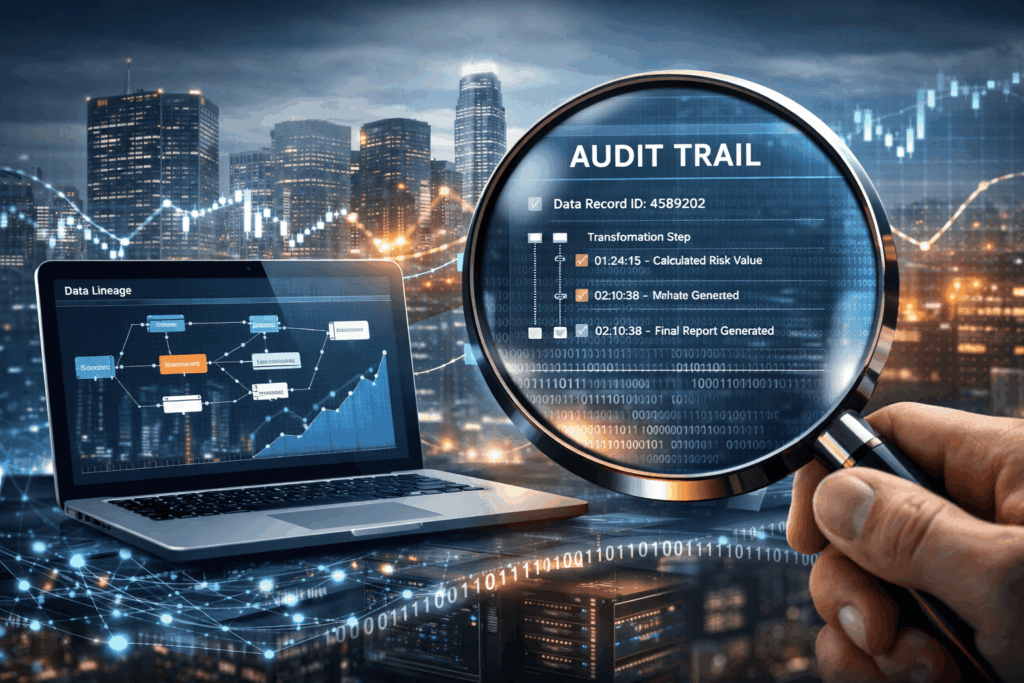

Regulatory Compliance at Scale: Automating record-level lineage and audit trails for BCBS 239
📋 Did you know? In the wake of the 2008 financial crisis, the Basel Committee found that many global banks were unable to aggregate risk exposures accurately or quickly because their data landscapes were too complex. This led to the birth of BCBS 239. Today, non-compliance isn’t just a legal risk; it is a financial one.
The Scale Challenge: Why Traditional Methods Fail
For Tier-1 banks, data is not a stream; it is an ocean. The primary issue businesses face is granularity at scale. Most legacy tools provide “object-level” lineage. However, BCBS 239 demands “record-level” transparency. When a regulator asks why a specific risk metric jumped by 2%, a bank must identify the exact underlying transactions that caused the shift.
Manual documentation and metadata-only mapping fall apart under this pressure. Siloed environments lead to “black boxes” where transformations happen in hidden scripts, making it impossible to reconstruct an audit trail during a crisis. Furthermore, the sheer volume of data often results in “lineage lag,” where the documentation is weeks behind the actual data flows, rendering it useless for real-time risk management.
Precision Engineering with IOblend
IOblend redefines regulatory compliance by automating the heavy lifting of data engineering. Unlike traditional middleware, IOblend focuses on DataOps automation, providing a seamless way to generate record-level lineage without the manual overhead.
How IOblend Solves the Issue:
- Automated Lineage: It builds a living map of your data ecosystem. Every move and change is logged automatically, ensuring the lineage is always “as-run” and not just “as-designed.”
- Immutable Audit Trails: IOblend creates a tamper-proof history of data movements. This provides the “integrity” required by BCBS 239, proving that data hasn’t been surreptitiously altered.
- High-Performance Engine: Designed for scale, IOblend handles massive datasets without bottlenecks, ensuring that auditability doesn’t come at the cost of processing speed.
- End-to-End Visibility: By integrating with various sources and targets, it eliminates data silos, providing a “single pane of glass” for compliance officers and data engineers alike.
Transform your regulatory framework into a competitive advantage with IOblend.

How IOblend Enables Real-Time Analytics of IoT Data
The real power of IoT lies in the data it generates in real-time. This data is continuously analysed to derive meaningful insights, mainly by automated systems.

Data Plumbing Essentials: Production Pipelines
The creation of production data pipelines is an exercise in precision engineering, meticulous planning, robust construction, and continuous maintenance.

Breaking Down the Walls: Overcoming Data Silos
All enterprise data should be discoverable, catalogued and made available for analytics. But the reality is quite different. Data silos are a persistent issue.

Complex World of Enterprise Data Estates
Large enterprises data estates are complex and costly to run and maintain. IOblend enables simplified data integration capabilities that alleviates complexities
Advanced data integration solutions: IOblend vs Pentaho
IOblend and Hitachi Pentaho are advanced data integration tools catering to the data needs of businesses. They differ in architecture design, features and cost.
Advanced data integration solutions: IOblend vs Fivetran
IOblend and Fivetran are both advanced data integration platforms that cater to the growing needs of businesses.