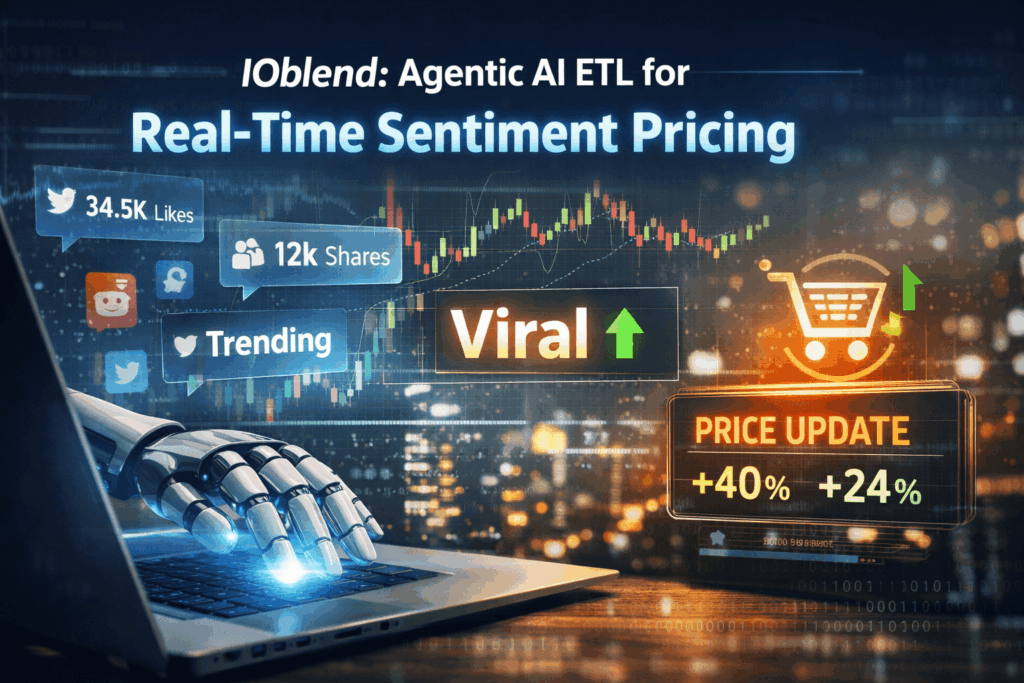
Sentiment-Driven Pricing: Using Agentic AI ETL to scrape social sentiment and adjust prices dynamically within the data flow
🤖 Did you know? A single viral tweet or a trending TikTok “dupe” video can alter the perceived value of a product by over 40% in less than six hours. Traditional pricing engines, which rely on historical sales data, often take days to catch up, costing retailers millions in missed margins or lost volume during the critical “hype window”.
The Concept: Sentiment-Driven Pricing
Sentiment-driven pricing is the evolution of dynamic cost models. Traditionally, prices fluctuate based on inventory levels or competitor benchmarks. However, by integrating Agentic AI into the ETL (Extract, Transform, Load) process, businesses can ingest unstructured social data tweets, Reddit threads, or TikTok trends and treat “public mood” as a primary data variable. The AI agents don’t just move data; they interpret the emotional intensity and urgency of the market, adjusting price points autonomously within the data pipeline.
The Friction: Why Static Models Fail
Data experts know the pain of “stale insights.” Most businesses operate on a lag; by the time social sentiment is scraped, cleaned, and visualised in a BI dashboard for a human to review, the market opportunity has often evaporated.
Key issues include:
- Latency: Traditional ETL batches are too slow for the velocity of social media.
- Contextual Blindness: Standard scripts struggle to distinguish between a “viral joke” and genuine “buying intent.”
- Pipeline Complexity: Maintaining separate flows for structured sales data and unstructured social sentiment creates a fragmented view of the truth.
- Manual Bottlenecks: Human-in-the-loop price adjustments cannot keep pace with 24/7 global digital discourse.
The IOblend Solution: Data Engineering at the Speed of Thought
This is where IOblend redefines the architecture. IOblend moves away from sluggish, rigid ETL to a fluid, metadata-driven approach that is perfect for Agentic AI workflows.
IOblend solves the sentiment-pricing gap by:
- Unified Processing: It seamlessly blends unstructured social feeds with structured SQL databases, allowing sentiment scores to act as immediate triggers for pricing logic.
- Real-time Velocity: IOblend’s “Data-at-Rest” is a thing of the past; its engine is designed for the high-frequency demands of dynamic pricing.
- No-Code Agility: Data experts can deploy complex logic without writing thousands of lines of brittle code, making the integration of AI agents into the flow remarkably simple.
- Cost Efficiency: By optimising how data is transformed, IOblend ensures that scraping massive social datasets doesn’t result in a prohibitive cloud bill.
Stop chasing trends and start pricing ahead of them, supercharge your data agility with IOblend.

DB2 CDC to Lakehouse Without Re-Platforming
From DB2 to Lakehouse: Real-Time CDC Without Re-Platforming 💻 Did you know? Mainframe systems like DB2 still process approximately 30 billion business transactions every single day. Despite the rush toward modern cloud architectures, the world’s most critical financial and logistical data often resides in these “legacy” environments, making them the silent engines of the global economy.

Real-Time Upserts: Deduping and Idempotency
Streaming Upserts Done Right: Deduping and Idempotency at Scale 💻 Did you know? In many high-velocity streaming environments, the “same” event can be sent or processed multiple times due to network retries or distributed system failures. The Art of the Upsert At its core, a streaming upsert (a portmanteau of “update” and “insert”) is the process of synchronising incoming data with an existing

Streaming Data Quality That Won’t Break Pipelines
Streaming Without the Sting: Data Quality Rules That Never Break the Flow 💻 Did you know? A single minute of downtime in a high-velocity streaming environment can result in the loss of millions of data points, potentially costing a business thousands of pounds in missed opportunities or regulatory fines. — Defining Resilient Streaming Quality Data quality in

Schema Drift: The Silent Killer of Data Pipelines
The Silent Pipeline Killer: Surviving Schema Drift in the Wild 📊 Did you know? In the early days of big data, a single column change in a source database could trigger a “data graveyard” effect, where downstream analytics remained broken for weeks. The silent pipeline killer Schema drift occurs when the structure of source data changes

Preventing Data Drift in Modern Data Systems
The Invisible Erosion: Detecting and Managing Data Drift in Modern Architectures 📊 Did you know? According to recent industry surveys, over 70% of organisations experience significant data drift within the first six months of deploying a production system. The Concept of Data Drift Data drift occurs when the statistical properties or the underlying structure of incoming data change

Stream Database Changes to Your Lakehouse with CDC
Zero-Lag Operations: Stream Database Changes to Your Lakehouse 💾 Did you know? The “data downtime” caused by traditional batch processing costs the average enterprise approximately £12,000 per minute. The Concept: Moving at the Speed of Change Zero-lag operations rely on a transition from periodic “snapshots” to continuous “streams.” Instead of moving massive blocks of data at