Migration QA at Scale: Reconciliation, Checksums, and Audit Trails
📂 Did you know that during enterprise database migrations, as much as 20% of quiet data corruption goes entirely unnoticed until post-cutover operational failures occur?
Understanding migration QA at scale
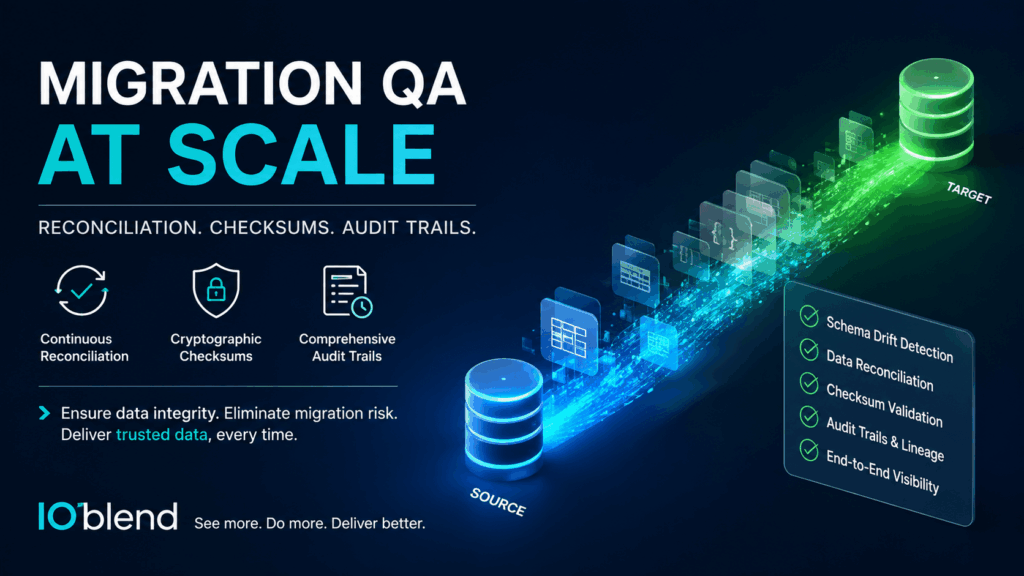
Migration QA at scale refers to the systematic validation of volume, structure, and integrity when shifting enterprise data across heterogeneous environments. Rather than relying on simple row counts, modern reconciliation demands three core pillars: continuous reconciliation to guarantee record symmetry, cryptographic checksums to verify payload fidelity down to individual byte values, and comprehensive audit trails to record end-to-end lineage and schema evolution.
The operational bottlenecks in enterprise migrations
Engineering teams undertaking complex migrations regularly encounter severe operational hurdles:
- Silent schema drift and field truncation: Unannounced schema changes or subtle precision losses (e.g. timestamp truncation or numeric overflow) in active source pipelines corrupt target datasets quietly without throwing fatal job errors.
- Prohibitive compute overhead: Executing full-table hashing or cell-by-cell row comparisons across billions of records introduces unsustainable latency and spikes warehouse consumption costs.
- Lack of record-level lineage: When discrepancies emerge, pinpointing whether the fault stemmed from network drops, transformation logic, or late-arriving CDC records requires painstaking manual log analysis.
- Multi-tool stack complexity: Orchestrating separate tools for batch extracts, streaming CDC, data quality assertions, and logging creates fragile pipelines that fail unexpectedly under high throughput.
Eliminating migration risks with IOblend
IOblend solves these migration QA challenges by standardising production data pipelines on Apache Spark through portable JSON playbooks and native Python/SQL logic.
- Automated continuous reconciliation and line-level lineage: IOblend tracks schema evolution and change data capture in real time (including late-arriving data), delivering record-level lineage so you can trace, debug, and replay discrepancies instantly.
- Cryptographic integrity and high-throughput validation: Capable of processing over 1 million transactions per second with ultra-low P99 latency, IOblend executes validation rules and custom checksum checks directly on Spark infrastructure without heavy warehouse compute costs.
- Unified governance and auditability: Built-in audit trails, automated data quality controls, and drift handling ensure full end-to-end compliance from source to sink across cloud and on-premises environments.
Eliminate migration anxiety and streamline your data pipeline testing. Supercharge your enterprise data migrations with IOblend.

The ERP Shortcut: How to Integrate Faster Than You Think
IOblend was designed with one mission in mind: to simplify data integration. We deliver complex, real-time multi-system syncing with ERP in under a week.

IOblend seamlessly powers real-time multi-system integration
The adoption of IOblend significantly improved our data transformation capabilities, allowing for efficient and secure data integration between multiple systems

The AI Hype Trap: Why Overblown Promises Backfire
AI and GenAI adoption must make a visible and material positive impact on the business or it’s a waste of money.

The Art of Assembly: Where Data Meets Conveyors
Manufacturing is all about getting the most out of automation, skilled workforce, and data. Data helps drive the decisions that keep everything running smoothly

Saving Cents on Data Sense: Less Cost, More Value
No company is immune from the pains of data integration. It is one of the top IT cost items. Companies must get on top of their integration effort.

Operational Analytics: Real-Time Insights That Matter
Operational analytics involves processing and analysing operational data in “real-time” to gain insights that inform immediate and actionable decisions.