Migration QA at Scale: Reconciliation, Checksums, and Audit Trails
📂 Did you know that during enterprise database migrations, as much as 20% of quiet data corruption goes entirely unnoticed until post-cutover operational failures occur?
Understanding migration QA at scale
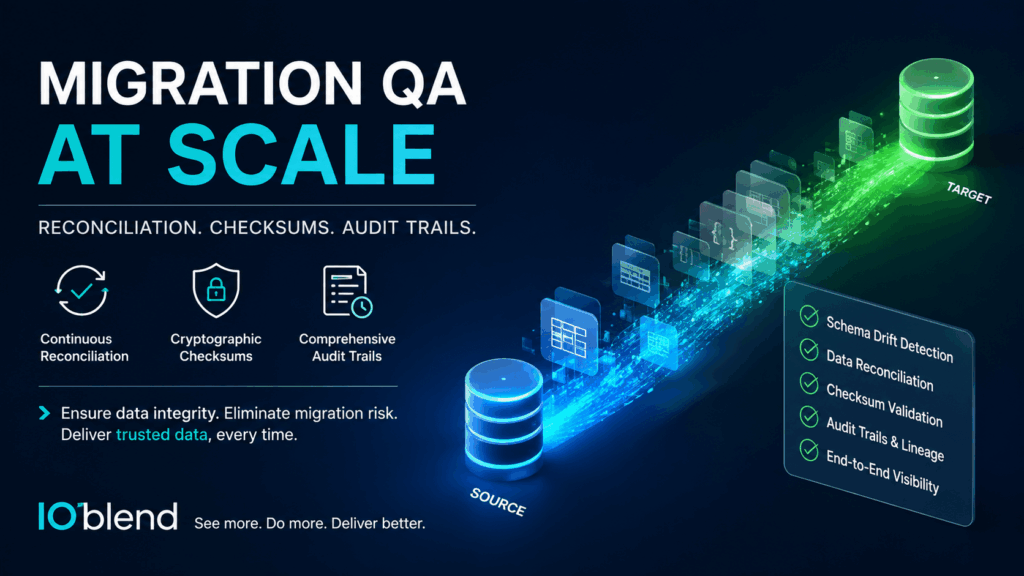
Migration QA at scale refers to the systematic validation of volume, structure, and integrity when shifting enterprise data across heterogeneous environments. Rather than relying on simple row counts, modern reconciliation demands three core pillars: continuous reconciliation to guarantee record symmetry, cryptographic checksums to verify payload fidelity down to individual byte values, and comprehensive audit trails to record end-to-end lineage and schema evolution.
The operational bottlenecks in enterprise migrations
Engineering teams undertaking complex migrations regularly encounter severe operational hurdles:
- Silent schema drift and field truncation: Unannounced schema changes or subtle precision losses (e.g. timestamp truncation or numeric overflow) in active source pipelines corrupt target datasets quietly without throwing fatal job errors.
- Prohibitive compute overhead: Executing full-table hashing or cell-by-cell row comparisons across billions of records introduces unsustainable latency and spikes warehouse consumption costs.
- Lack of record-level lineage: When discrepancies emerge, pinpointing whether the fault stemmed from network drops, transformation logic, or late-arriving CDC records requires painstaking manual log analysis.
- Multi-tool stack complexity: Orchestrating separate tools for batch extracts, streaming CDC, data quality assertions, and logging creates fragile pipelines that fail unexpectedly under high throughput.
Eliminating migration risks with IOblend
IOblend solves these migration QA challenges by standardising production data pipelines on Apache Spark through portable JSON playbooks and native Python/SQL logic.
- Automated continuous reconciliation and line-level lineage: IOblend tracks schema evolution and change data capture in real time (including late-arriving data), delivering record-level lineage so you can trace, debug, and replay discrepancies instantly.
- Cryptographic integrity and high-throughput validation: Capable of processing over 1 million transactions per second with ultra-low P99 latency, IOblend executes validation rules and custom checksum checks directly on Spark infrastructure without heavy warehouse compute costs.
- Unified governance and auditability: Built-in audit trails, automated data quality controls, and drift handling ensure full end-to-end compliance from source to sink across cloud and on-premises environments.
Eliminate migration anxiety and streamline your data pipeline testing. Supercharge your enterprise data migrations with IOblend.

Shift Left: Unleashing Data Power with In-Memory Processing
Mind the Gap: Bridging Data Shift Left: Unleashing Data Power with In-Memory Processing 💻 Did you know? Organisations that implement shift-left strategies can experience up to a 30% reduction in compute costs by cleaning data at the source. The Essence of Shifting Left Shifting data compute and governance “left” essentially means moving these processes closer

Mind the Gap: Bridging Data Silos with IOblend Integration
Mind the Gap: Bridging Data Silos to Unlock Organisational Insight 💾 Did you know? Back in the early days of computing, data integration often involved physically moving punch cards between different machines – a rather less streamlined approach than what we have today! Piecing Together the Data Puzzle At its core, data integration is about

Rapid AI Implementation: Moving Beyond Proof of Concept
Rapid AI Implementation: Moving Beyond Proof of Concept 💻 Did you know that in 2024, the average time it took for a business to deploy an AI model from the experimental stage to full production was approximately six months? Bringing AI Experiments to Life The journey of an AI project typically begins with a “proof

Agentic AI ETL: The Future of Data Integration
Agentic AI ETL: The Future of Data Integration 📓 Did you know? By 2025, the volume of data generated globally is projected to reach 175 zettabytes? That’s a truly enormous number, highlighting the ever-increasing importance of efficient data management. What is Agentic AI ETL? Agentic AI ETL represents a transformative evolution in data integration. Traditional

Break Down the Data Walls with IOblend
Break Down the Data Walls with IOblend 📑 Did you know? It’s estimated that a whopping 80% of business data is just floating about, unstructured and stuck in siloed systems. Siloed data only brings value (if at all!) to the domain it belongs to. But the true value lies in the insights in brings to

Put a Stop to Data Chaos with IOblend Governed Integration
Put a Stop to Data Chaos with IOblend Governed Integration 🤯💥Did you know? By 2025, the global datasphere is projected to grow to 175 zettabytes? This staggering figure underscores the sheer scale of data businesses must manage, making simplification not just a luxury, but a necessity. Today, businesses don’t have a shortage of data. What