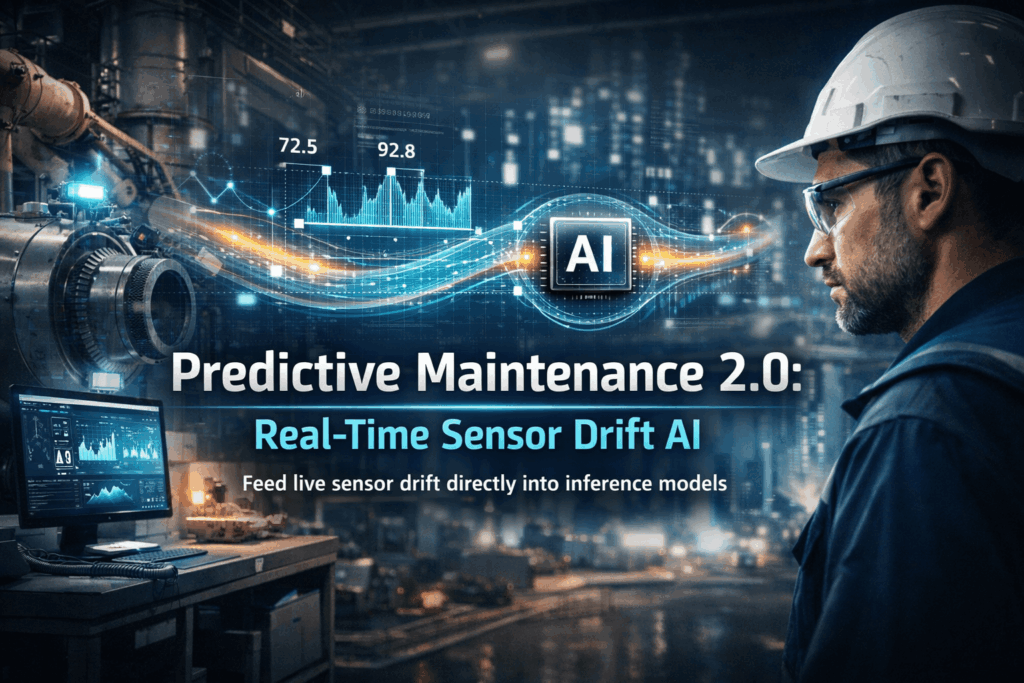

Predictive Maintenance 2.0: Feeding real-time sensor drifts directly into inference models using streaming engine
🔩 Did you know? The cost of unplanned downtime for industrial manufacturers is estimated at nearly £400 billion annually.
Predictive Maintenance 2.0: The Real-Time Evolution
Predictive Maintenance 2.0 represents a paradigm shift from batch-processed diagnostics to live, autonomous synchronisation. In the traditional 1.0 era, data was collected, stored in a lake, and analysed hours or days later. Predictive Maintenance 2.0, however, feeds real-time sensor drifts, the gradual deviation of a sensor’s output from its true value directly into inference models. By treating data as a continuous stream rather than a static snapshot, businesses can adjust their AI’s baseline in milliseconds, ensuring that “model decay” never interferes with operational safety.
The Problem: The Drift Dilemma and Data Latency
For most data experts, the hurdle isn’t building the machine learning model; it is the “data plumbing” required to keep it accurate. Industrial sensors operate in harsh environments where heat, vibration, and age cause readings to drift.
Standard architectures struggle with this for two reasons.
Firstly, Data Latency: By the time sensor data is cleaned and moved through a traditional ETL (Extract, Transform, Load) pipeline, the “real-time” window has closed.
Secondly, Feature Inconsistency: If an inference model is fed raw, unadjusted drift data, it triggers false positives.
The IOblend Solution: Streamlining the Edge to Inference
This is where IOblend transforms the landscape. IOblend’s streaming engine is designed to eliminate the friction between raw IoT outputs and production-ready AI.
- Real-time Transformation at Scale: IOblend allows data engineers to build high-performance streaming pipelines that perform complex transformations, such as normalising sensor drift on the fly. Instead of waiting for a batch job, IOblend’s engine calculates moving averages and handles out-of-order events instantly, ensuring the inference model receives perfectly “cleaned” features.
- Unified Data Engineering: IOblend simplifies the tech stack by merging streaming and batch processing into a single workflow. For a manufacturer, this means using the same logic to train a model on historical data as they do to run inference on live sensor streams. This consistency eliminates the “training-serving skew” that plagues many predictive projects.
- Automated Schema Evolution: In complex industrial setups, adding new sensors or updating firmware often breaks data pipelines. IOblend’s “Data Engineering in a Box” approach handles these changes automatically, ensuring that the flow of drift data to your inference models remains uninterrupted.
Ready to eliminate downtime? Synchronise your data and your destiny with IOblend.
IOblend presents a ground-breaking approach to IoT and data integration, revolutionizing the way businesses handle their data. It’s an all-in-one data integration accelerator, boasting real-time, production-grade, managed Apache Spark™ data pipelines that can be set up in mere minutes. This facilitates a massive acceleration in data migration projects, whether from on-prem to cloud or between clouds, thanks to its low code/no code development and automated data management and governance.
IOblend also simplifies the integration of streaming and batch data through Kappa architecture, significantly boosting the efficiency of operational analytics and MLOps. Its system enables the robust and cost-effective delivery of both centralized and federated data architectures, with low latency and massively parallelized data processing, capable of handling over 10 million transactions per second. Additionally, IOblend integrates seamlessly with leading cloud services like Snowflake and Microsoft Azure, underscoring its versatility and broad applicability in various data environments.
At its core, IOblend is an end-to-end enterprise data integration solution built with DataOps capability. It stands out as a versatile ETL product for building and managing data estates with high-grade data flows. The platform powers operational analytics and AI initiatives, drastically reducing the costs and development efforts associated with data projects and data science ventures. It’s engineered to connect to any source, perform in-memory transformations of streaming and batch data, and direct the results to any destination with minimal effort.
IOblend’s use cases are diverse and impactful. It streams live data from factories to automated forecasting models and channels data from IoT sensors to real-time monitoring applications, enabling automated decision-making based on live inputs and historical statistics. Additionally, it handles the movement of production-grade streaming and batch data to and from cloud data warehouses and lakes, powers data exchanges, and feeds applications with data that adheres to complex business rules and governance policies.
The platform comprises two core components: the IOblend Designer and the IOblend Engine. The IOblend Designer is a desktop GUI used for designing, building, and testing data pipeline DAGs, producing metadata that describes the data pipelines. The IOblend Engine, the heart of the system, converts this metadata into Spark streaming jobs executed on any Spark cluster. Available in Developer and Enterprise suites, IOblend supports both local and remote engine operations, catering to a wide range of development and operational needs. It also facilitates collaborative development and pipeline versioning, making it a robust tool for modern data management and analytics

Building Live ETA Pipelines for Fleet Operations
Logistics: Live ETA Prediction Pipelines from Fleet + Orders 🚚 Did you know? The “Last Mile” is famously the most expensive and inefficient part of the supply chain, often accounting for up to 53% of total shipping costs. The Evolution of Real-Time Logistics Live ETA (Estimated Time of Arrival) prediction pipelines represent the shift from reactive

DB2 CDC to Lakehouse Without Re-Platforming
From DB2 to Lakehouse: Real-Time CDC Without Re-Platforming 💻 Did you know? Mainframe systems like DB2 still process approximately 30 billion business transactions every single day. Despite the rush toward modern cloud architectures, the world’s most critical financial and logistical data often resides in these “legacy” environments, making them the silent engines of the global economy.

Real-Time Upserts: Deduping and Idempotency
Streaming Upserts Done Right: Deduping and Idempotency at Scale 💻 Did you know? In many high-velocity streaming environments, the “same” event can be sent or processed multiple times due to network retries or distributed system failures. The Art of the Upsert At its core, a streaming upsert (a portmanteau of “update” and “insert”) is the process of synchronising incoming data with an existing

Streaming Data Quality That Won’t Break Pipelines
Streaming Without the Sting: Data Quality Rules That Never Break the Flow 💻 Did you know? A single minute of downtime in a high-velocity streaming environment can result in the loss of millions of data points, potentially costing a business thousands of pounds in missed opportunities or regulatory fines. — Defining Resilient Streaming Quality Data quality in

Schema Drift: The Silent Killer of Data Pipelines
The Silent Pipeline Killer: Surviving Schema Drift in the Wild 📊 Did you know? In the early days of big data, a single column change in a source database could trigger a “data graveyard” effect, where downstream analytics remained broken for weeks. The silent pipeline killer Schema drift occurs when the structure of source data changes

Preventing Data Drift in Modern Data Systems
The Invisible Erosion: Detecting and Managing Data Drift in Modern Architectures 📊 Did you know? According to recent industry surveys, over 70% of organisations experience significant data drift within the first six months of deploying a production system. The Concept of Data Drift Data drift occurs when the statistical properties or the underlying structure of incoming data change