AW-10865990051

De-Risk Cloud Migration with Parallel Runs

Cloud migration de-risked with parallel runs IOblend

De-Risk Your Migration: Run Legacy and New Systems in Parallel 

💻 Did you know? An alarming 83% of data migrations either fail outright or drastically overrun their budgets. When management loses patience with mounting technical friction, entire digital transformations are written off. 

Minimising the migration gamble 

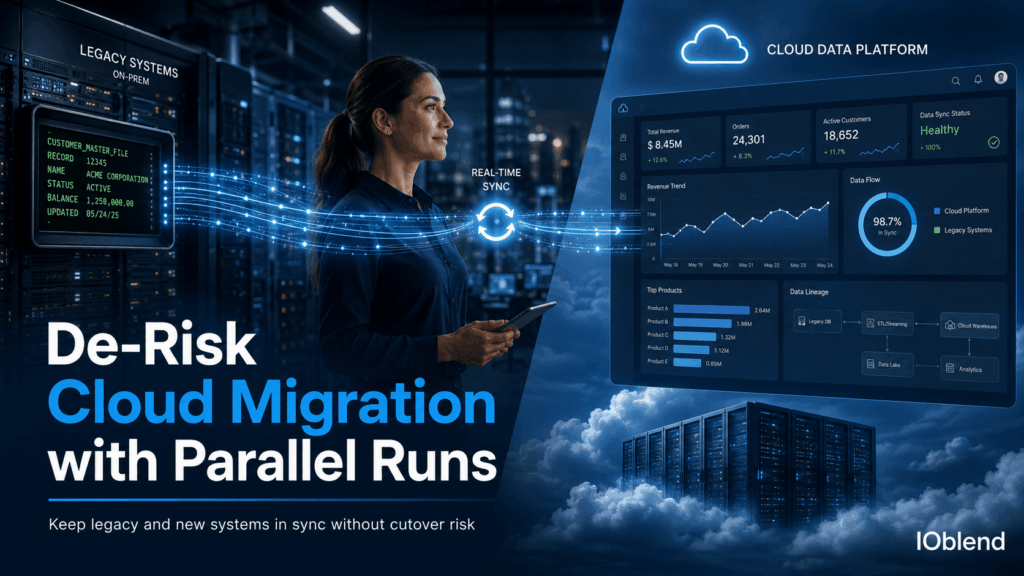
To eliminate this operational hazard, running legacy and new systems in parallel has become the preferred methodology for data experts. Instead of risking a single, catastrophic cutover, you replicate business logic in the new cloud environment and synchronise data flows across both systems. By operating both platforms simultaneously, you create a safety net. This allows you to validate data consistency, test performance under real-world loads, and ensure continuity without interrupting daily business operations. 

The friction of double maintenance 

While parallel runs dramatically lower operational risk, they introduce distinct architectural challenges. Data engineers face the immense burden of maintaining data integrity across disparate system vintages. 

Businesses commonly struggle with several critical issues: 

  • Logic Drift: Replicating complex, shifting business rules between on-prem systems and modern cloud architectures often results in data discrepancies. 
  • Dual-Write Complexity: Building custom Change Data Capture (CDC) and bi-directional synchronization to keep multiple databases aligned in real-time requires immense developer resources. 
  • Pipeline Bloat: Engineers routinely end up “babysitting” a fragmented five-tool stack just to handle streaming, data quality checks, and schema evolution. 

How IOblend turns months into weeks 

This is where IOblend completely alters the migration paradigm. As a next-generation data integration application, IOblend abstracts away the architectural complexity of parallel runs, allowing you to build production-grade pipelines in minutes rather than quarters. 

By standardising pipelines on Apache Spark™ as portable JSON playbooks, IOblend delivers the tools needed to execute a seamless, risk-free parallel migration: 

  • Real-Time Synchronisation: With built-in, log-based CDC and bi-directional data mirroring, IOblend keeps your legacy and new platforms perfectly in sync, automatically eliminating manual updates and data errors. 
  • Out-of-the-Box DataOps: Every pipeline automatically manages record-level lineage, Slowly Changing Dimensions (SCD Types I and II), data quality checks, and schema drift, ensuring absolute trust in your new data asset. 
  • Unprecedented Time-to-Value: In a recent enterprise use case involving complex legacy systems, IOblend safely compressed a traditional nine-month migration scope down to just six weeks. 

You no longer have to choose between project speed and operational safety. 

De-risk your enterprise migration and run your systems in perfect harmony. 

IOblend: See more. Do more. Deliver better.

AI
admin

BCBS 239 Compliance with Record-Level Lineage

Regulatory Compliance at Scale: Automating record-level lineage and audit trails for BCBS 239  📋 Did you know? In the wake of the 2008 financial crisis, the Basel Committee found that many global banks were unable to aggregate risk exposures accurately or quickly because their data landscapes were too complex. This led to the birth of BCBS

Read More »
AI
admin

Real-Time Churn Agents with Closed-Loop MLOps

Churn Prevention: Building “closed-loop” MLOps systems that predict churn and trigger automated retention agents  🔗 Did you know? In the telecommunications and subscription-based sectors, a mere 5% increase in customer retention can lead to a staggering profit surge of more than 25%.  Closed-Loop MLOps A “closed-loop” MLOps system is an advanced architectural pattern that transcends simple predictive analytics. While

Read More »
Predicitve_Maintenance_IOblend
AI
admin

Streaming Predictive MX: Drift-Aware Inference

Predictive Maintenance 2.0: Feeding real-time sensor drifts directly into inference models using streaming engine  🔩 Did you know? The cost of unplanned downtime for industrial manufacturers is estimated at nearly £400 billion annually.  Predictive Maintenance 2.0: The Real-Time Evolution  Predictive Maintenance 2.0 represents a paradigm shift from batch-processed diagnostics to live, autonomous synchronisation. In the traditional 1.0

Read More »
AI
admin

Beyond Micro-Batching: Continuous Streaming for AI

Beyond Micro-batching: Why Continuous Streaming Engine is the Future of “Fresh Data” for AI  💻 Did you know? Most modern “real-time” AI applications are actually running on data that is already several minutes old. Traditional micro-batching collects data into small chunks before processing it, introducing a “latency tax” that can render predictive models obsolete before they

Read More »
AI
admin

ERP Cloud Migration With Live Data Sync

Seamless Core System Migration: The Move of Large-Scale Banking and Insurance ERP Data to a Modern Cloud Architecture  ⛅ Did you know that core system migrations in large financial institutions, which typically rely on manual data mapping and validation, often require parallel runs lasting over 18 months?  The Core Challenge  The migration of multi-terabyte ERP and

Read More »
AI
admin

Legacy ERP Integration to Modern Data Fabric

Warehouse Automation Efficiency: Migrating and Integrating Legacy ERP Data into a Modern Big Data Ecosystem  📦 Did you know? Analysts estimate that warehouses leveraging robust, real-time data integration see inventory accuracy improvements of up to 99%.  The Convergence of WMS and Big Data  Data professionals in logistics face a profound challenge extracting mission-critical operational data such

Read More »
Scroll to Top