De-Risk Your Migration: Run Legacy and New Systems in Parallel
💻 Did you know? An alarming 83% of data migrations either fail outright or drastically overrun their budgets. When management loses patience with mounting technical friction, entire digital transformations are written off.
Minimising the migration gamble
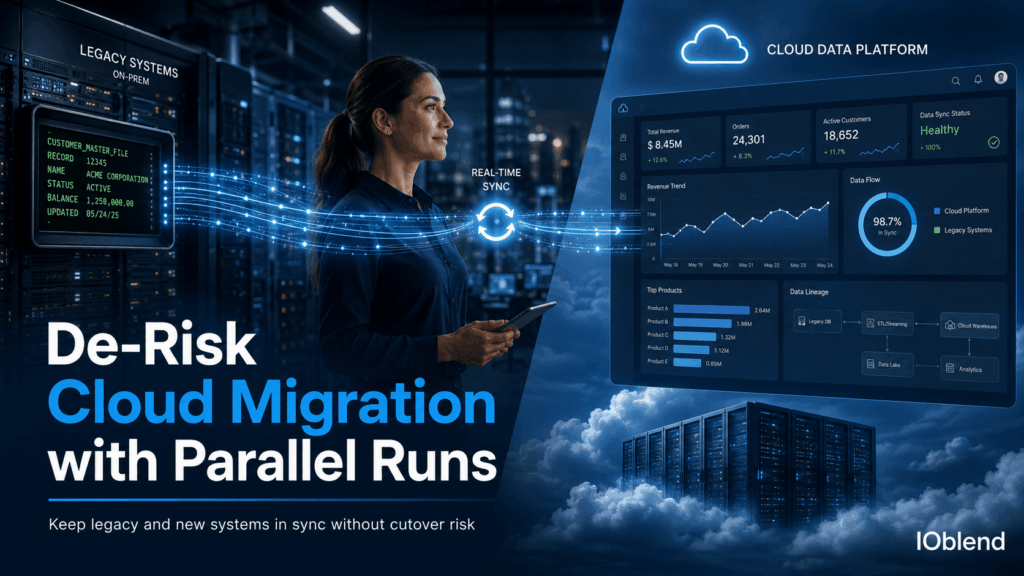
To eliminate this operational hazard, running legacy and new systems in parallel has become the preferred methodology for data experts. Instead of risking a single, catastrophic cutover, you replicate business logic in the new cloud environment and synchronise data flows across both systems. By operating both platforms simultaneously, you create a safety net. This allows you to validate data consistency, test performance under real-world loads, and ensure continuity without interrupting daily business operations.
The friction of double maintenance
While parallel runs dramatically lower operational risk, they introduce distinct architectural challenges. Data engineers face the immense burden of maintaining data integrity across disparate system vintages.
Businesses commonly struggle with several critical issues:
- Logic Drift: Replicating complex, shifting business rules between on-prem systems and modern cloud architectures often results in data discrepancies.
- Dual-Write Complexity: Building custom Change Data Capture (CDC) and bi-directional synchronization to keep multiple databases aligned in real-time requires immense developer resources.
- Pipeline Bloat: Engineers routinely end up “babysitting” a fragmented five-tool stack just to handle streaming, data quality checks, and schema evolution.
How IOblend turns months into weeks
This is where IOblend completely alters the migration paradigm. As a next-generation data integration application, IOblend abstracts away the architectural complexity of parallel runs, allowing you to build production-grade pipelines in minutes rather than quarters.
By standardising pipelines on Apache Spark™ as portable JSON playbooks, IOblend delivers the tools needed to execute a seamless, risk-free parallel migration:
- Real-Time Synchronisation: With built-in, log-based CDC and bi-directional data mirroring, IOblend keeps your legacy and new platforms perfectly in sync, automatically eliminating manual updates and data errors.
- Out-of-the-Box DataOps: Every pipeline automatically manages record-level lineage, Slowly Changing Dimensions (SCD Types I and II), data quality checks, and schema drift, ensuring absolute trust in your new data asset.
- Unprecedented Time-to-Value: In a recent enterprise use case involving complex legacy systems, IOblend safely compressed a traditional nine-month migration scope down to just six weeks.
You no longer have to choose between project speed and operational safety.
De-risk your enterprise migration and run your systems in perfect harmony.

De-Risk Cloud Migration with Parallel Runs
De-Risk Your Migration: Run Legacy and New Systems in Parallel 💻 Did you know? An alarming 83% of data migrations either fail outright or drastically overrun their budgets. When management loses patience with mounting technical friction, entire digital transformations are written off. Minimising the migration gamble To eliminate this operational hazard, running legacy and new systems in

Compliance DataOps for Auditable Pipelines
Compliance-Friendly DataOps: Repeatable, Reviewable, Versioned Pipelines 📓 Did you know? According to industry compliance reports, nearly 70% of businesses face difficulties tracing their data back to its raw origins during regular regulatory audits. The Concept of Compliance-Friendly DataOps Compliance-friendly DataOps represents an operational framework that embeds strict regulatory governance directly into the data engineering lifecycle. Instead of treating data auditing

Continuous Data Replication for DR and Continuity
Continuous Data Replication: for Business Continuity and DR 📝 Did you know? According to industry studies, the average cost of IT downtime is approximately £4,500 per minute. For a large enterprise, a single hour of data loss or system unavailability can translate into millions in lost revenue, legal penalties, and irreparable brand damage. The Pulse of

Smart Meter Data: Billing to Forecasting
Utilities: Smart Meter Data to Billing and Demand Forecasting 📋 Did You Know? The global roll-out of smart meters generates more data in a single day than most utility companies used to collect in an entire decade. While traditional meters were read once a month, or even once a quarter, smart meters transmit data at intervals

SCADA Streams to Reliability Analytics
Energy: SCADA Streams to Reliability Analytics 🔌 Did you know? The average modern wind turbine or smart substation generates roughly 1 to 2 terabytes of data every month. However, historically, less than 5% of that sensor data was actually used for decision-making. Most of it was simply discarded or “siloed” in SCADA systems, serving as a

Building Live ETA Pipelines for Fleet Operations
Logistics: Live ETA Prediction Pipelines from Fleet + Orders 🚚 Did you know? The “Last Mile” is famously the most expensive and inefficient part of the supply chain, often accounting for up to 53% of total shipping costs. The Evolution of Real-Time Logistics Live ETA (Estimated Time of Arrival) prediction pipelines represent the shift from reactive