Debug Streaming Like a Pro: Visual Tracing and Rapid Iteration
📎 Did you know? The vast majority of real-time streaming data pipeline bugs only reveal themselves under production workloads, usually at 03:00 am. Because streaming systems process unbounded data in memory, traditional breakpoints and step-through debugging are impossible without stopping the entire world, corrupting states, and causing downstream disaster.
The Concept of Visual Tracing
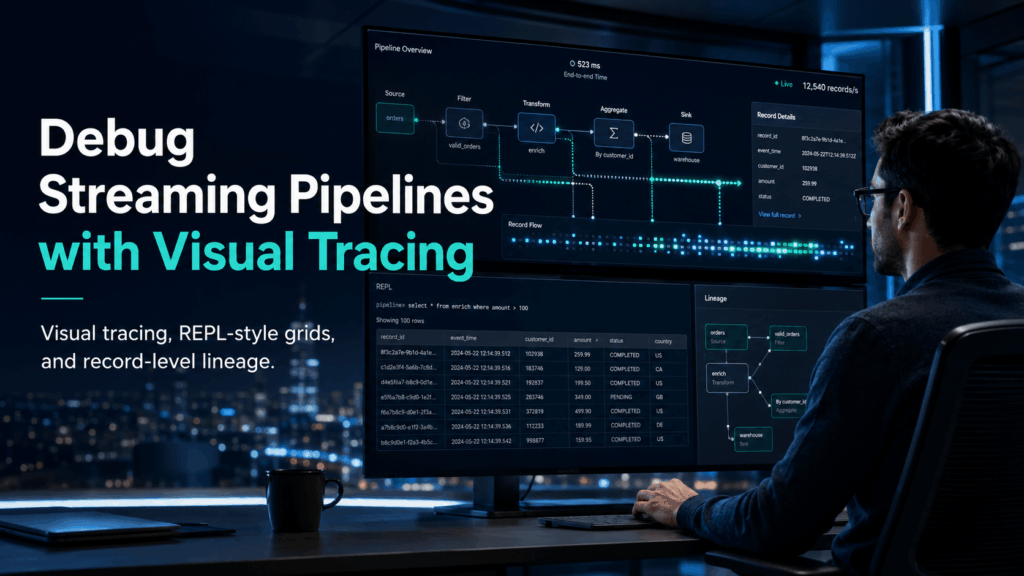
Streaming debugging is notoriously complex. Unlike batch processing, where you can pause, inspect, and rerun a static chunk of data, streaming flows constantly. Visual tracing changes this entirely. It acts like a high-speed camera for data-in-motion, allowing data experts to map out data flows and evaluate execution blocks in real time. Instead of looking at unformatted command-line error logs, engineers can see records moving through transformations interactively, mimicking Read-Eval-Print Loop (REPL) interactive grids.
Streaming Bottlenecks for Modern Enterprises
Building real-time data architectures, like Kappa or Lambda models, presents massive operational challenges for businesses:
- The Black Box Dilemma: When an aggregate metric spikes or a schema drifts, finding the exact corrupted record or broken joint downstream requires hours of parsing log files.
- Sluggish Iteration Cycles: Testing a minor business logic adjustment or custom Python snippet often requires full redeployment to a remote Apache Spark or Apache Flink cluster, dragging out development phases from days into weeks.
- Late-Arriving Records & Drift: Data arriving out of order or unexpected upstream structural modifications can silently break hand-written stateful transformations, resulting in inaccurate real-time dashboards and broken business trust.
The IOblend Solution
To overcome these production bottlenecks, IOblend shifts the entire streaming paradigm by embedding built-in DataOps directly into a low-code visual environment. Running on a highly optimised Kappa architecture, IOblend autogenerates distributed Apache Spark streaming jobs without requiring manual code.
For data experts debugging complex streams, IOblend provides specific, production-ready capabilities:
- Visual Debugging & REPL Grids: Test real-time data flows locally via an interactive developer desktop application with REPL-like data grids, allowing you to iterate instantly before pushing pipelines live.
- Granular Record-Level Lineage: If an error occurs, IOblend tracks data changes down to the individual record, exposing exactly what modified the data.
- Automated Drift & Late Data Handling: It automatically tracks schema evolution, protects data contracts, and seamlessly replays transforms whenever late-arriving data hits the engine.
Simplify your pipelines and scale with confidence by leveraging the real-time observability of IOblend.

When Enterprise Data Platforms Become Too Complex
When Enterprise Data Platforms Become Too Complex Enterprise data platforms usually start with a sensible goal: Connect the data Make it trustworthy Make it useful The problem is that, over time, the platform itself can become part of the complexity. More services are added. More specialist skills are needed. More workloads become dependent on one

Real-Time Entity Resolution for Enterprise Data and AI
Entity Resolution at Scale: Merge Duplicates as Data Moves Enterprise data rarely arrives clean. The same customer, supplier or product can exist across multiple systems under different names, IDs or formats. For reporting, this creates inconsistency. For AI and automation, it creates unreliable context. Entity resolution has traditionally been handled through batch processing. But when

Real-Time Customer 360: MDM for AI-Ready Data
Real-Time Customer 360: MDM That Keeps Data Current A Customer 360 view is only useful if the data behind it is current. Many organisations still rely on batch integration, which means customer profiles can quickly fall behind reality. As businesses adopt AI, copilots and real-time analytics, that gap becomes harder to ignore. Real-time Master Data

Data Migration QA: Checksums & Audit Trails
Migration QA at Scale: Reconciliation, Checksums, and Audit Trails 📂 Did you know that during enterprise database migrations, as much as 20% of quiet data corruption goes entirely unnoticed until post-cutover operational failures occur? Understanding migration QA at scale Migration QA at scale refers to the systematic validation of volume, structure, and integrity when shifting enterprise

Lakehouse Data Quality Gates: Stop Bad Data Fast
Lakehouse Quality Gates: Fail Fast Before Bad Data Lands 📋 Did You Know? Up to 20% of real-time event streams suffer from schema drift, duplicate payloads, or corrupted records, costing global organisations billions each year in wasted compute, broken analytical models, and polluted reporting layers. The Concept: Stopping Bad Data at the Border Lakehouse Quality Gates are automated,

Automated Data Contracts: Stop Schema Drift
Data Contracts That Stick: Enforce Schema and Expectations Automatically 📜 Did You Know? In the early days of big data, a single unannounced column type change in an upstream transactional database could trigger a catastrophic “data graveyard” effect, corrupting millions of analytics records before anyone noticed. The Concept of Enforceable Data Contracts A data contract is