
AW-10865990051

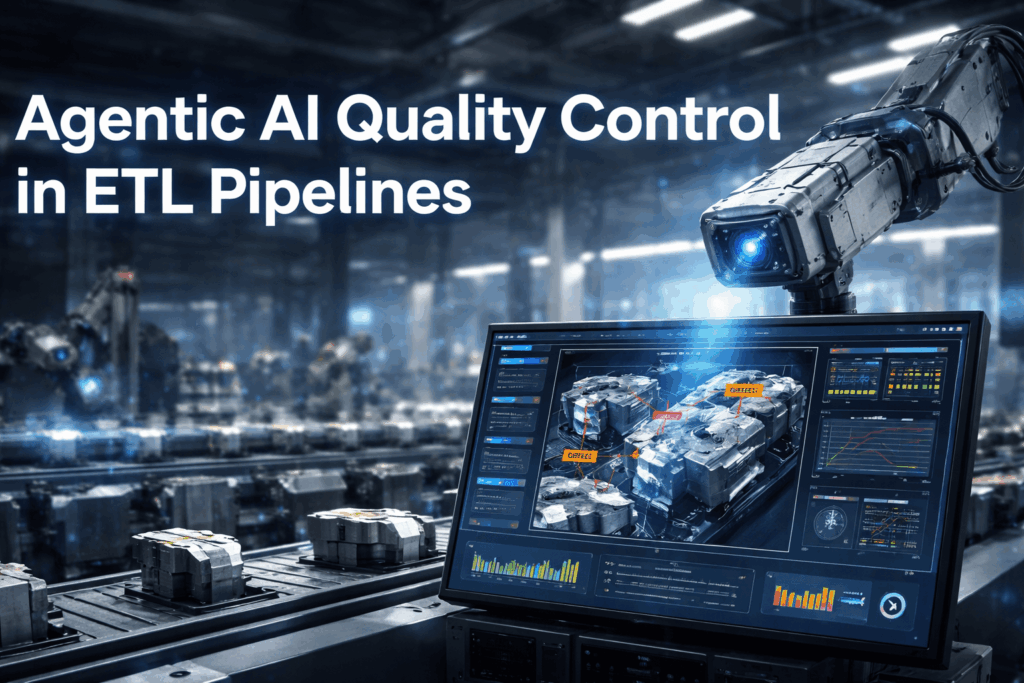
Real-Time Defect Detection with Agentic AI + ETL

Smart Quality Control: Embedding Agentic AI into ETL pipelines to visually inspect and categorise production defects 

🔩 Did you know? “visual drift” in manual quality control can lead to a 20% drop in defect detection accuracy over a single eight-hour shift 

The Concept: Agentic AI in the ETL Stream

Traditional ETL (Extract, Transform, Load) has long been the backbone of data engineering, typically handling structured logs and transactional records. Smart Quality Control evolves this by embedding Agentic AI, autonomous AI agents capable of reasoning and decision-making, directly into the pipeline. 

Instead of merely moving data, the pipeline “sees.” As raw image data from the factory floor is extracted, these agents use computer vision to inspect products, categorise defects (such as hairline fractures or colour deviations), and autonomously decide whether to trigger an alert, reroute a batch, or update a predictive maintenance model. 

The Friction: Scaling Human Vision 

Modern manufacturers face a “data gravity” problem. High-speed production lines generate terabytes of visual data that are often too heavy to move to a central cloud for delayed analysis. Businesses struggle with: 

  • Latency Gaps: Sending images to a separate AI module outside the ETL flow creates bottlenecks, leading to defective products leaving the facility before the system flags them. 
  • Categorisation Complexity: Standard automation can detect “something is wrong,” but it struggles to distinguish between a superficial scratch and a structural crack without intensive manual labelling. 
  • Infrastructure Rigidity: Integrating complex AI models into legacy data architectures often requires bespoke, brittle code that breaks during schema changes. 

How IOblend Transforms Quality Control

The complexity of building these agentic workflows is where most enterprises stall. IOblend solves this by providing an advanced Data Engineering toolset that simplifies the deployment of AI-driven pipelines. 

IOblend allows data experts to build high-performance, metadata-driven pipelines that handle both structured and unstructured data with ease. By using IOblend, businesses can: 

  • Embed Intelligence: Seamlessly integrate AI models into the transformation layer, allowing for real-time visual inspection without the need for complex, hand-coded “plumbing.” 
  • Achieve Unmatched Speed: IOblend’s engine is designed for massive scale, processing complex visual data at the edge or in the cloud with minimal latency. 
  • Ensure Data Lineage: Every defect categorised by the AI is tracked with full observability, providing a clear audit trail from the factory camera to the final analytics dashboard. 

Stop wrestling with fragmented data silos and start building the future of manufacturing. 

Revolutionise your production line and achieve flawless precision: it’s time to power your vision with IOblend. 

IOblend: See more. Do more. Deliver better.

Mainframe-to-Cloud-with-CDC-IOblend
Data analytics

Mainframe to Cloud: Data Migration with CDC

Mainframe to Cloud: A Practical Data Migration Playbook  💾 Did you know? An alarming 83% of data migrations fail outright or drastically overrun their budgets.  Shifting Mainframe Heavyweights to the Cloud  Mainframe-to-cloud data migration is the process of moving core legacy
Read More »
Real-time-CDC-pipelines-into-Delta-tables-IOblend
AI

Real-Time CDC to Databricks Delta Tables

Realtime Ingestion to Databricks: From Source to Delta Tables  💽 Did you know? According to industry surveys, nearly eighty per cent of an enterprise’s data budget is consumed purely by data integration and upfront data wrangling rather than actual analytics.  Defining

Read More »
Cloud migration de-risked with parallel runs IOblend
Data analytics

De-Risk Cloud Migration with Parallel Runs

De-Risk Your Migration: Run Legacy and New Systems in Parallel  💻 Did you know? An alarming 83% of data migrations either fail outright or drastically overrun their budgets. When management loses patience with mounting technical friction, entire digital transformations are written

Read More »
Scroll to Top