
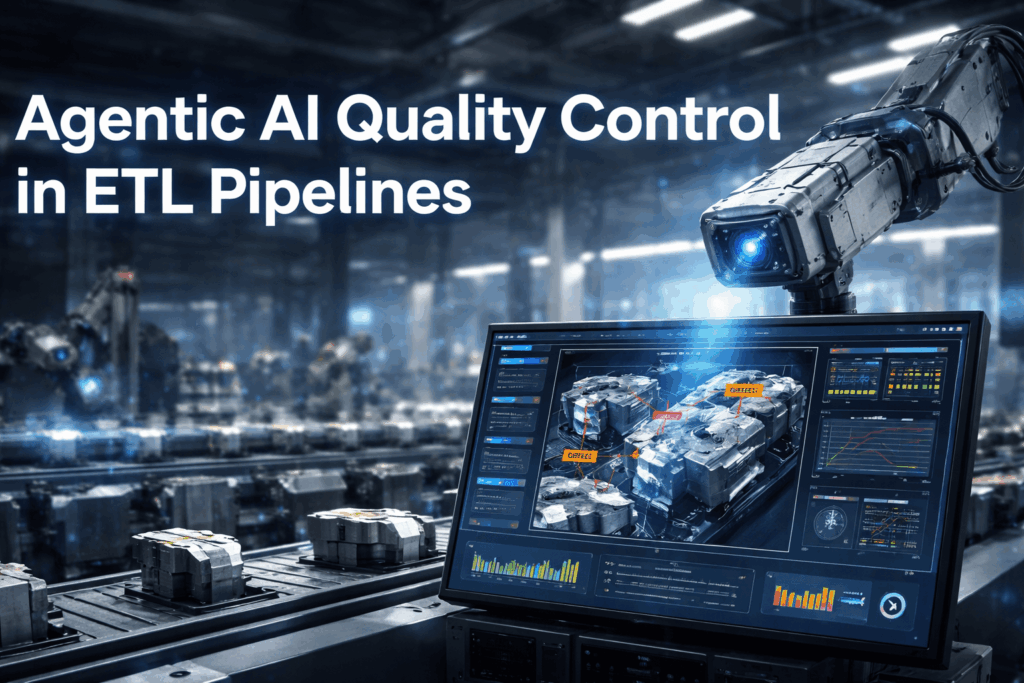

Smart Quality Control: Embedding Agentic AI into ETL pipelines to visually inspect and categorise production defects
🔩 Did you know? “visual drift” in manual quality control can lead to a 20% drop in defect detection accuracy over a single eight-hour shift
The Concept: Agentic AI in the ETL Stream
Traditional ETL (Extract, Transform, Load) has long been the backbone of data engineering, typically handling structured logs and transactional records. Smart Quality Control evolves this by embedding Agentic AI, autonomous AI agents capable of reasoning and decision-making, directly into the pipeline.
Instead of merely moving data, the pipeline “sees.” As raw image data from the factory floor is extracted, these agents use computer vision to inspect products, categorise defects (such as hairline fractures or colour deviations), and autonomously decide whether to trigger an alert, reroute a batch, or update a predictive maintenance model.
The Friction: Scaling Human Vision
Modern manufacturers face a “data gravity” problem. High-speed production lines generate terabytes of visual data that are often too heavy to move to a central cloud for delayed analysis. Businesses struggle with:
- Latency Gaps: Sending images to a separate AI module outside the ETL flow creates bottlenecks, leading to defective products leaving the facility before the system flags them.
- Categorisation Complexity: Standard automation can detect “something is wrong,” but it struggles to distinguish between a superficial scratch and a structural crack without intensive manual labelling.
- Infrastructure Rigidity: Integrating complex AI models into legacy data architectures often requires bespoke, brittle code that breaks during schema changes.
How IOblend Transforms Quality Control
The complexity of building these agentic workflows is where most enterprises stall. IOblend solves this by providing an advanced Data Engineering toolset that simplifies the deployment of AI-driven pipelines.
IOblend allows data experts to build high-performance, metadata-driven pipelines that handle both structured and unstructured data with ease. By using IOblend, businesses can:
- Embed Intelligence: Seamlessly integrate AI models into the transformation layer, allowing for real-time visual inspection without the need for complex, hand-coded “plumbing.”
- Achieve Unmatched Speed: IOblend’s engine is designed for massive scale, processing complex visual data at the edge or in the cloud with minimal latency.
- Ensure Data Lineage: Every defect categorised by the AI is tracked with full observability, providing a clear audit trail from the factory camera to the final analytics dashboard.
Stop wrestling with fragmented data silos and start building the future of manufacturing.
Revolutionise your production line and achieve flawless precision: it’s time to power your vision with IOblend.

Change Data Capture: IOblend’s Seamless Approach
Change Data Capture In the fast-paced world of data management, staying ahead of the curve is not an option, it’s a necessity. Change Data Capture (CDC) is the secret weapon that allows businesses to keep pace with the constant flux of data. In this blog, we will delve into the world of CDC, explore different

Data Schema Management with IOblend
Data Schema Management In today’s data-driven world, managing data effectively is crucial for businesses seeking to gain insights and make informed decisions. Data schema management is a fundamental aspect of this process, ensuring that data is organized, structured, and compatible with various applications and systems. In this blog post, we’ll explore the significance of data

Smarter office management with real-time analytics
Commercial property Welcome to the next issue of our real-time analytics blog. This time we are taking a detour from the aviation analytics to the world of commercial property management. The topic arose from a use case we are working on now at IOblend. It just shows how broad a scope is for real-time data

Better airport operations with real-time analytics
Good and bad Welcome to the next issue of our real-time analytics blog. Now that the summer holiday season is upon us, many of us will be using air travel to get to their destinations of choice. This means, we will be going through the airports. As passengers, we have love-hate relationships with airports. Some

The making of a commercial flight
What makes a flight Welcome to the next leg of our airline data blog journey. In this article, we will be looking at what happens behind the scenes to make a single commercial flight, well, take flight. We will again consider how processes and data come together in (somewhat of a) harmony to bring your

Enhance your airline’s analytics with a data mesh
Building a flying program In the last blog, I have covered how airlines plan their route networks using various strategies, data sources and analytical tools. Today, we will be covering how the network plan comes to life. Once the plans are developed, they are handed over to “production”. Putting a network plan into production is