


AW-10865990051

Smarter office management with real-time analytics

Commercial property

Welcome to the next issue of our real-time analytics blog. This time we are taking a detour from the aviation analytics to the world of commercial property management. The topic arose from a use case we are working on now at IOblend. It just shows how broad a scope is for real-time data applications pretty much everywhere we look.

Commercial property covers everything, from offices, to shops, to warehouses, etc. Government buildings, airports, hotels, amusement parks – they all fall into this category of property or real estate. These properties have one essential feature in common: they act as focal points for people to perform work, particularly office buildings.

Post-pandemic changes

Offices generally see a lot of use, so they require constant management to keep the buildings and facilities fit for purpose, cater for the workers’ needs and comply with health and safety regulations. Ground rents and upkeep are expensive, so property managers also need to maximise occupancy rates to be financially viable.

COVID 19 has changed the way we work (perhaps forever), so we no longer use the office space as much as we used to. Companies downsize their offices, meaning they require less space, thus reducing the rents they pay. Property managers then face under-utilised buildings, diminishing rent income and high maintenance costs (you still need to do upkeep). They needed to get smarter and more creative to lure people back into the buildings, which is now leading towards new interior designs, healthier food options, more co-working spaces, etc.

But how would you know what measures make a material difference?

As you may have correctly guessed it, data is used extensively by large property management companies to inform their operations. They use multiple data feeds such as lease agreements, utility bills, maintenance records, catering/shops sales, parking stats, front desk registry and turnstiles, meeting room bookings, surveys, etc. They collate and analyse this data manually to derive general trends and financial forecasts. The analysis is always static and only shows a limited picture.

But how would you know what measures make a material difference?
  • Once inside, what do the tenants do besides occupying their desks?
  • What areas do they visit and at what times?
  • Do they go anywhere aside from using the restrooms and kitchens in their respective areas?
  • How do they split their time between the desks, break-out areas, social spaces, and meeting rooms?
  • Are there any consistently under-utilised spaces that could be converted to different purposes?
  • If we invest in more attractive facilities, will they bring more customers?

It is challenging from a technical perspective to track what is happening inside the building at any given time, especially considering the privacy aspect – we, humans, do not like being constantly scrutinised by an unseen eye.

So here lies the challenge:

Property management companies want an ability to monitor activity inside the buildings in real-time but at the same time they must preserve privacy and remain unintrusive to the workers. Oh, and the system must not cost a fortune to build and maintain.

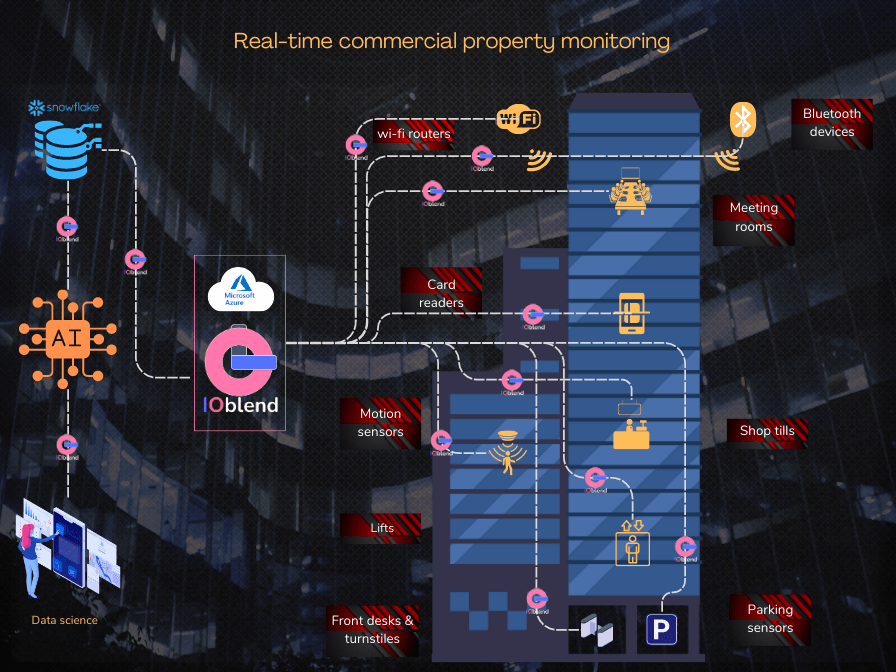
We have recently started to collaborate to bring one such capability to reality. While some solutions on the market today provide information about the building usage, they tend to analyse data from static data sources. IOblend connects to any source that produces data and processes it in-memory, performing multiple complex transformations in real-time cost-effectively. We process data in real-time in the customer’s cloud infra (MS Azure here).

In this case the project involves live entries from the front desks, turnstile scans, lift panels, meeting room reservations systems, wi-fi routers, motion sensors, Bluetooth devices, shop tills, parking sensors and internal card readers. Any personal data gets anonymised before we stream it to the warehouse (they use Snowflake).

A custom analytics suite then maps this data onto a virtual layout of the building and produces a visual representation of the interior activity, allowing property managers to analyse how the building is being used at any given time.

It’s early days still, but the insights from just one office already identified poorly utilised spaces and overcrowded areas (and the underlying causes), showed people flows by time of day across the entire building, and highlighted a potential to easily save energy. Interestingly, the project is not dissimilar to the one we described earlier for airport passenger tracking.

The next phase is to integrate an AI model to start introducing predictive maintenance capabilities. In parallel, they are also experimenting with the LLM to dynamically run comparisons with other properties in their portfolio and general market. Very exciting times for real-time data indeed.

If you are considering real-time analytics capabilities for your commercial property portfolios, get in touch today and let us show you the art of the possible.

Resolving the complexities of managing offices with real-time data, as opposed to common methods, involves a transformative approach that IOblend offers. Traditional property management relies on static data sources like lease agreements and utility bills, which only provide a limited view. IOblend, on the other hand, utilizes real-time data from diverse sources like front desk entries, turnstile scans, and sensor data, processed cost-effectively in the cloud. This approach allows property managers to gain instantaneous insights into space utilization, people flow, and energy consumption, enabling more informed decision-making. By mapping this data onto a virtual layout of buildings, IOblend not only enhances operational efficiency but also respects privacy concerns, a vital aspect in today’s data-driven world.

DR-and-continuity-with-IOblend
AI
admin

Continuous Data Replication for DR and Continuity

Continuous Data Replication: for Business Continuity and DR  📝 Did you know? According to industry studies, the average cost of IT downtime is approximately £4,500 per minute. For a large enterprise, a single hour of data loss or system unavailability can translate into millions in lost revenue, legal penalties, and irreparable brand damage.  The Pulse of

Read More »
Smart meter billing and AI forecasting with IOblend
AI
admin

Smart Meter Data: Billing to Forecasting

Utilities: Smart Meter Data to Billing and Demand Forecasting  📋 Did You Know? The global roll-out of smart meters generates more data in a single day than most utility companies used to collect in an entire decade. While traditional meters were read once a month, or even once a quarter, smart meters transmit data at intervals

Read More »
SCADA streams with IOblend
AI
admin

SCADA Streams to Reliability Analytics

Energy: SCADA Streams to Reliability Analytics  🔌 Did you know? The average modern wind turbine or smart substation generates roughly 1 to 2 terabytes of data every month. However, historically, less than 5% of that sensor data was actually used for decision-making. Most of it was simply discarded or “siloed” in SCADA systems, serving as a

Read More »
Logistics operator at a workstation using a tablet with holographic screens showing live ETA, weather, and a route map at a busy distribution hub.
AI
admin

Building Live ETA Pipelines for Fleet Operations

Logistics: Live ETA Prediction Pipelines from Fleet + Orders  🚚 Did you know? The “Last Mile” is famously the most expensive and inefficient part of the supply chain, often accounting for up to 53% of total shipping costs.  The Evolution of Real-Time Logistics  Live ETA (Estimated Time of Arrival) prediction pipelines represent the shift from reactive

Read More »
DB2-to-Lakehouse-with-CDC-IOblend
AI
admin

DB2 CDC to Lakehouse Without Re-Platforming

From DB2 to Lakehouse: Real-Time CDC Without Re-Platforming  💻 Did you know? Mainframe systems like DB2 still process approximately 30 billion business transactions every single day. Despite the rush toward modern cloud architectures, the world’s most critical financial and logistical data often resides in these “legacy” environments, making them the silent engines of the global economy. 

Read More »
Real-time-data-processing-with-deduplication
AI
admin

Real-Time Upserts: Deduping and Idempotency

Streaming Upserts Done Right: Deduping and Idempotency at Scale  💻 Did you know? In many high-velocity streaming environments, the “same” event can be sent or processed multiple times due to network retries or distributed system failures.  The Art of the Upsert  At its core, a streaming upsert (a portmanteau of “update” and “insert”) is the process of synchronising incoming data with an existing

Read More »
Scroll to Top