Streaming Without the Sting: Data Quality Rules That Never Break the Flow
💻 Did you know? A single minute of downtime in a high-velocity streaming environment can result in the loss of millions of data points, potentially costing a business thousands of pounds in missed opportunities or regulatory fines.
—
Defining Resilient Streaming Quality
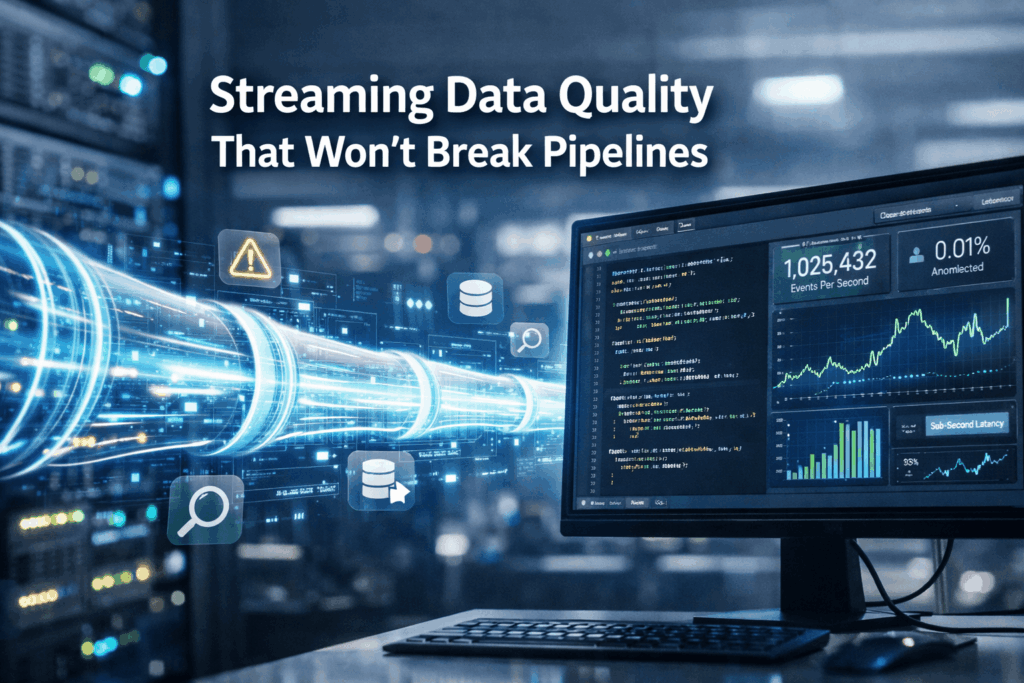
Data quality in a streaming context refers to the continuous validation of data as it moves through a pipeline, ensuring it is accurate, complete, and consistent without pausing the flow. Unlike batch processing, where you can afford to halt a job to investigate a null value, streaming requires a “non-breaking” approach where rules are applied in-flight, allowing valid data to pass while isolating anomalies in real-time.
The Hurdles of Modern Data Streams
Businesses today face significant challenges when trying to maintain high standards of data integrity within live environments:
- Schema Drift: Source systems often change without notice. A new field or a renamed column can instantly crash a traditional Spark job, leading to “silent failures” where data is lost or corrupted.
- Latency vs. Logic: Complex validation rules often introduce lag. For data experts, balancing sophisticated Python or SQL logic with the need for sub-second latency is a constant struggle.
- Tooling Bloat: Many teams “babysit” a five-tool stack just to handle CDC, streaming, and quality audits, leading to high operational overhead and fragmented lineage.
- Scaling Costs: Most vendors charge more as your data volume grows, making high-throughput quality checks prohibitively expensive.
How IOblend Solves the Streaming Puzzle
IOblend is designed to eliminate the fragility of production-grade pipelines by standardising them as portable playbooks. It offers a unique suite of solutions to ensure your data quality rules never break the stream:
- Drift Handling & Lineage: IOblend doesn’t fail quietly. It identifies what changed and what it impacted, providing record-level lineage so you can fix issues without stopping the flow.
- In-Flight Transformations: You can apply custom quality rules using SQL or Python directly within the pipeline. This allows for complex validation at scale (over 1M TPS) without the usual performance penalties.
- Agentic AI ETL: IOblend now allows you to embed AI agents directly into your ETL process. These agents can validate unstructured data or perform intelligent automation in real-time, bridging the gap between raw data and actionable insight.
- Infrastructure Agnostic: Whether on-prem or in the cloud, IOblend runs on your Spark infrastructure, reducing compute costs by up to 50% compared to DIY setups.
Stop rebuilding fragile pipelines and start delivering ROI, turbo-charge your data integration with IOblend today.

Predictive Aircraft Maintenance with Agentic AI
Predictive Aircraft Maintenance: Consolidating Data from Engine Sensors and MRO Systems 🛫 Did you know that leveraging Big Data analytics for predictive aircraft maintenance can reduce unscheduled aircraft downtime by up to 30% Predictive Maintenance: The Core Concept Predictive Maintenance (PdM) in aviation is the strategic shift from a time-based or reactive approach to an ‘as-needed’ model,

Digital Twin Evolution: Big Data & AI with
The Industrial Renaissance: How Agentic AI and Big Data Power the Self-Optimising Digital Twin 🏭 Did You Know? A fully realised industrial Digital Twin, underpinned by real-time data, has been proven to reduce unplanned production downtime by up to 20%. The Digital Twin Evolution The Digital Twin is a sophisticated, living, virtual counterpart of a physical production system. It

Real-Time Risk Modelling with Legacy & Modern Data
Risk Modelling in Real-time: Integrating Legacy Oracle/HP Underwriting Data with Modern External Datasets 💼 Did you know that in the time it takes to brew a cup of tea, a real-time risk model could have processed enough data to flag over 60 million potential fraudulent insurance claims? The Real-Time Risk Modelling Imperative Real-time risk modelling is

Unify Clinical & Financial Data to Cut Readmissions
Clinical-Financial Synergy: The Seamless Integration of Clinical and Financial Data to Minimise Readmissions 🚑 Did You Know? Unnecessary hospital readmissions within 30 days represent a colossal financial burden, often reflecting suboptimal transitional care. Clinical-Financial Synergy: The Seamless Integration of Clinical and Financial Data to Minimise Readmissions The Convergence of Clinical and Financial Data The convergence of clinical and financial

Agentic Pipelines and Real-Time Data with Guardrails
The New Era of ETL: Agentic Pipelines and Real-Time Data with Guardrails For years, ETL meant one thing — moving and transforming data in predictable, scheduled batches, often using a multitude of complementary tools. It was practical, reliable, and familiar. But in 2025, well, that’s no longer enough. Let’s have a look at the shift

Real-Time Insurance Claims with CDC and Spark
From Batch to Real-Time: Accelerating Insurance Claims Processing with CDC and Spark 💼 Did you know? In the insurance sector, the move from overnight batch processing to real-time stream processing has been shown to reduce the average claims settlement time from several days to under an hour in highly automated systems. Real-Time Data and Insurance