AW-10865990051

Agentic AI: The New Standard for ETL Governance

Autonomous Finance: Agentic AI as the New Standard for ETL Governance and Resilience 

📌 Did You Know? Autonomous data quality agents deployed by leading financial institutions have been shown to proactively detect and correct up to 95% of critical data quality issues. 

The Agentic AI Concept

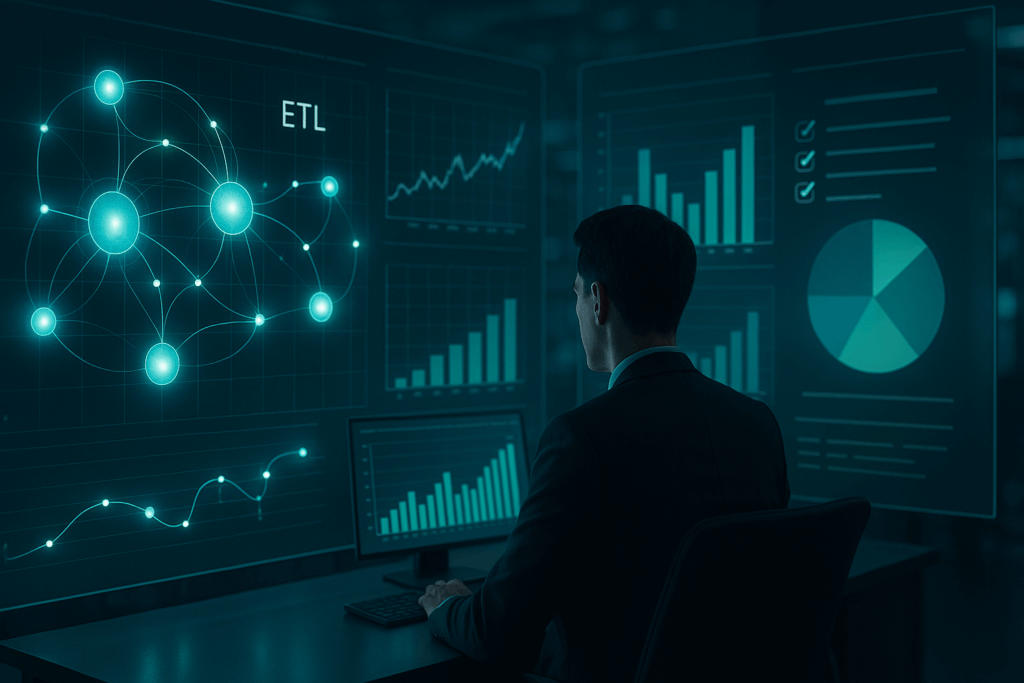
Agentic Artificial Intelligence (AI) represents the progression beyond simple prompt-and-response Generative AI. In data engineering, an Agentic system is an autonomous, goal-oriented architecture composed of collaborative, specialised agents. These agents can reason, plan, execute complex tasks, and adapt to unforeseen changes in real-time, all without constant human intervention. In a financial Extract, Transform, Load (ETL) pipeline, this translates to self-managing data flows capable of handling the sector’s stringent complexity and compliance demands. 

The Bottleneck of Traditional Financial Data Flows 

For data experts in finance, the challenge is no longer merely moving data, but managing its staggering rate of change and complexity. Legacy ETL systems, typically reliant on fragile, hand-coded scripts, consistently fail against four key persistent issues: 


  • Schema Volatility: Rapid changes in upstream API endpoints or regulatory reporting formats cause pipelines to break instantly, requiring hours of manual coding to fix. 
  • Policy Drift: Ensuring continuous, proactive enforcement of constantly changing compliance policies across disparate systems remains a manual, error-prone burden. 
  • Data Trust: Maintaining continuous data quality and lineage tracking in real-time is challenging, hindering the confidence required for mission-critical trading and risk models. 
  • Streaming Scale: Traditional batch processing struggles to keep pace with the massive transaction volumes and low-latency requirements of modern financial operations. 

IOblend’s Unified Agentic Approach to Data Integration 

IOblend delivers this future today, providing an all-in-one DataOps accelerator that seamlessly integrates Agentic AI capabilities directly into the dataflow. For data engineers, IOblend’s solution is revolutionary: 

  • Embedded AI Agents: IOblend allows the direct embedding of custom AI agents into the ETL pipeline, empowering systems to mine unstructured financial documents for structured data, validate the output, and combine it with structured feeds on-the-fly. 
  • Spark Muscle, Low-Code Power: The platform’s intuitive low-code Designer generates highly optimised, production-grade Apache Spark jobs automatically, eliminating complex Spark coding and accelerating development time tenfold. 
  • Built-in DataOps: The system provides automated data lineage, robust error handling, and comprehensive audit trails, ensuring data integrity and regulatory compliance are effortless, allowing teams to focus on strategy rather than maintenance. 

Unlock your data’s full potential and accelerate your time-to-value with IOblend. 

IOblend: See more. Do more. Deliver better. 

IOblend presents a ground-breaking approach to IoT and data integration, revolutionizing the way businesses handle their data. It’s an all-in-one data integration accelerator, boasting real-time, production-grade, managed Apache Spark™ data pipelines that can be set up in mere minutes. This facilitates a massive acceleration in data migration projects, whether from on-prem to cloud or between clouds, thanks to its low code/no code development and automated data management and governance.

IOblend also simplifies the integration of streaming and batch data through Kappa architecture, significantly boosting the efficiency of operational analytics and MLOps. Its system enables the robust and cost-effective delivery of both centralized and federated data architectures, with low latency and massively parallelized data processing, capable of handling over 10 million transactions per second. Additionally, IOblend integrates seamlessly with leading cloud services like Snowflake and Microsoft Azure, underscoring its versatility and broad applicability in various data environments.

At its core, IOblend is an end-to-end enterprise data integration solution built with DataOps capability. It stands out as a versatile ETL product for building and managing data estates with high-grade data flows. The platform powers operational analytics and AI initiatives, drastically reducing the costs and development efforts associated with data projects and data science ventures. It’s engineered to connect to any source, perform in-memory transformations of streaming and batch data, and direct the results to any destination with minimal effort.

IOblend’s use cases are diverse and impactful. It streams live data from factories to automated forecasting models and channels data from IoT sensors to real-time monitoring applications, enabling automated decision-making based on live inputs and historical statistics. Additionally, it handles the movement of production-grade streaming and batch data to and from cloud data warehouses and lakes, powers data exchanges, and feeds applications with data that adheres to complex business rules and governance policies.

The platform comprises two core components: the IOblend Designer and the IOblend Engine. The IOblend Designer is a desktop GUI used for designing, building, and testing data pipeline DAGs, producing metadata that describes the data pipelines. The IOblend Engine, the heart of the system, converts this metadata into Spark streaming jobs executed on any Spark cluster. Available in Developer and Enterprise suites, IOblend supports both local and remote engine operations, catering to a wide range of development and operational needs. It also facilitates collaborative development and pipeline versioning, making it a robust tool for modern data management and analytics

DR-and-continuity-with-IOblend
AI
admin

Continuous Data Replication for DR and Continuity

Continuous Data Replication: for Business Continuity and DR  📝 Did you know? According to industry studies, the average cost of IT downtime is approximately £4,500 per minute. For a large enterprise, a single hour of data loss or system unavailability can translate into millions in lost revenue, legal penalties, and irreparable brand damage.  The Pulse of

Read More »
Smart meter billing and AI forecasting with IOblend
AI
admin

Smart Meter Data: Billing to Forecasting

Utilities: Smart Meter Data to Billing and Demand Forecasting  📋 Did You Know? The global roll-out of smart meters generates more data in a single day than most utility companies used to collect in an entire decade. While traditional meters were read once a month, or even once a quarter, smart meters transmit data at intervals

Read More »
SCADA streams with IOblend
AI
admin

SCADA Streams to Reliability Analytics

Energy: SCADA Streams to Reliability Analytics  🔌 Did you know? The average modern wind turbine or smart substation generates roughly 1 to 2 terabytes of data every month. However, historically, less than 5% of that sensor data was actually used for decision-making. Most of it was simply discarded or “siloed” in SCADA systems, serving as a

Read More »
Logistics operator at a workstation using a tablet with holographic screens showing live ETA, weather, and a route map at a busy distribution hub.
AI
admin

Building Live ETA Pipelines for Fleet Operations

Logistics: Live ETA Prediction Pipelines from Fleet + Orders  🚚 Did you know? The “Last Mile” is famously the most expensive and inefficient part of the supply chain, often accounting for up to 53% of total shipping costs.  The Evolution of Real-Time Logistics  Live ETA (Estimated Time of Arrival) prediction pipelines represent the shift from reactive

Read More »
DB2-to-Lakehouse-with-CDC-IOblend
AI
admin

DB2 CDC to Lakehouse Without Re-Platforming

From DB2 to Lakehouse: Real-Time CDC Without Re-Platforming  💻 Did you know? Mainframe systems like DB2 still process approximately 30 billion business transactions every single day. Despite the rush toward modern cloud architectures, the world’s most critical financial and logistical data often resides in these “legacy” environments, making them the silent engines of the global economy. 

Read More »
Real-time-data-processing-with-deduplication
AI
admin

Real-Time Upserts: Deduping and Idempotency

Streaming Upserts Done Right: Deduping and Idempotency at Scale  💻 Did you know? In many high-velocity streaming environments, the “same” event can be sent or processed multiple times due to network retries or distributed system failures.  The Art of the Upsert  At its core, a streaming upsert (a portmanteau of “update” and “insert”) is the process of synchronising incoming data with an existing

Read More »
Scroll to Top