
Logistics: Live ETA Prediction Pipelines from Fleet + Orders
🚚 Did you know? The “Last Mile” is famously the most expensive and inefficient part of the supply chain, often accounting for up to 53% of total shipping costs.
The Evolution of Real-Time Logistics
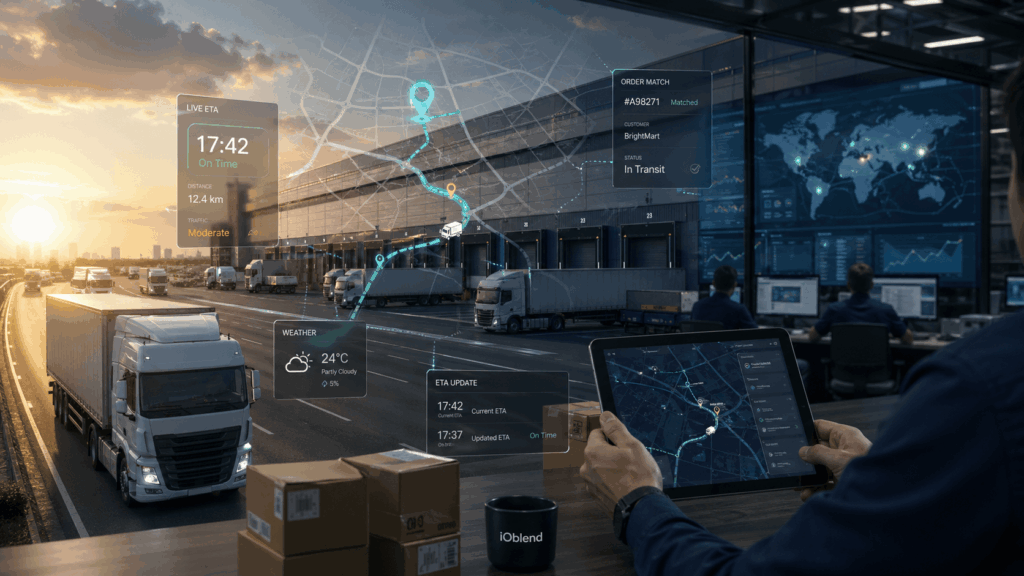
Live ETA (Estimated Time of Arrival) prediction pipelines represent the shift from reactive tracking to proactive orchestration. By fusing high-frequency telemetry data from vehicle fleets, such as GPS coordinates, engine diagnostics, and fuel consumption, with transactional order data and external variables like live traffic and weather, firms can create a dynamic digital twin of their entire logistics network. For data experts, this isn’t just about a timestamp; it’s about a continuous stream of state updates that allow for millisecond-level recalculations of delivery windows.
The Friction in the Pipeline
Building these systems is notoriously difficult due to the “velocity-variety” trap. Logistics data is inherently messy. Fleet telemetry often arrives via asynchronous MQTT streams, while order data might sit in a legacy SQL database or a modern ERP.
Common hurdles include:
- Schema Drift: When a telematics provider updates their sensor payload without notice, downstream prediction models often break silently.
- Late-Arriving Data: Handling out-of-order events from drivers moving through “dead zones” requires complex watermarking and state management.
- Feature Engineering at Scale: Calculating a “rolling average speed over the last 10 minutes” for 10,000 trucks simultaneously creates immense computational overhead.
- The Integration Gap: Most businesses struggle to join the inflight stream of a truck with the static metadata of the 500 parcels inside it, leading to “stale” predictions that frustrate end customers.
Synchronising the Stream with IOblend
This is where IOblend transforms the architectural approach. Rather than duct-taping disparate tools together, IOblend provides a unified environment to build robust DataOps pipelines that handle the rigours of live logistics.
IOblend’s platform excels at managing the complexity of real-time ETA engines:
- Unified Streaming & Batch: It seamlessly blends high-speed fleet telemetry with heavy-duty order history, ensuring your models always have the full context.
- Late Arriving Data: IOblend handles late arriving data automatically through metadata-driven rules for event time, watermarks, deduplication, controlled upserts, and selective reprocessing.
- Automated Schema Evolution: IOblend detects and manages changes in data structures automatically, preventing the pipeline failures that typically plague IoT-heavy sectors.
- Record-Level Lineage: In logistics, knowing why a prediction was wrong is as vital as the prediction itself. IOblend provides granular visibility into every data point’s journey.
- Resilient Data Engineering: By simplifying the deployment of complex transformations, IOblend allows data teams to focus on refining their ML models rather than managing infrastructure.
Stop chasing the clock and start commanding your data, deliver certainty at scale with IOblend.

Continuous Data Replication for DR and Continuity
Continuous Data Replication: for Business Continuity and DR 📝 Did you know? According to industry studies, the average cost of IT downtime is approximately £4,500 per minute. For a large enterprise, a single hour of data loss or system unavailability can translate into millions in lost revenue, legal penalties, and irreparable brand damage. The Pulse of

Smart Meter Data: Billing to Forecasting
Utilities: Smart Meter Data to Billing and Demand Forecasting 📋 Did You Know? The global roll-out of smart meters generates more data in a single day than most utility companies used to collect in an entire decade. While traditional meters were read once a month, or even once a quarter, smart meters transmit data at intervals

SCADA Streams to Reliability Analytics
Energy: SCADA Streams to Reliability Analytics 🔌 Did you know? The average modern wind turbine or smart substation generates roughly 1 to 2 terabytes of data every month. However, historically, less than 5% of that sensor data was actually used for decision-making. Most of it was simply discarded or “siloed” in SCADA systems, serving as a

Building Live ETA Pipelines for Fleet Operations
Logistics: Live ETA Prediction Pipelines from Fleet + Orders 🚚 Did you know? The “Last Mile” is famously the most expensive and inefficient part of the supply chain, often accounting for up to 53% of total shipping costs. The Evolution of Real-Time Logistics Live ETA (Estimated Time of Arrival) prediction pipelines represent the shift from reactive

DB2 CDC to Lakehouse Without Re-Platforming
From DB2 to Lakehouse: Real-Time CDC Without Re-Platforming 💻 Did you know? Mainframe systems like DB2 still process approximately 30 billion business transactions every single day. Despite the rush toward modern cloud architectures, the world’s most critical financial and logistical data often resides in these “legacy” environments, making them the silent engines of the global economy.

Real-Time Upserts: Deduping and Idempotency
Streaming Upserts Done Right: Deduping and Idempotency at Scale 💻 Did you know? In many high-velocity streaming environments, the “same” event can be sent or processed multiple times due to network retries or distributed system failures. The Art of the Upsert At its core, a streaming upsert (a portmanteau of “update” and “insert”) is the process of synchronising incoming data with an existing