
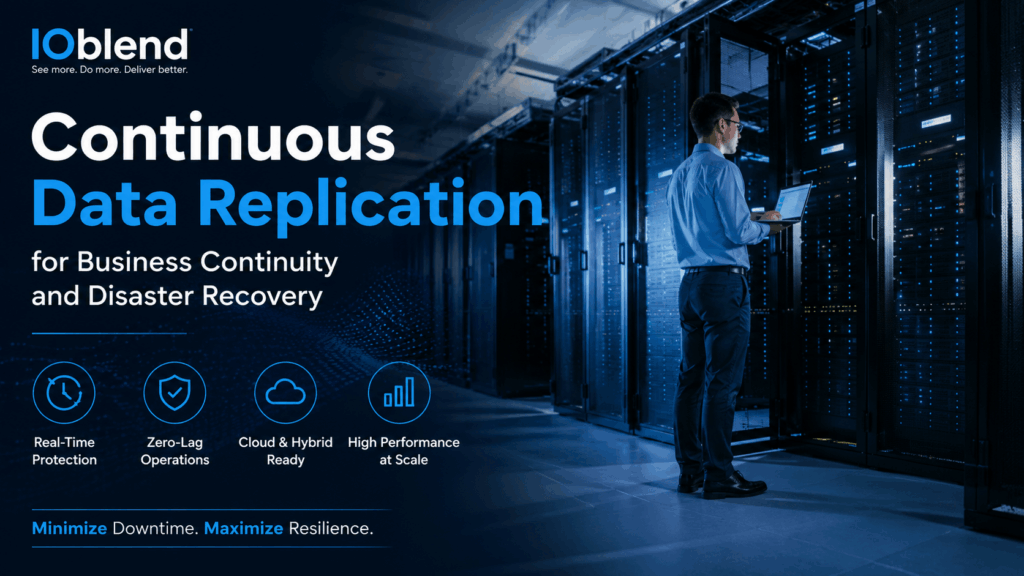
Continuous Data Replication: for Business Continuity and DRÂ
📝 Did you know? According to industry studies, the average cost of IT downtime is approximately ÂŁ4,500 per minute. For a large enterprise, a single hour of data loss or system unavailability can translate into millions in lost revenue, legal penalties, and irreparable brand damage.Â
The Pulse of AvailabilityÂ
Continuous Data Replication (CDR) is the practice of moving data between systems in real-time or near real-time, ensuring that a secondary environment always mirrors the primary one. Unlike traditional batch backups that create “snapshots” of data at specific intervals, CDR captures every change, every click, transaction, and update, as it happens. This creates a foundation for Business Continuity and Disaster Recovery (DR) where the Recovery Point Objective (RPO) is measured in seconds, not hours.Â
The High Cost of Stale DataÂ
Businesses today face a mounting wall of technical debt and operational risk when managing data protection. The most common issues include:Â
- The “Gap” of Data Loss: With batch processing, any data generated between the last backup and the moment of failure is lost forever.Â
- Performance Degradation: Traditional replication often places a heavy load on production databases, causing “stun” or latency that frustrates end-users.Â
- Complexity and Vendor Lock-in: Managing disparate tools for different clouds and on-premises systems creates a fragmented architecture that is difficult to test and even harder to fail over during a crisis.Â
- Schema Drift: If the structure of your production data changes (e.g., a new column is added), many replication tools simply break, leaving the business unprotected until a manual fix is applied.Â
Transforming Resilience with IOblendÂ
IOblend redefines the standards for continuous replication by moving away from brittle, code-heavy pipelines. It provides a “Swiss Army Knife” for data experts to build robust, production-grade pipelines that handle Disaster Recovery with ease.Â
- Real-Time CDC: IOblend utilises advanced Change Data Capture (CDC) to synchronise systems without the “5-tool stack” complexity.Â
- Zero-Lag Operations: Built on Apache Spark, IOblend offers massive throughput (over 1 million TPS), ensuring your DR site is always current without impacting production performance.Â
- Automated Integrity:Â Features like record-level lineage, de-duping, and automated schema drift handling ensure that your replicated data isn’t just there, it’s accurate and auditable.Â
- Portability:Â With JSON playbooks, your replication logic remains portable, preventing vendor lock-in and allowing for seamless cloud-to-cloud or hybrid-cloud migrations.Â
Don’t let a system failure become a business failure; secure your future and synchronise your world with IOblend.Â

Building Live ETA Pipelines for Fleet Operations
Logistics: Live ETA Prediction Pipelines from Fleet + Orders 🚚 Did you know? The “Last Mile” is famously the most expensive and inefficient part of the supply chain, often accounting for up to 53% of total shipping costs. The Evolution of
DB2 CDC to Lakehouse Without Re-Platforming
From DB2 to Lakehouse: Real-Time CDC Without Re-Platforming 💻 Did you know? Mainframe systems like DB2 still process approximately 30 billion business transactions every single day. Despite the rush toward modern cloud architectures, the world’s most critical financial and logistical data
Real-Time Upserts: Deduping and Idempotency
Streaming Upserts Done Right: Deduping and Idempotency at Scale 💻 Did you know? In many high-velocity streaming environments, the “same” event can be sent or processed multiple times due to network retries or distributed system failures. The Art of the Upsert At its core,