AW-10865990051

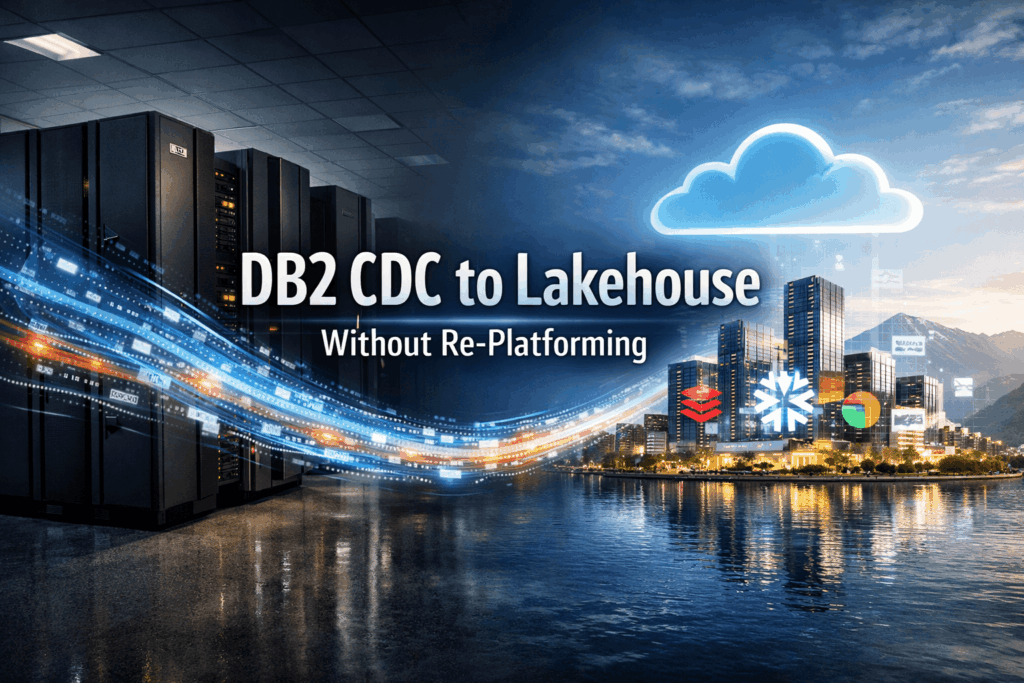
DB2 CDC to Lakehouse Without Re-Platforming

DB2-to-Lakehouse-with-CDC-IOblend

From DB2 to Lakehouse: Real-Time CDC Without Re-Platforming 

💻 Did you know? Mainframe systems like DB2 still process approximately 30 billion business transactions every single day. Despite the rush toward modern cloud architectures, the world’s most critical financial and logistical data often resides in these “legacy” environments, making them the silent engines of the global economy. 

The Concept: Bridging the Gap 

The journey from a traditional DB2 relational database to a modern Data Lakehouse is often framed as a binary choice: stay put and suffer from data latency, or undergo a multi-year “re-platforming” nightmare. Real-time Change Data Capture (CDC) offers a third way. It involves identifying and capturing every insertion, update, or deletion in the DB2 source as it happens and immediately streaming those changes to a Lakehouse (like Snowflake, Databricks, or Fabric). This creates a live, synchronised mirror of your operational data, ready for AI and analytics, without moving the original database. 

The Friction: Why Legacy Systems Stall Innovation 

Enterprises relying on DB2 frequently hit a wall when trying to feed modern analytics platforms. The primary issue is Batch Latency; waiting for nightly ETL runs means your “real-time” dashboard is actually 24 hours out of date.  

Furthermore, DB2 environments are notoriously sensitive. Traditional query-based extraction puts an immense “observer load” on the production system, slowing down the very transactions the business depends on. 

There is also the Complexity Trap: many CDC tools require installing invasive agents on the mainframe or demand bespoke coding to handle schema evolution. 

The Friction: Why The Solution: IOblend’s Modern Path 

This is where IOblend transforms the architecture. Rather than requiring a total re-platforming, IOblend provides an “AI-Forward” ingestion and transformation layer that specialises in high-speed, agentless CDC.  

Real-World Use Case: Financial Services 

Consider a bank running core ledgers on DB2. By using IOblend, they can stream transaction logs into a Lakehouse in seconds. IOblend handles the complex schema mapping and data type conversions automatically. 

How IOblend Solves the Issue: 

  • Zero-Code Engineering: IOblend replaces manual Python or SQL pipelines with an intuitive interface, allowing experts to focus on data strategy rather than plumbing. 
  • Agentless CDC: It captures changes without taxing the DB2 source, ensuring production performance remains intact. 
  • Automatic Schema Evolution: If a table structure changes in DB2, IOblend detects and propagates that change to the Lakehouse automatically, preventing pipeline failure. 
  • Unified Data Flow: IOblend merges ingestion and transformation into a single move, ensuring data is “AI-ready” the moment it hits the Lakehouse. 

Stop migrating and start innovating, unleash your legacy data with the power of IOblend. 

IOblend: See more. Do more. Deliver better.

AI
admin

IOblend JSON Playbooks: Keep Logic Portable, No Lock-In

The End of Vendor Lock-in: Keeping your logic portable with IOblend’s JSON-based playbooks and Python/SQL core 💾 Did you know? The average enterprise now uses over 350 different data sources, yet nearly 70% of data leaders feel “trapped” by their infrastructure. Recent industry reports suggest that migrating a legacy data warehouse to a new provider can

Read More »
AI
admin

Real-Time Defect Detection with Agentic AI + ETL

Smart Quality Control: Embedding Agentic AI into ETL pipelines to visually inspect and categorise production defects  🔩 Did you know? “visual drift” in manual quality control can lead to a 20% drop in defect detection accuracy over a single eight-hour shift  The Concept: Agentic AI in the ETL Stream Traditional ETL (Extract, Transform, Load) has long been the

Read More »
AI
admin

Agentic AI ETL for Real-Time Sentiment Pricing

Sentiment-Driven Pricing: Using Agentic AI ETL to scrape social sentiment and adjust prices dynamically within the data flow  🤖 Did you know? A single viral tweet or a trending TikTok “dupe” video can alter the perceived value of a product by over 40% in less than six hours. Traditional pricing engines, which rely on historical sales

Read More »
AI
admin

BCBS 239 Compliance with Record-Level Lineage

Regulatory Compliance at Scale: Automating record-level lineage and audit trails for BCBS 239  📋 Did you know? In the wake of the 2008 financial crisis, the Basel Committee found that many global banks were unable to aggregate risk exposures accurately or quickly because their data landscapes were too complex. This led to the birth of BCBS

Read More »
AI
admin

Real-Time Churn Agents with Closed-Loop MLOps

Churn Prevention: Building “closed-loop” MLOps systems that predict churn and trigger automated retention agents  🔗 Did you know? In the telecommunications and subscription-based sectors, a mere 5% increase in customer retention can lead to a staggering profit surge of more than 25%.  Closed-Loop MLOps A “closed-loop” MLOps system is an advanced architectural pattern that transcends simple predictive analytics. While

Read More »
Predicitve_Maintenance_IOblend
AI
admin

Streaming Predictive MX: Drift-Aware Inference

Predictive Maintenance 2.0: Feeding real-time sensor drifts directly into inference models using streaming engine  🔩 Did you know? The cost of unplanned downtime for industrial manufacturers is estimated at nearly £400 billion annually.  Predictive Maintenance 2.0: The Real-Time Evolution  Predictive Maintenance 2.0 represents a paradigm shift from batch-processed diagnostics to live, autonomous synchronisation. In the traditional 1.0

Read More »
Scroll to Top