
Streaming Upserts Done Right: Deduping and Idempotency at Scale
💻 Did you know? In many high-velocity streaming environments, the “same” event can be sent or processed multiple times due to network retries or distributed system failures.
The Art of the Upsert
At its core, a streaming upsert (a portmanteau of “update” and “insert”) is the process of synchronising incoming data with an existing dataset in real time. If a record with a specific primary key already exists, it is updated; if not, it is created.
To do this “right” at scale, two concepts are non-negotiable:
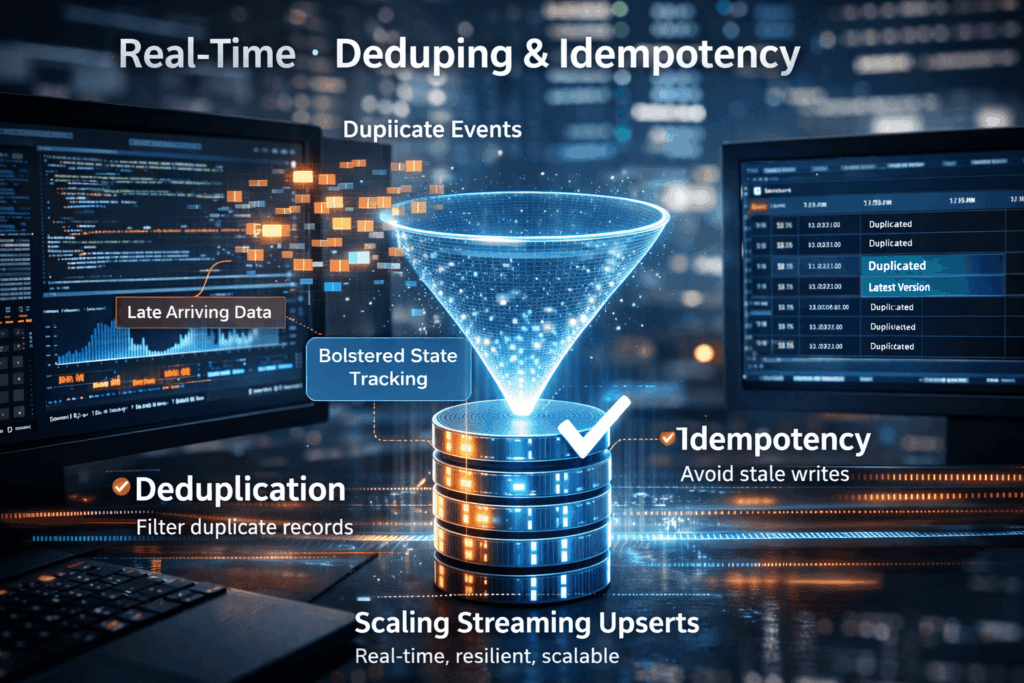
Deduplication: Removing identical redundant records before they hit the storage layer.
Idempotency: Ensuring that performing an operation multiple times has the same effect as performing it once.
The Scalability Wall: Why Businesses Struggle
Most businesses start with simple batch updates, but as they move toward real-time insights, they hit a wall. In a distributed stream (like Kafka or Kinesis), data rarely arrives in the correct order. This leads to several critical issues:
- Late-Arriving Data: An older version of a customer’s profile might arrive after a newer version. If the system blindly upserts, it “downgrades” the data to an incorrect, stale state.
- The “Double Bubble” Problem: During system spikes or restarts, producers often resend batches. Without a robust state store to track what has already been processed, the downstream database suffers from bloated storage and inaccurate analytics.
- Performance Bottlenecks: Checking for the existence of a record in a multi-terabyte table before every single write is computationally expensive. Traditional databases often crawl to a halt under the high-IOPS (Input/Output Operations Per Second) demand of a true streaming upsert.
Mastering the Stream with IOblend
IOblend solves the complexity of streaming upserts by shifting the heavy lifting away from the database and into a high-performance, “AI-Forward” data engineering tier.
Instead of writing complex, custom Spark or Flink scripts to manage state and watermarking, IOblend provides a unified interface to handle real-time data synchronisation. It natively manages:
- Automated Deduplication: Identifying and discarding redundant events at the ingestion point to save on downstream costs.
- Stateful Processing: Ensuring idempotency by keeping track of the latest version of every record, regardless of the order in which they arrive.
- Schema Evolution: Seamlessly handling changes in data structure without breaking the streaming pipeline.
By using IOblend’s advanced CDC (Change Data Capture) and streaming capabilities, businesses can move from fragile, “bolt-on” deduplication to a resilient, enterprise-grade data mesh that guarantees accuracy at any scale.
Don’t let duplicate data dilute your insights, streamline your future with IOblend.

Real-Time Upserts: Deduping and Idempotency
Streaming Upserts Done Right: Deduping and Idempotency at Scale 💻 Did you know? In many high-velocity streaming environments, the “same” event can be sent or processed multiple times due to network retries or distributed system failures. The Art of the Upsert At its core, a streaming upsert (a portmanteau of “update” and “insert”) is the process of synchronising incoming data with an existing

Streaming Data Quality That Won’t Break Pipelines
Streaming Without the Sting: Data Quality Rules That Never Break the Flow 💻 Did you know? A single minute of downtime in a high-velocity streaming environment can result in the loss of millions of data points, potentially costing a business thousands of pounds in missed opportunities or regulatory fines. — Defining Resilient Streaming Quality Data quality in

Schema Drift: The Silent Killer of Data Pipelines
The Silent Pipeline Killer: Surviving Schema Drift in the Wild 📊 Did you know? In the early days of big data, a single column change in a source database could trigger a “data graveyard” effect, where downstream analytics remained broken for weeks. The silent pipeline killer Schema drift occurs when the structure of source data changes

Preventing Data Drift in Modern Data Systems
The Invisible Erosion: Detecting and Managing Data Drift in Modern Architectures 📊 Did you know? According to recent industry surveys, over 70% of organisations experience significant data drift within the first six months of deploying a production system. The Concept of Data Drift Data drift occurs when the statistical properties or the underlying structure of incoming data change

Stream Database Changes to Your Lakehouse with CDC
Zero-Lag Operations: Stream Database Changes to Your Lakehouse 💾 Did you know? The “data downtime” caused by traditional batch processing costs the average enterprise approximately £12,000 per minute. The Concept: Moving at the Speed of Change Zero-lag operations rely on a transition from periodic “snapshots” to continuous “streams.” Instead of moving massive blocks of data at

Real-Time Salesforce CDC to Snowflake
Real-Time CDC: Keep Salesforce and Snowflake in Perfect Sync 🔎 Did you know? While many businesses still rely on nightly batch windows to move CRM data, Salesforce generates millions of events every hour. The Concept: Real-Time CDC Real-Time Change Data Capture (CDC) is a software design pattern used to determine and track data that has