LeanData Optimising Cloud Migration: for Telecoms with Agentic AI ETL
📡 Did you know? The global telecommunications industry is projected to create over £120 billion in value from agentic AI by 2026.
The Dawn of Agentic AI ETL
For data experts in the telecoms sector, the term ETL—Extract, Transform, Load—is a familiar, if often laborious, process. It’s the bedrock of any data-driven strategy, enabling the consolidation of vast, disparate datasets. Unlike traditional, rule-based automation, agentic AI employs multiple autonomous agents that work together to set goals, plan actions, and execute complex workflows with minimal human oversight. In an ETL context, these AI agents can dynamically discover, validate, and govern unstructured data, adapting to new challenges in real time and revolutionising how telcos manage their information ecosystems.
The Problem: Migrating a Mountain of Data
The ambition to migrate to the cloud is universal for telcos, promising greater scalability, flexibility, and cost efficiency. However, the path is fraught with significant hurdles, particularly when it comes to data:
- Data Volume and Velocity: Telecoms generate unimaginable quantities of data from network logs, billing systems, and customer interactions. Migrating this “data lake” is not a one-off event but a continuous, high-speed operation that legacy ETL tools simply cannot handle without significant downtime.
- Compliance and Integrity: Data integrity and security are non-negotiable. During migration, any corruption or non-compliance with regulations like GDPR can have severe financial and reputational consequences.
- Cost and Resource Strain: The sheer time and resource commitment of a manual migration can lead to budget overruns. The need for a highly skilled, specialised team to manage multiple, inflexible tools further exacerbates this issue.
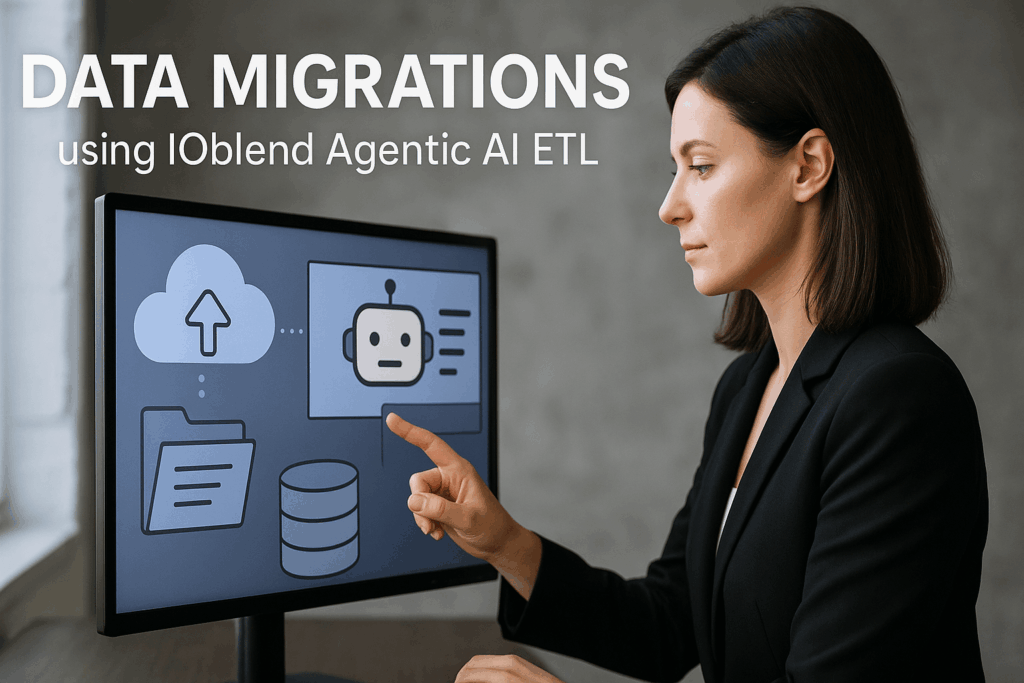
Enhancing Data Migrations with IOblend Agentic AI ETL
IOblend offers a paradigm shift, transforming the daunting task of cloud migration and ETL into a seamless, automated process.
- Autonomous Migration: IOblend’s solution uses a real-time Change Data Capture (CDC) approach to synchronise systems. This allows for the swift migration of massive data volumes and complex business logic without any downtime. Once the cloud environment is ready, the legacy systems can be securely decommissioned, a process that might have taken years in the past.
- Low-Code, High-Power ETL: The platform’s intuitive drag-and-drop interface empowers data teams to build sophisticated data pipelines rapidly. This isn’t just simple ingestion; it autogenerates optimised Apache Spark jobs, capable of handling both large-scale batch processing and real-time data streams.
- Built-in DataOps and Compliance: IOblend ensures data trust from the start. Its solution embeds automated data quality checks, robust error handling, and comprehensive audit trails and data lineage.
- Add AI agents into your migration pipelines: IOblend allows embedding of AI agents straight into the data pipelines, so you can process unstructured data, validate quality and combine with the structured datasets on-the-fly.
Revolutionise your cloud migration and ETL processes with IOblend.
IOblend presents a ground-breaking approach to IoT and data integration, revolutionizing the way businesses handle their data. It’s an all-in-one data integration accelerator, boasting real-time, production-grade, managed Apache Spark™ data pipelines that can be set up in mere minutes. This facilitates a massive acceleration in data migration projects, whether from on-prem to cloud or between clouds, thanks to its low code/no code development and automated data management and governance.
IOblend also simplifies the integration of streaming and batch data through Kappa architecture, significantly boosting the efficiency of operational analytics and MLOps. Its system enables the robust and cost-effective delivery of both centralized and federated data architectures, with low latency and massively parallelized data processing, capable of handling over 10 million transactions per second. Additionally, IOblend integrates seamlessly with leading cloud services like Snowflake and Microsoft Azure, underscoring its versatility and broad applicability in various data environments.
At its core, IOblend is an end-to-end enterprise data integration solution built with DataOps capability. It stands out as a versatile ETL product for building and managing data estates with high-grade data flows. The platform powers operational analytics and AI initiatives, drastically reducing the costs and development efforts associated with data projects and data science ventures. It’s engineered to connect to any source, perform in-memory transformations of streaming and batch data, and direct the results to any destination with minimal effort.
IOblend’s use cases are diverse and impactful. It streams live data from factories to automated forecasting models and channels data from IoT sensors to real-time monitoring applications, enabling automated decision-making based on live inputs and historical statistics. Additionally, it handles the movement of production-grade streaming and batch data to and from cloud data warehouses and lakes, powers data exchanges, and feeds applications with data that adheres to complex business rules and governance policies.
The platform comprises two core components: the IOblend Designer and the IOblend Engine. The IOblend Designer is a desktop GUI used for designing, building, and testing data pipeline DAGs, producing metadata that describes the data pipelines. The IOblend Engine, the heart of the system, converts this metadata into Spark streaming jobs executed on any Spark cluster. Available in Developer and Enterprise suites, IOblend supports both local and remote engine operations, catering to a wide range of development and operational needs. It also facilitates collaborative development and pipeline versioning, making it a robust tool for modern data management and analytics

When Enterprise Data Platforms Become Too Complex
When Enterprise Data Platforms Become Too Complex Enterprise data platforms usually start with a sensible goal: Connect the data Make it trustworthy Make it useful The problem is that, over time, the platform itself can become part of the complexity. More services are added. More specialist skills are needed. More workloads become dependent on one

Real-Time Entity Resolution for Enterprise Data and AI
Entity Resolution at Scale: Merge Duplicates as Data Moves Enterprise data rarely arrives clean. The same customer, supplier or product can exist across multiple systems under different names, IDs or formats. For reporting, this creates inconsistency. For AI and automation, it creates unreliable context. Entity resolution has traditionally been handled through batch processing. But when

Real-Time Customer 360: MDM for AI-Ready Data
Real-Time Customer 360: MDM That Keeps Data Current A Customer 360 view is only useful if the data behind it is current. Many organisations still rely on batch integration, which means customer profiles can quickly fall behind reality. As businesses adopt AI, copilots and real-time analytics, that gap becomes harder to ignore. Real-time Master Data

Data Migration QA: Checksums & Audit Trails
Migration QA at Scale: Reconciliation, Checksums, and Audit Trails 📂 Did you know that during enterprise database migrations, as much as 20% of quiet data corruption goes entirely unnoticed until post-cutover operational failures occur? Understanding migration QA at scale Migration QA at scale refers to the systematic validation of volume, structure, and integrity when shifting enterprise

Lakehouse Data Quality Gates: Stop Bad Data Fast
Lakehouse Quality Gates: Fail Fast Before Bad Data Lands 📋 Did You Know? Up to 20% of real-time event streams suffer from schema drift, duplicate payloads, or corrupted records, costing global organisations billions each year in wasted compute, broken analytical models, and polluted reporting layers. The Concept: Stopping Bad Data at the Border Lakehouse Quality Gates are automated,

Automated Data Contracts: Stop Schema Drift
Data Contracts That Stick: Enforce Schema and Expectations Automatically 📜 Did You Know? In the early days of big data, a single unannounced column type change in an upstream transactional database could trigger a catastrophic “data graveyard” effect, corrupting millions of analytics records before anyone noticed. The Concept of Enforceable Data Contracts A data contract is