The End of Vendor Lock-in: Keeping your logic portable with IOblend’s JSON-based playbooks and Python/SQL core
💾 Did you know? The average enterprise now uses over 350 different data sources, yet nearly 70% of data leaders feel “trapped” by their infrastructure. Recent industry reports suggest that migrating a legacy data warehouse to a new provider can cost up to five times the original implementation price, primarily due to proprietary code conversion.
The Concept of Portable Logic
In the modern data stack, “vendor lock-in” is the invisible tether that binds your intellectual property, your business logic, to a specific service provider’s proprietary format. IOblend disrupts this cycle by decoupling the execution engine from the logic itself. By using a combination of universal SQL, standard Python, and JSON-based playbooks, IOblend ensures that your data pipelines remain platform-agnostic. Essentially, it treats your data integration as “living code” that can be moved, audited, and executed across different environments without a total rewrite.
The High Cost of Architectural Rigidity
For many organisations, the initial ease of “drag-and-drop” ETL tools eventually turns into a technical debt nightmare. When logic is stored in a vendor’s proprietary binary format or hidden behind a “black-box” GUI, the business loses its agility.
Data experts frequently encounter these friction points:
- The Migration Tax: Switching from one cloud provider to another often requires manual translation of thousands of stored procedures.
- Skill Gaps: Teams become specialists in a specific tool’s interface rather than the data itself, making it difficult to hire or pivot.
- Opaque Version Control: Proprietary tools often struggle with Git integration, making CI/CD pipelines fragile and difficult to peer-review.
The IOblend Solution: Portability by Design
IOblend solves these challenges by providing a developer-centric framework that prioritises transparency.
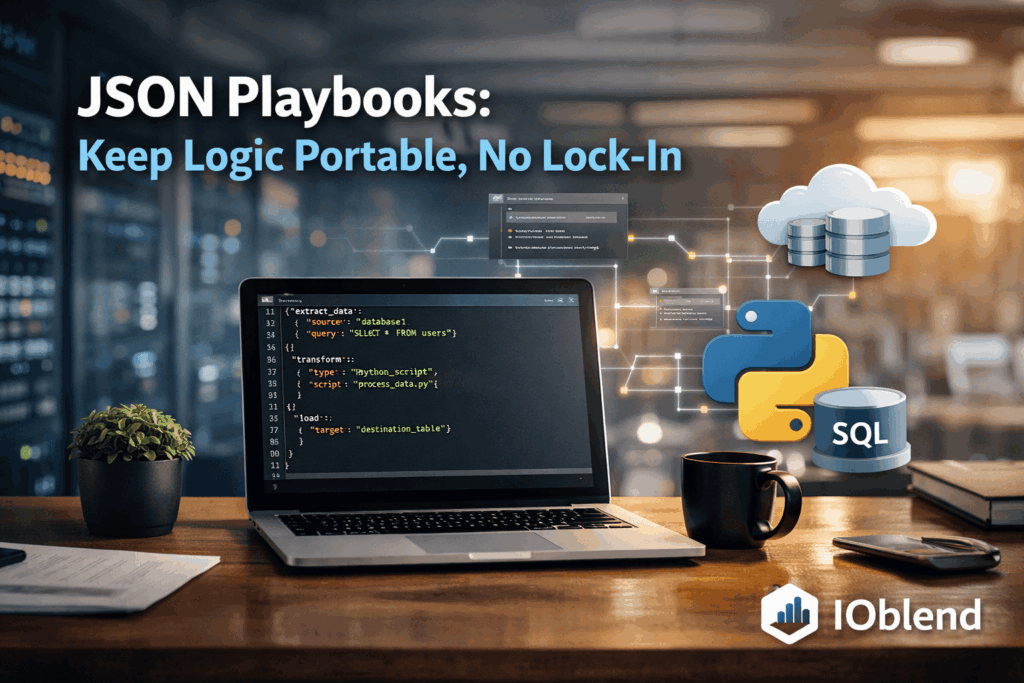
- JSON-Based Playbooks: Instead of opaque configurations, IOblend uses human-readable JSON playbooks to define pipeline stages. This means your entire workflow is documented in a standard format that can be version-controlled in Git and reviewed by any engineer.
- Python & SQL Core: By sticking to the industry-standard languages of data, SQL for transformations and Python for complex logic, IOblend ensures that your code remains your own. If you want to run a specific transformation elsewhere, the SQL block remains valid.
- Seamless Integration: IOblend’s approach allows you to build, run, and monitor pipelines at scale. By leveraging advanced metadata-driven automation, it eliminates the need for manual plumbing, allowing your team to focus on extracting value rather than managing infrastructure.
Future-proof your data strategy and break free from the shackles of legacy lock-in with IOblend.

The Proactive Shift: Harnessing Data to Transform Healthcare
The Proactive Shift: Harnessing Data to Transform Healthcare Outcomes 🔔 Did You Know? According to the National Institutes of Health, the implementation of data analytics in healthcare settings can reduce hospital readmissions by over 33%. The Proactive Healthcare Paradigm The healthcare industry has traditionally operated on a reactive model, where intervention occurs only after symptoms manifest

PoC to Production: Accelerating AI Deployment with IOblend
PoC to Production: Accelerating AI Deployment with IOblend 💭 Did You Know? While a staggering 92% of companies are actively experimenting with Artificial Intelligence, a mere 1% ever achieve full maturity in deploying AI solutions at scale. The AI Production Journey A Proof of Concept (PoC) in AI serves as a small-scale, experimental project designed

AI in Healthcare with Smart Data Pipelines
AI in Healthcare: Powering Progress with Smart Data Pipelines 💉 Did you know? Hospitals in the UK alone produce an astonishing 50 petabytes of data per year, more than double the data managed by the US Library of Congress in 2022! What are Data Pipelines for AI Model Training? In the context of healthcare, this means

The Urgency of Now: Real-Time Data in Analytics
The Urgency of Now: Real-Time Data in Analytics ✈️ Did you know? Every minute of delay in airline operations can cost as much as £100 per minute for a single aircraft. With thousands of flights daily, those minutes add up fast. Just like in aviation, in data analytics, even small delays can lead to big

Still Confused in 2025? AI, ML & Data Science Explained
Still Confused in 2025? AI, ML & Data Science Explained…finally It seems everyone in business circles talks about these days. AI will solve all our business challenges and make/save us a ton of money. AI will replace manual labour with clever agents. It will change the world and our business will be at the forefront

Beyond Spreadsheets: The CFO’s Path to Data-Driven Decisions
Beyond Spreadsheets: The CFO’s Path to Data-Driven Decisions 📊 Did you know? Companies leveraging data-driven insights consistently report a significant uplift in profitability – often exceeding 20%. That’s not just a marginal gain; it’s a game-changer. The Data-Driven CFO The modern Chief Financial Officer operates in a world awash with data. No longer solely focused