AW-10865990051

IOblend JSON Playbooks: Keep Logic Portable, No Lock-In

The End of Vendor Lock-in: Keeping your logic portable with IOblend’s JSON-based playbooks and Python/SQL core

💾 Did you know? The average enterprise now uses over 350 different data sources, yet nearly 70% of data leaders feel “trapped” by their infrastructure. Recent industry reports suggest that migrating a legacy data warehouse to a new provider can cost up to five times the original implementation price, primarily due to proprietary code conversion. 

The Concept of Portable Logic 

In the modern data stack, “vendor lock-in” is the invisible tether that binds your intellectual property, your business logic, to a specific service provider’s proprietary format. IOblend disrupts this cycle by decoupling the execution engine from the logic itself. By using a combination of universal SQL, standard Python, and JSON-based playbooks, IOblend ensures that your data pipelines remain platform-agnostic. Essentially, it treats your data integration as “living code” that can be moved, audited, and executed across different environments without a total rewrite. 

The High Cost of Architectural Rigidity 

For many organisations, the initial ease of “drag-and-drop” ETL tools eventually turns into a technical debt nightmare. When logic is stored in a vendor’s proprietary binary format or hidden behind a “black-box” GUI, the business loses its agility. 

Data experts frequently encounter these friction points:

  • The Migration Tax: Switching from one cloud provider to another often requires manual translation of thousands of stored procedures. 
  • Skill Gaps: Teams become specialists in a specific tool’s interface rather than the data itself, making it difficult to hire or pivot. 
  • Opaque Version Control: Proprietary tools often struggle with Git integration, making CI/CD pipelines fragile and difficult to peer-review. 

The IOblend Solution: Portability by Design 

IOblend solves these challenges by providing a developer-centric framework that prioritises transparency. 

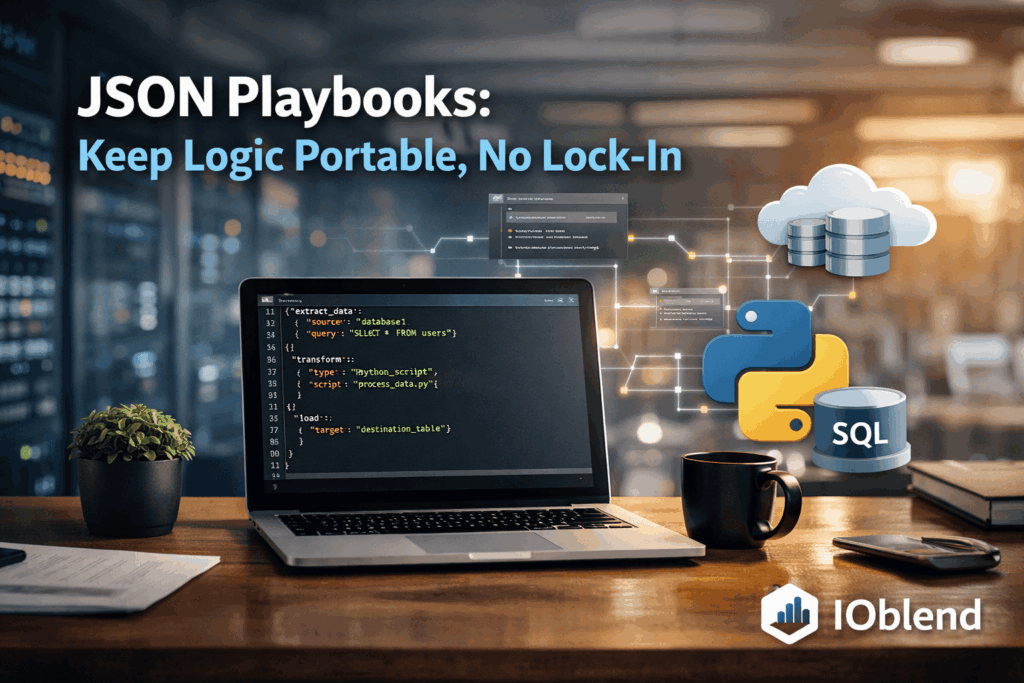
  • JSON-Based Playbooks: Instead of opaque configurations, IOblend uses human-readable JSON playbooks to define pipeline stages. This means your entire workflow is documented in a standard format that can be version-controlled in Git and reviewed by any engineer. 
  • Python & SQL Core: By sticking to the industry-standard languages of data, SQL for transformations and Python for complex logic, IOblend ensures that your code remains your own. If you want to run a specific transformation elsewhere, the SQL block remains valid. 
  • Seamless Integration: IOblend’s approach allows you to build, run, and monitor pipelines at scale. By leveraging advanced metadata-driven automation, it eliminates the need for manual plumbing, allowing your team to focus on extracting value rather than managing infrastructure. 

Future-proof your data strategy and break free from the shackles of legacy lock-in with IOblend. 

IOblend: See more. Do more. Deliver better.

DB2-to-Lakehouse-with-CDC-IOblend
AI
admin

DB2 CDC to Lakehouse Without Re-Platforming

From DB2 to Lakehouse: Real-Time CDC Without Re-Platforming  💻 Did you know? Mainframe systems like DB2 still process approximately 30 billion business transactions every single day. Despite the rush toward modern cloud architectures, the world’s most critical financial and logistical data often resides in these “legacy” environments, making them the silent engines of the global economy. 

Read More »
Real-time-data-processing-with-deduplication
AI
admin

Real-Time Upserts: Deduping and Idempotency

Streaming Upserts Done Right: Deduping and Idempotency at Scale  💻 Did you know? In many high-velocity streaming environments, the “same” event can be sent or processed multiple times due to network retries or distributed system failures.  The Art of the Upsert  At its core, a streaming upsert (a portmanteau of “update” and “insert”) is the process of synchronising incoming data with an existing

Read More »
Optimising-data-streams-and-analytics-with-IOblend
AI
admin

Streaming Data Quality That Won’t Break Pipelines

Streaming Without the Sting: Data Quality Rules That Never Break the Flow  💻 Did you know? A single minute of downtime in a high-velocity streaming environment can result in the loss of millions of data points, potentially costing a business thousands of pounds in missed opportunities or regulatory fines. —  Defining Resilient Streaming Quality  Data quality in

Read More »
schema-drift-handling-with-IOblend
AI
admin

Schema Drift: The Silent Killer of Data Pipelines

The Silent Pipeline Killer: Surviving Schema Drift in the Wild  📊 Did you know? In the early days of big data, a single column change in a source database could trigger a “data graveyard” effect, where downstream analytics remained broken for weeks.  The silent pipeline killer  Schema drift occurs when the structure of source data changes

Read More »
Drift-detection-in-data-systems-IOblend
AI
admin

Preventing Data Drift in Modern Data Systems

The Invisible Erosion: Detecting and Managing Data Drift in Modern Architectures  📊 Did you know? According to recent industry surveys, over 70% of organisations experience significant data drift within the first six months of deploying a production system.  The Concept of Data Drift  Data drift occurs when the statistical properties or the underlying structure of incoming data change

Read More »
CDC-steam-to-lakehouses-IOblend
AI
admin

Stream Database Changes to Your Lakehouse with CDC

Zero-Lag Operations: Stream Database Changes to Your Lakehouse  💾 Did you know? The “data downtime” caused by traditional batch processing costs the average enterprise approximately £12,000 per minute.  The Concept: Moving at the Speed of Change  Zero-lag operations rely on a transition from periodic “snapshots” to continuous “streams.” Instead of moving massive blocks of data at

Read More »
Scroll to Top