The End of Vendor Lock-in: Keeping your logic portable with IOblend’s JSON-based playbooks and Python/SQL core
💾 Did you know? The average enterprise now uses over 350 different data sources, yet nearly 70% of data leaders feel “trapped” by their infrastructure. Recent industry reports suggest that migrating a legacy data warehouse to a new provider can cost up to five times the original implementation price, primarily due to proprietary code conversion.
The Concept of Portable Logic
In the modern data stack, “vendor lock-in” is the invisible tether that binds your intellectual property, your business logic, to a specific service provider’s proprietary format. IOblend disrupts this cycle by decoupling the execution engine from the logic itself. By using a combination of universal SQL, standard Python, and JSON-based playbooks, IOblend ensures that your data pipelines remain platform-agnostic. Essentially, it treats your data integration as “living code” that can be moved, audited, and executed across different environments without a total rewrite.
The High Cost of Architectural Rigidity
For many organisations, the initial ease of “drag-and-drop” ETL tools eventually turns into a technical debt nightmare. When logic is stored in a vendor’s proprietary binary format or hidden behind a “black-box” GUI, the business loses its agility.
Data experts frequently encounter these friction points:
- The Migration Tax: Switching from one cloud provider to another often requires manual translation of thousands of stored procedures.
- Skill Gaps: Teams become specialists in a specific tool’s interface rather than the data itself, making it difficult to hire or pivot.
- Opaque Version Control: Proprietary tools often struggle with Git integration, making CI/CD pipelines fragile and difficult to peer-review.
The IOblend Solution: Portability by Design
IOblend solves these challenges by providing a developer-centric framework that prioritises transparency.
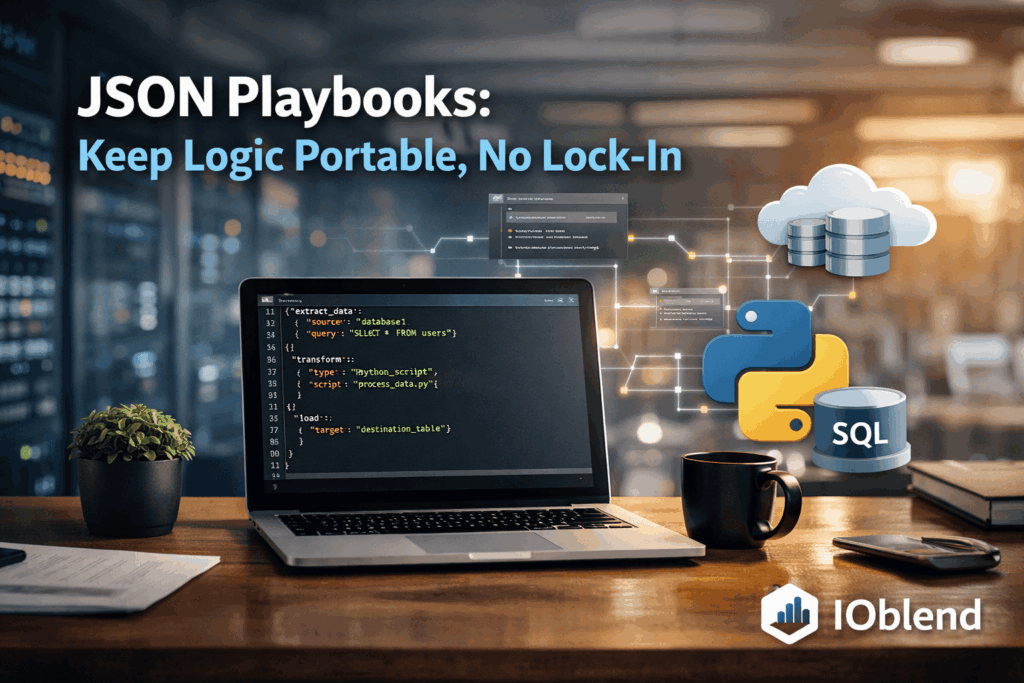
- JSON-Based Playbooks: Instead of opaque configurations, IOblend uses human-readable JSON playbooks to define pipeline stages. This means your entire workflow is documented in a standard format that can be version-controlled in Git and reviewed by any engineer.
- Python & SQL Core: By sticking to the industry-standard languages of data, SQL for transformations and Python for complex logic, IOblend ensures that your code remains your own. If you want to run a specific transformation elsewhere, the SQL block remains valid.
- Seamless Integration: IOblend’s approach allows you to build, run, and monitor pipelines at scale. By leveraging advanced metadata-driven automation, it eliminates the need for manual plumbing, allowing your team to focus on extracting value rather than managing infrastructure.
Future-proof your data strategy and break free from the shackles of legacy lock-in with IOblend.

IOblend: Simplifying Feature Stores for Modern MLOps
IOblend: Simplifying Feature Stores for Modern MLOps Feature stores emerged to solve a real challenge in machine learning: managing features across models, maintaining consistency between training and inference, and ensuring proper governance. To meet this need, many solutions introduced new infrastructure layers—Redis, DynamoDB, Feast-style APIs, and others. While these tools provided powerful capabilities, they also

Rethinking the Feature Store concept for MLOps
Rethinking the Feature Store concept for MLOps Today we talk about Feature Stores. The recent Databricks acquisition of Tecton raised an interesting question for us: can we make a feature store work with any infra just as easily as a dedicated system using IOblend? Let’s have a look. How a Feature Store Works Today Machine

CRM + ERP: Powering Predictive Analytics
The Data-Driven Value Chain: Predictive Analytics with CRM and ERP 📊 Did you know? A study on real-time data integration platforms revealed that organisations can reduce their average response time to supply chain disruptions from 5.2 hours to just 37 minutes. A Unified Data Landscape The modern value chain is a complex ecosystem where every component is interconnected,

Enhancing Data Migrations with IOblend Agentic AI ETL
LeanData Optimising Cloud Migration: for Telecoms with Agentic AI ETL 📡 Did you know? The global telecommunications industry is projected to create over £120 billion in value from agentic AI by 2026. The Dawn of Agentic AI ETL For data experts in the telecoms sector, the term ETL—Extract, Transform, Load—is a familiar, if often laborious, process. It’s

LeanData: Reduce Data Waste & Boost Efficiency
LeanData Strategy: Reduce Data Waste & Boost Efficiency | IOblend 📊 Did you know? Globally, we generate around 50 million tonnes of e-waste every year. What is LeanData? LeanData is more than a passing trend — it’s a disciplined, results-focused approach to data management.At its core, LeanData means shifting from a “collect everything, sort it later” mentality to

The Data Deluge: Are You Ready?
The Data Deluge: Are You Ready? 📰 Did you know? Some modern data centres are being designed with modularity in mind, allowing them to expand upwards – effectively “raising the roof” – to accommodate future increases in data demand without significant structural overhauls. — Raising the data roof refers to designing and implementing a data