AW-10865990051
Real-time Customer 360 · MDM · identity resolution

Build a Customer 360 that stays current.

IOblend builds real-time Customer 360 data pipelines that combine CRM, ERP, billing, support, transaction and behavioural data into a governed customer golden record. Use batch, streaming and Change Data Capture together, resolve duplicate identities, preserve customer history and continuously deliver trusted customer context to analytics, applications and AI—without replacing the systems that already run the business.

Customer 360 single customer view customer data integration Master Data Management identity resolution CDC SCD Type I / II
Real-time Customer 360 and Master Data Management with a governed customer golden record for analytics and AI
Existing IOblend WordPress media asset: Real-Time Customer 360 and MDM for AI-ready customer data.
CUSTOMER SYSTEMSCRM · ERP · billing · orders · support · web · apps
IOBLEND CUSTOMER DATA LAYERmatch · dedupe · validate · merge · maintain history
TRUSTED CUSTOMER CONTEXTanalytics · AI · CRM · service · applications
What is Customer 360?

One customer. Many systems. One trusted identity.

A Customer 360 is a continuously maintained view of a customer assembled from the systems that each hold part of the relationship. The goal is not simply to copy everything into one database. It is to determine which records belong to the same person or organisation, resolve conflicting values, preserve useful history and make a trusted version available wherever the business needs it.

SalesCRMAccounts · contacts · opportunities · activities
FinanceERP + billingInvoices · payments · contracts · account status
CommerceOrdersPurchases · returns · subscriptions · product history
ExperienceSupportCases · service interactions · complaints · resolutions
DigitalWeb + appsSessions · behaviour · events · preferences
EngagementMarketingCampaigns · responses · consent · channel activity
Customer 360 is a data integration and identity problem before it is a dashboard problem. If identities, history and quality are inconsistent upstream, a more sophisticated BI or AI layer simply makes the inconsistency easier to see.
The fragmented identity problem

Customer data is usually complete only after the systems disagree.

A CRM may know the contact owner. Billing knows what the customer pays. Support knows what went wrong. Ecommerce knows what they bought. Marketing knows what they clicked. The Customer 360 problem is joining those fragments without creating another ambiguous pile of records.

Duplicate identitiesThe same customer appears under different IDs, names, email addresses or account structures.
Conflicting attributesSystems disagree about address, status, segment, owner or preferred contact details.
Stale profilesScheduled batch jobs mean the “single view” can already be out of date when somebody uses it.
Missing contextAI, analytics and service teams see one system’s version of the customer rather than the relationship as a whole.
Customer data integration challenge illustrated as fragmented puzzle pieces that must be matched into a coherent customer view
Existing IOblend WordPress media asset: fragmented enterprise data as a matching problem.
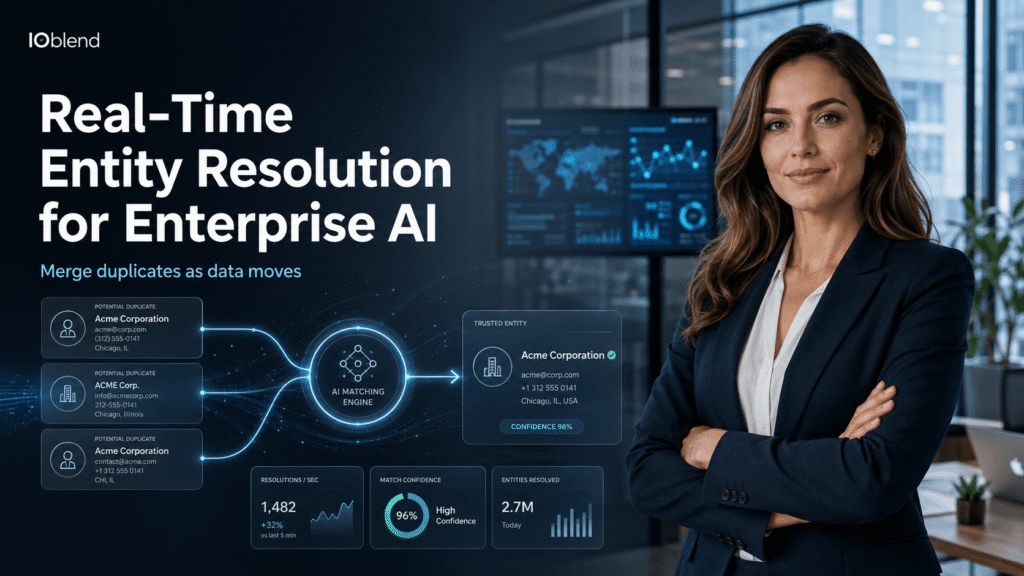
Real-time entity resolution matching duplicate customer identities into a trusted enterprise record
Existing IOblend WordPress media asset: real-time entity resolution for trusted enterprise identities.
Real-time identity resolution

Resolve the customer while the data is moving.

IOblend can apply matching, deduplication, enrichment and validation directly in the production data flow. A new record can be classified as a new customer, a known customer update, a duplicate or an exception before it reaches the golden record, analytics layer or AI application.

Deterministic matchingCustomer IDs, email addresses, telephone numbers, account numbers and composite keys.
NormalisationStandardise names, addresses, formats and reference values before comparison.
Fuzzy / advanced logicUse SQL, Python or assisted matching logic where exact business keys are not enough.
Exception routingQuarantine ambiguous records instead of silently merging the wrong identities.
Read the entity-resolution deep dive →
The Customer 360 lifecycle

A golden record is a process, not a one-time merge.

A useful single customer view stays alive as source systems change. The pipeline must ingest new information, resolve identity, decide which values survive, maintain history and republish the trusted profile continuously.

01

Ingest

Bring together batch history, CDC changes and live customer events.

02

Normalise

Standardise keys, formats, names, addresses and reference values.

03

Match

Determine which records represent the same customer or account.

04

Survive

Apply rules that decide which source value becomes trusted.

05

Historise

Preserve changes where business history matters using SCD patterns.

06

Validate

Check quality, schema and business expectations before publication.

07

Activate

Deliver current customer context to CRM, analytics, AI and applications.

Modern Customer 360 pattern: source systems → CDC/events → quality → identity resolution → golden record → analytics, applications and AI. The customer profile stays aligned with the business instead of becoming another historical snapshot.
Master Data Management in the flow

Keep the present accurate without losing the past.

Customer master data changes continuously. IOblend supports the state, matching and history patterns needed to maintain a current golden record while preserving the changes that still matter to reporting, operations and AI.

Current state

SCD Type I

Replace outdated attributes when the business only needs the latest trusted value.

History

SCD Type II

Preserve historical versions where customer segment, status or relationship changes must remain traceable.

Identity

Dedup + MDM merge

Collapse duplicates and apply survivorship rules to build one trusted representation from multiple source records.

Freshness

CDC + state

Update the customer view from inserts, changes and deletes without rebuilding the full profile dataset every time.

The golden record does not need to live in an IOblend-owned database. IOblend can maintain the logic and state required to construct it, then materialise or synchronise the trusted customer record into the CRM, warehouse, lakehouse, application or other destination chosen by the enterprise.
Activate the customer view

A single customer view only matters when the rest of the business can use it.

Customer 360 should not become another passive repository. The trusted identity and customer history need to be consumable by the systems making decisions, serving customers and running analytics.

Sales

CRM

Give account teams the current customer state across billing, service, transactions and engagement.

Service

Support

Provide interaction and account context without forcing agents to search multiple operational systems.

Insights

Analytics

Calculate value, churn, journey and segment metrics from one resolved identity instead of duplicate customer rows.

Intelligence

AI + models

Give assistants, agents and predictive models a governed customer context that stays aligned with source changes.

Operations

Applications

Synchronise trusted attributes back into operational applications when the business process requires them.

Customer 360 for enterprise AI

AI needs one customer—not five conflicting versions of the same customer.

Customer 360 is increasingly an AI-readiness problem. Assistants, agents, recommendation models and predictive services cannot reason reliably about the customer if transactions, preferences, service history and account state are split across duplicate identities or stale batch snapshots.

Current contextCDC and streaming keep the profile closer to the operational truth than periodic full refreshes alone.
Resolved identityAI consumes activity against one trusted entity instead of double-counting behaviour across duplicates.
History with meaningSCD and state patterns make it possible to understand how the customer relationship changed—not only the latest value.
Quality before inferenceInvalid or ambiguous records can be quarantined before they become AI context.
Read the Real-Time Customer 360 / AI-ready data deep dive →
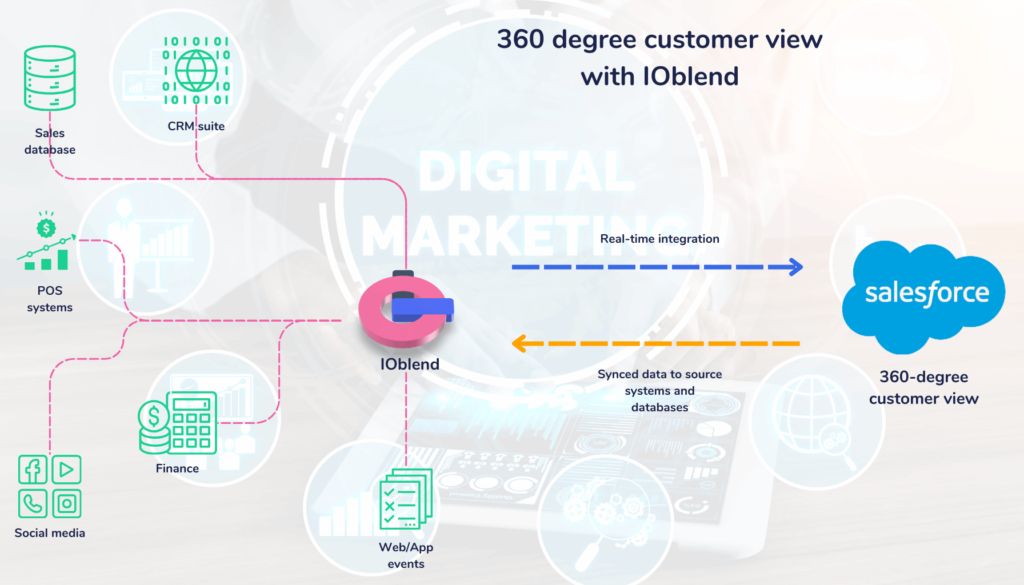
IOblend 360 degree customer view connecting customer systems and synchronising trusted data to Salesforce and analytics
Existing IOblend WordPress media asset: multi-system customer data integration and 360-degree customer context.
Illustrative Customer 360 pattern

CRM + billing + support + ecommerce → one governed customer identity.

A Customer 360 does not have to centralise every application. IOblend can resolve and maintain customer identity while the source systems continue doing the jobs they were bought to do.

CRMaccount · contact · sales activity
BILLINGinvoice · payment · contract
SUPPORTcase · interaction · outcome
ECOMMERCEorder · return · product behaviour
IOblend customer data layer

Resolve → merge → historise → validate

Batch history and live changes are normalised, matched to the customer identity, governed by survivorship rules and checked before the golden record is updated.

CRM VIEWtrusted current account context
ANALYTICSresolved customer journeys + value
AI / AGENTSgoverned enterprise customer context
OPERATIONSsynchronised customer attributes
Illustrative architecture. The important design choice is that identity logic stays reusable and independent of any one CRM, warehouse, lakehouse or AI platform.
Trust the customer record

Customer data governance belongs inside the flow that creates the record.

A golden record is useful only if teams understand why it is trusted. Quality, lineage, schema expectations and exception handling should be part of the Customer 360 pipeline—not documentation somebody has to reconstruct later.

Record-level lineageTrace the trusted customer attribute back through source, transformation and merge logic.
Survivorship rulesMake explicit which source wins when systems disagree about an attribute.
Schema controlsDetect unexpected structural changes before they silently corrupt customer profiles downstream.
Quality gatesValidate customer records while they move and quarantine failures without stopping healthy data.
Exception historyRetain context around ambiguous matches and failed records so they can be corrected and replayed.
Versioned logicKeep matching, transformation and identity rules testable and comparable as customer data requirements evolve.
The trust model should be explainable: this is the customer identity, these records contributed to it, these rules decided which values survived, this is how the profile changed, and these exceptions were kept out of the trusted path.
Customer 360 FAQ

Questions data leaders ask before building a single customer view.

The answers below focus on identity, freshness, MDM and production data engineering—the parts of Customer 360 that determine whether the final customer view can actually be trusted.

Customer 360single customer viewcustomer golden recordreal-time MDMidentity resolutioncustomer data integration
What is a Customer 360?

A Customer 360 is a unified, governed view of a customer assembled from multiple enterprise systems. It connects customer identity, transactions, account data, service interactions, behaviour and history so analytics, operational teams and AI systems work from the same trusted context.

What is the difference between Customer 360 and a CRM?

A CRM is an operational application for managing sales and customer relationships. A Customer 360 integrates data from the CRM plus other systems such as ERP, billing, ecommerce, support and digital channels. The result can be written back to CRM, delivered to analytics, or consumed elsewhere without requiring the CRM to become the integration platform for the whole enterprise.

What is a customer golden record?

A customer golden record is the trusted representation of a customer created after source records have been normalised, matched, deduplicated and reconciled. Survivorship rules determine which attributes become authoritative, while history can be preserved where the business needs to understand change over time.

How does identity resolution work in Customer 360?

Identity resolution determines which records refer to the same real-world customer. Matching can use deterministic keys such as customer ID, email and telephone number, composite business rules, normalisation and more advanced logic for ambiguous cases. IOblend can run that matching while data moves through the pipeline rather than waiting for a separate downstream clean-up process.

How does Change Data Capture keep Customer 360 current?

CDC captures inserts, updates and deletes from operational systems as the underlying records change. IOblend can process those changes incrementally, update identity and state, and maintain the customer golden record without repeatedly rebuilding the entire Customer 360 dataset.

Can IOblend combine batch history and real-time customer data?

Yes. Historical batch data, CDC events and streaming interactions can be processed within the same IOblend pipeline model. This allows teams to establish the customer history first and then keep it current with live operational changes.

How are duplicate customers handled?

IOblend can apply deduplication and MDM merge logic in the pipeline. Records can be matched, merged or quarantined based on business rules. Ambiguous matches do not have to be silently forced into the golden record; they can be isolated with enough lineage and context for review.

How does Customer 360 preserve customer history?

IOblend supports Slowly Changing Dimension patterns including SCD Type I and Type II. Type I is useful where the latest trusted value should replace the old value. Type II preserves historical versions where changes in customer status, segment or other attributes need to remain traceable.

Does IOblend replace Salesforce, Dynamics 365 or a CDP?

No. IOblend is the production data integration and DataOps layer. Existing CRM, customer-data, warehouse, lakehouse and AI platforms can remain in place. IOblend connects those systems, resolves and governs the customer data, and delivers the resulting context to the destination chosen by the enterprise.

Why does Customer 360 matter for AI?

AI systems need resolved, current customer context. If one customer exists as several duplicate identities, recommendations can be inconsistent, lifetime value can be double-counted and service or account history can be incomplete. A governed Customer 360 gives AI and agents a more reliable entity on which to reason.

Where can the Customer 360 golden record be stored?

The golden record can be materialised into a CRM, warehouse, lakehouse, operational database or other supported destination. IOblend does not require a new proprietary storage tier in order to maintain the customer-integration logic.

When is IOblend a strong fit for Customer 360?

IOblend is a strong fit when customer data is distributed across multiple operational systems, needs to stay current, requires identity resolution or historical state, and must serve several consumers such as CRM, analytics, applications and AI without replacing the existing data estate.


Build the view around your customer—not your software stack

Bring us the systems that disagree about the customer.

We can map the identity keys, source priorities, history rules, update cadence and downstream consumers—then turn them into a production Customer 360 pipeline that fits the enterprise estate you already have.

Scroll to Top