
AW-10865990051

LeanData: Reduce Data Waste & Boost Efficiency

data integration IOblend

LeanData Strategy: Reduce Data Waste & Boost Efficiency | IOblend

📊 Did you know? Globally, we generate around 50 million tonnes of e-waste every year. 

What is LeanData?

LeanData is more than a passing trend — it’s a disciplined, results-focused approach to data management.
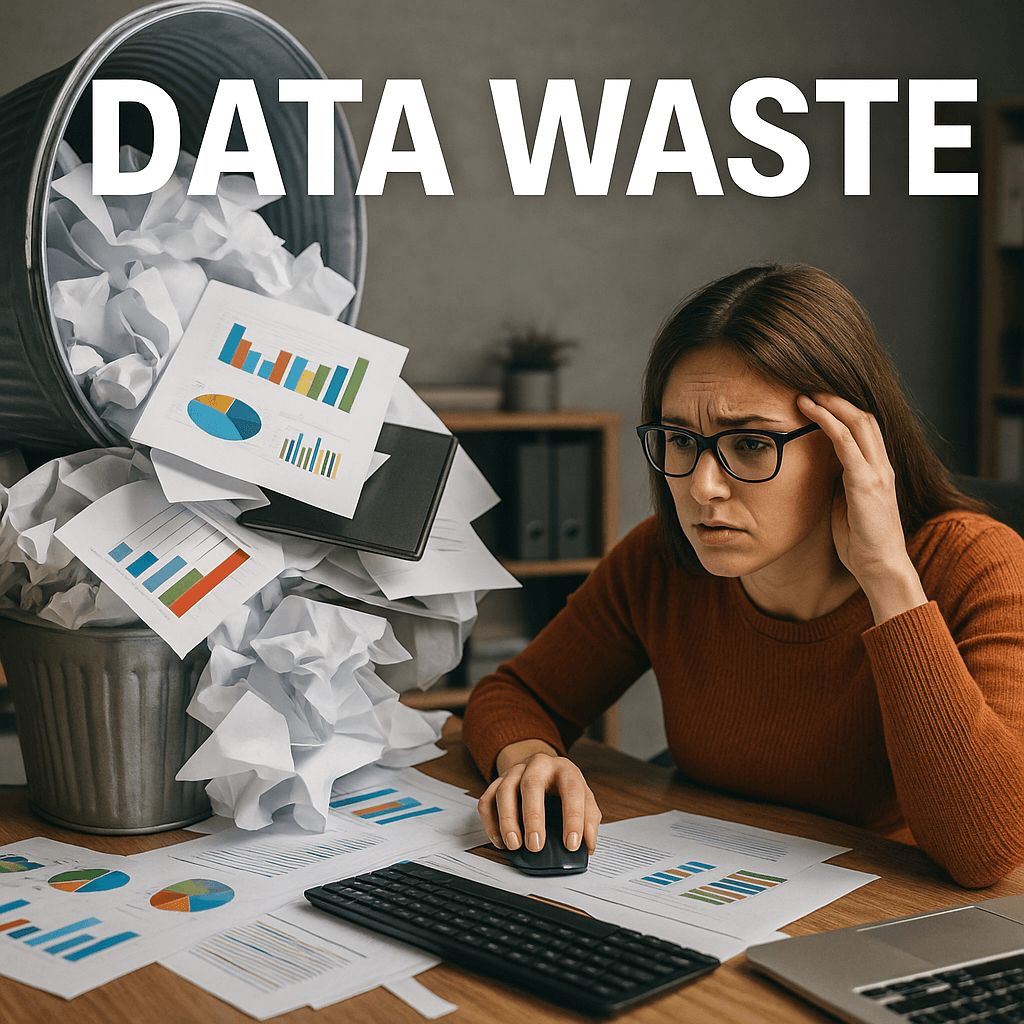
At its core, LeanData means shifting from a “collect everything, sort it later” mentality to a “collect only what matters” mindset.

Instead of hoarding terabytes of low-value information, organisations implementing LeanData prioritise data that is accurate, relevant, and actionable. This allows teams to make decisions faster, reduce storage costs, and free up resources for innovation rather than maintenance.

Think of it as data minimalism — but with maximum impact. Just like a lean manufacturing process removes unnecessary steps to improve output, LeanData removes irrelevant or poor-quality data from your workflow, leaving only the information that drives measurable results.

Core principles of LeanData include:

  • Value Over Volume – Focus on datasets that directly support business objectives and strategic initiatives.
  • Continuous Quality Improvement – Regularly cleanse, validate, and enrich data to maintain accuracy.
  • Operational Efficiency – Automate repetitive data handling tasks to reduce human error and free up skilled staff for higher-value work.
  • Sustainability in Data Practices – Minimise “data waste” to cut energy costs, reduce infrastructure strain, and lower your digital carbon footprint.

In a world where bad data can cost companies up to 20% of their revenue (Gartner), LeanData isn’t just an efficiency tactic — it’s a competitive advantage.

How IOblend Delivers the LeanData Advantage:

IOblend provides powerful DataOps capabilities that act as a “LeanData turbocharger”, helping businesses eliminate waste and unlock the full value of their data.

Smart Data Integration – Automates data flow across all sources with real-time Change Data Capture (CDC), ensuring fresh, up-to-date data without manual intervention.

Built-in Data Quality & Governance – Delivers automated lineage tracking, error handling, audit trails, and quality checks to turn messy datasets into analytics-ready, compliant data.

Low-Code/No-Code Efficiency – Enables rapid creation and deployment of optimised Apache Spark jobs, cutting development time and reducing operational drag.

AI-Ready Data – Guarantees reliable training and inference data for AI models. Uses Agentic AI to merge structured and unstructured data on the fly, automatically processing documents to extract untapped insights and ground them with the structured data.

Unlock the power of your data. Minimise waste. Maximise value.

Discover how the LeanData approach with IOblend can transform your business operations.

Get in touch today!

IOblend — See more. Do more. Deliver better.

IOblend presents a ground-breaking approach to IoT and data integration, revolutionizing the way businesses handle their data. It’s an all-in-one data integration accelerator, boasting real-time, production-grade, managed Apache Spark™ data pipelines that can be set up in mere minutes. This facilitates a massive acceleration in data migration projects, whether from on-prem to cloud or between clouds, thanks to its low code/no code development and automated data management and governance.

IOblend also simplifies the integration of streaming and batch data through Kappa architecture, significantly boosting the efficiency of operational analytics and MLOps. Its system enables the robust and cost-effective delivery of both centralized and federated data architectures, with low latency and massively parallelized data processing, capable of handling over 10 million transactions per second. Additionally, IOblend integrates seamlessly with leading cloud services like Snowflake and Microsoft Azure, underscoring its versatility and broad applicability in various data environments.

At its core, IOblend is an end-to-end enterprise data integration solution built with DataOps capability. It stands out as a versatile ETL product for building and managing data estates with high-grade data flows. The platform powers operational analytics and AI initiatives, drastically reducing the costs and development efforts associated with data projects and data science ventures. It’s engineered to connect to any source, perform in-memory transformations of streaming and batch data, and direct the results to any destination with minimal effort.

IOblend’s use cases are diverse and impactful. It streams live data from factories to automated forecasting models and channels data from IoT sensors to real-time monitoring applications, enabling automated decision-making based on live inputs and historical statistics. Additionally, it handles the movement of production-grade streaming and batch data to and from cloud data warehouses and lakes, powers data exchanges, and feeds applications with data that adheres to complex business rules and governance policies.

The platform comprises two core components: the IOblend Designer and the IOblend Engine. The IOblend Designer is a desktop GUI used for designing, building, and testing data pipeline DAGs, producing metadata that describes the data pipelines. The IOblend Engine, the heart of the system, converts this metadata into Spark streaming jobs executed on any Spark cluster. Available in Developer and Enterprise suites, IOblend supports both local and remote engine operations, catering to a wide range of development and operational needs. It also facilitates collaborative development and pipeline versioning, making it a robust tool for modern data management and analytics

Real-time-CDC-pipelines-into-Delta-tables-IOblend
AI
admin

Real-Time CDC to Databricks Delta Tables

Realtime Ingestion to Databricks: From Source to Delta Tables  💽 Did you know? According to industry surveys, nearly eighty per cent of an enterprise’s data budget is consumed purely by data integration and upfront data wrangling rather than actual analytics.  Defining real-time ingestion  Real-time ingestion to Databricks represents the technical evolution from rigid scheduled batch processing

Read More »
Cloud migration de-risked with parallel runs IOblend
Data analytics
admin

De-Risk Cloud Migration with Parallel Runs

De-Risk Your Migration: Run Legacy and New Systems in Parallel  💻 Did you know? An alarming 83% of data migrations either fail outright or drastically overrun their budgets. When management loses patience with mounting technical friction, entire digital transformations are written off.  Minimising the migration gamble  To eliminate this operational hazard, running legacy and new systems in

Read More »
Governed and auditable data pipelines with IOblend
AI
admin

Compliance DataOps for Auditable Pipelines

Compliance-Friendly DataOps: Repeatable, Reviewable, Versioned Pipelines  📓 Did you know? According to industry compliance reports, nearly 70% of businesses face difficulties tracing their data back to its raw origins during regular regulatory audits.  The Concept of Compliance-Friendly DataOps  Compliance-friendly DataOps represents an operational framework that embeds strict regulatory governance directly into the data engineering lifecycle. Instead of treating data auditing

Read More »
DR-and-continuity-with-IOblend
AI
admin

Continuous Data Replication for DR and Continuity

Continuous Data Replication: for Business Continuity and DR  📝 Did you know? According to industry studies, the average cost of IT downtime is approximately £4,500 per minute. For a large enterprise, a single hour of data loss or system unavailability can translate into millions in lost revenue, legal penalties, and irreparable brand damage.  The Pulse of

Read More »
Smart meter billing and AI forecasting with IOblend
AI
admin

Smart Meter Data: Billing to Forecasting

Utilities: Smart Meter Data to Billing and Demand Forecasting  📋 Did You Know? The global roll-out of smart meters generates more data in a single day than most utility companies used to collect in an entire decade. While traditional meters were read once a month, or even once a quarter, smart meters transmit data at intervals

Read More »
SCADA streams with IOblend
AI
admin

SCADA Streams to Reliability Analytics

Energy: SCADA Streams to Reliability Analytics  🔌 Did you know? The average modern wind turbine or smart substation generates roughly 1 to 2 terabytes of data every month. However, historically, less than 5% of that sensor data was actually used for decision-making. Most of it was simply discarded or “siloed” in SCADA systems, serving as a

Read More »
Scroll to Top