

Mind the Gap: Bridging Data Silos to Unlock Organisational Insight
💾 Did you know? Back in the early days of computing, data integration often involved physically moving punch cards between different machines – a rather less streamlined approach than what we have today!
Piecing Together the Data Puzzle
At its core, data integration is about connecting the dots—bringing together disparate datasets from multiple systems to form a coherent, comprehensive view. Think of it like assembling a jigsaw puzzle. Each data point—on its own—might show a piece of the picture, whether it’s a customer’s purchase history, a campaign click-through rate, or an inventory record. But it’s only when these pieces are joined—accurately and in real time—that you can see the bigger picture and make informed decisions.
This holistic approach is essential in a modern data-driven business landscape. Consider an e-commerce company tracking web traffic in Google Analytics, processing transactions in Shopify, and managing fulfilment through a third-party logistics provider. On their own, each system gives a narrow view. But when integrated, the company can analyse how marketing campaigns are influencing customer journeys, what factors drive conversions, and how fulfilment speed impacts repeat purchases—all in one place.
True integration isn’t just about merging data—it’s about contextualising it. It enables deeper analysis, draws links between seemingly unrelated metrics, and provides a clearer understanding of both day-to-day operations and strategic opportunities.
Navigating the Data Deluge
Organisations today are drowning in data—but not always making the most of it. Every department tends to operate its own stack of specialised software: CRM systems in sales, automation tools in marketing, ERPs in finance and operations, and HR platforms for people management. While each of these tools is optimised for its function, they rarely ‘talk’ to one another.
This fragmentation leads to operational blind spots. Take a typical B2B company: the sales team logs client meetings and closes deals in Salesforce, while marketing uses Mailchimp to run email campaigns. If those two datasets aren’t integrated, there’s no way to assess how a prospect’s engagement with email content influenced their decision to sign a contract. The business ends up making assumptions rather than data-backed conclusions.
The same challenge appears in logistics and supply chains. An operations manager may not know that stockouts in the warehouse are being caused by unanticipated demand spikes triggered by a marketing campaign—because the warehouse system and campaign analytics live in completely separate environments.
Without seamless data integration, organisations not only lose valuable time reconciling reports manually but also risk basing strategies on outdated or incomplete information.
The Importance of Effective Integration
The ability to integrate data effectively is no longer a technical luxury—it’s a strategic necessity. When organisations can merge data streams into a single source of truth, they unlock a host of competitive advantages.
Integrated data allows for:
More accurate reporting: Decision-makers no longer need to second-guess which version of the truth is correct. Reports reflect real-time, validated, and harmonised information.
Smarter insights: Trends and anomalies become visible across domains. For example, a retailer might identify that delivery delays are more frequent in specific regions during certain campaigns—insight that would be impossible without combining delivery, marketing, and sales data.
Faster, more agile decision-making: When leadership teams have the full picture in front of them, they can react to market shifts quickly. Whether it’s adjusting pricing models, reallocating ad spend, or reconfiguring supply chains, integrated data supports faster execution.
Cross-functional collaboration: Teams align more effectively when they’re working from the same playbook. Marketing, sales, and customer service can operate in sync, improving customer experience and driving efficiency.
And perhaps most critically, effective integration forms the foundation for AI, machine learning, and automation initiatives. Clean, consistent, and connected data is the fuel that powers predictive analytics, recommendation engines, and intelligent automation.
Unify Your Data with IOblend
Enter IOblend – a powerful, purpose-built data integration tool that doesn’t just connect data; it transforms the entire way organisations work with it. Unlike traditional methods that rely on time-consuming manual data wrangling or fragile point-to-point scripts, IOblend delivers a smart, scalable, and automated approach to integration across your entire data estate.
At its core, IOblend enables teams to consolidate, cleanse, and harmonise data from virtually any source – whether structured or unstructured, on-premises or in the cloud. But what makes IOblend stand out in a crowded marketplace is its real-time data synchronisation, combined with a clever data management layer that supports DataOps best practices. This means integrations are not only faster to build, but also easier to maintain, monitor, and scale.
Where manual workflows might involve teams exporting data from multiple systems, cleaning it in spreadsheets, and manually reconciling it into dashboards (introducing delays and errors along the way), IOblend automates the entire journey – from data ingestion and validation to transformation and delivery – all in real time.
Let’s say your marketing team uses HubSpot, your sales team works in Salesforce, and your finance team relies on NetSuite. Traditionally, aligning insights across these platforms would require bespoke scripts, or even weeks of back-and-forth between IT and business teams.
With IOblend’s modular connectors and drag-and-drop pipelines, these systems can be synchronised effortlessly. Data from each is enriched, reconciled, and delivered to a central reporting platform (such as Power BI or Tableau), offering a 360-degree view of customer journeys, campaign effectiveness, and revenue impact – all from a single source of truth.
But IOblend goes beyond simple connectivity.
It enables:
Schema management: tracking schema changes automatically.
Smart deduplication and conflict resolution: reducing inconsistency in records.
Audit trails and lineage tracking: helping data teams understand where data came from, how it changed, and where it’s going – at record level.
Event-driven triggers and alerts: ensuring key stakeholders are notified instantly when data anomalies arise.
These capabilities are wrapped in an intuitive UI but powered by enterprise-grade architecture, making IOblend just as suitable for large, complex enterprises as it is for mid-sized organisations looking to accelerate their digital maturity.
With IOblend, businesses shift from fragmented datasets and siloed thinking to a unified, contextualised view of operations and customers. This clarity drives more confident decision-making, fosters cross-team collaboration, and supports agile responses to rapidly changing business environments.
Want to move beyond data chaos? IOblend helps you see the bigger picture – clearly and in real time.
IOblend: See more. Do more. Deliver better.
IOblend presents a ground-breaking approach to IoT and data integration, revolutionizing the way businesses handle their data. It’s an all-in-one data integration accelerator, boasting real-time, production-grade, managed Apache Spark™ data pipelines that can be set up in mere minutes. This facilitates a massive acceleration in data migration projects, whether from on-prem to cloud or between clouds, thanks to its low code/no code development and automated data management and governance.
IOblend also simplifies the integration of streaming and batch data through Kappa architecture, significantly boosting the efficiency of operational analytics and MLOps. Its system enables the robust and cost-effective delivery of both centralized and federated data architectures, with low latency and massively parallelized data processing, capable of handling over 10 million transactions per second. Additionally, IOblend integrates seamlessly with leading cloud services like Snowflake and Microsoft Azure, underscoring its versatility and broad applicability in various data environments.
At its core, IOblend is an end-to-end enterprise data integration solution built with DataOps capability. It stands out as a versatile ETL product for building and managing data estates with high-grade data flows. The platform powers operational analytics and AI initiatives, drastically reducing the costs and development efforts associated with data projects and data science ventures. It’s engineered to connect to any source, perform in-memory transformations of streaming and batch data, and direct the results to any destination with minimal effort.
IOblend’s use cases are diverse and impactful. It streams live data from factories to automated forecasting models and channels data from IoT sensors to real-time monitoring applications, enabling automated decision-making based on live inputs and historical statistics. Additionally, it handles the movement of production-grade streaming and batch data to and from cloud data warehouses and lakes, powers data exchanges, and feeds applications with data that adheres to complex business rules and governance policies.
The platform comprises two core components: the IOblend Designer and the IOblend Engine. The IOblend Designer is a desktop GUI used for designing, building, and testing data pipeline DAGs, producing metadata that describes the data pipelines. The IOblend Engine, the heart of the system, converts this metadata into Spark streaming jobs executed on any Spark cluster. Available in Developer and Enterprise suites, IOblend supports both local and remote engine operations, catering to a wide range of development and operational needs. It also facilitates collaborative development and pipeline versioning, making it a robust tool for modern data management and analytics
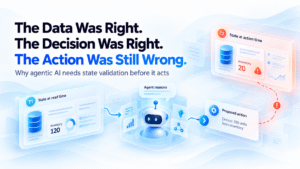
The Data Was Right. The Action Was Wrong.
The Data Was Right. The Decision Was Right. The Action Was Still Wrong. I’ve been thinking about one slightly awkward part of Agentic AI. Not hallucinations. Not prompts. Not whether the model is clever enough. Timing. We’ve spent a lot
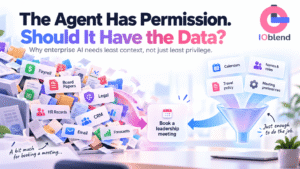
The Agent Has Permission. Should It Have the Data?
Why least privilege may need a companion: least context Here’s a funny thing about enterprise AI. We spend a lot of time talking about what an agent should be allowed to do, but much less time talking about what it
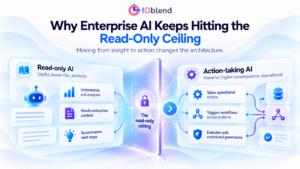
Why Enterprise AI Keeps Hitting the Read-Only Ceiling
The difficult part starts when an agent stops describing the business and starts changing it Enterprise AI has become very good at telling us what it thinks should happen next. It can investigate an incident, review a supplier, classify a
