

AW-10865990051

Real-Time Entity Resolution for Enterprise Data and AI

Real-Time-Entity-Resolution-for-Enterprise-AI-IOblend

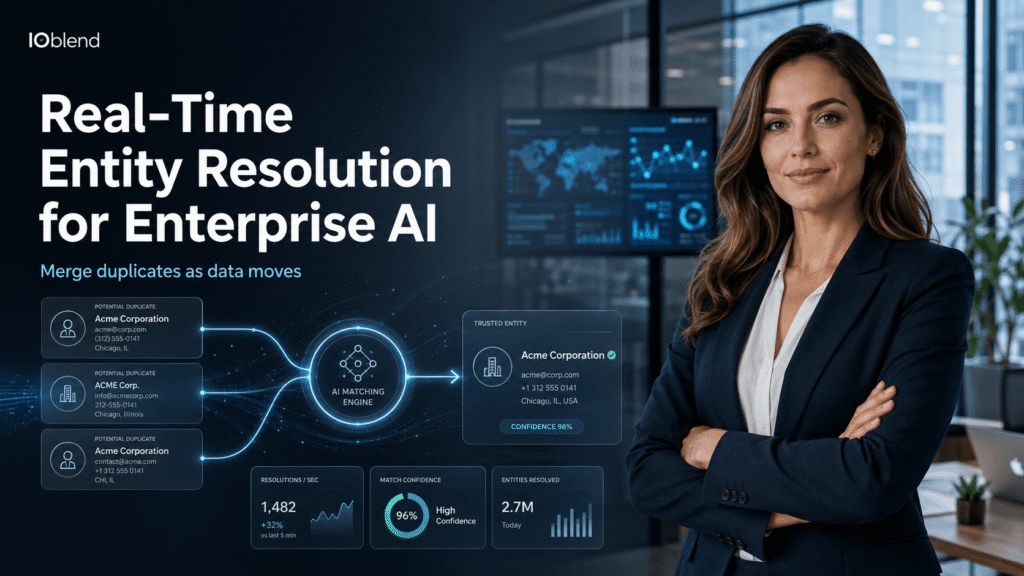
Entity Resolution at Scale: Merge Duplicates as Data Moves

Enterprise data rarely arrives clean. The same customer, supplier or product can exist across multiple systems under different names, IDs or formats. For reporting, this creates inconsistency. For AI and automation, it creates unreliable context.

Entity resolution has traditionally been handled through batch processing. But when data is moving continuously through CDC and event streams, resolving duplicates overnight is no longer enough.

What Is Entity Resolution?

Entity Resolution identifies records that refer to the same real-world entity and links or merges them into a trusted representation.

A CRM may contain “John Smith”, an ERP may store “J Smith”, and a support platform may record “John A. Smith”. At small scale, matching these records is simple. Across millions of continuously changing records, it becomes a significant engineering challenge.

Modern entity resolution needs to combine deterministic rules, fuzzy matching and more advanced logic while maintaining low latency and high throughput.

Why Real-Time Entity Resolution Is Difficult

The challenge is not simply finding a duplicate. Streaming records need to be matched against large volumes of historical data without creating processing bottlenecks.

The system also needs to maintain state. A new event may need to be compared with information that arrived months or years earlier, while customer details, supplier records and product hierarchies continue to change.

Many organisations solve this by combining separate CDC tools, streaming engines, matching services, lookup databases, batch jobs and data-quality platforms. The result is often an architecture that works, but becomes increasingly complex and expensive to maintain.

Resolve Entities Inside the Data Flow

IOblend takes a different approach.

Instead of treating entity resolution as a separate downstream process, IOblend allows matching, deduplication, enrichment and validation to happen directly within the data pipeline.

As data moves between operational systems, Microsoft Fabric, Databricks, Snowflake, applications or AI platforms, IOblend can determine whether a record represents a new entity, an update, a duplicate or an exception requiring further validation.

This turns entity resolution from an occasional clean-up exercise into a continuous data operation.

How IOblend Helps

Powered by Apache Spark, IOblend can process historical data, CDC events and streaming workloads through the same execution layer. Data teams can apply matching and transformation logic using familiar SQL or Python without building a separate architecture for every processing pattern.

Deterministic rules such as customer IDs, email addresses, telephone numbers, product codes and composite business keys can be applied directly in the pipeline. More complex records can also be enriched, normalised or validated using AI-assisted processing where ambiguity exists.

Duplicate or invalid records can be merged, corrected or quarantined before they reach reporting, applications or AI systems.

IOblend can also support Slowly Changing Dimension patterns, including SCD Type I and Type II, helping organisations maintain trusted current records while preserving historical changes where required.

Keep Your Existing Data Platform

Entity resolution should not require another major platform migration.

IOblend works across existing environments including Microsoft Fabric, Databricks, Snowflake, databases, ERP platforms, CRM systems, APIs and event sources.

The objective is not to create another storage layer. It is to improve the quality of data while it is already moving between systems.

Entity Resolution Is Becoming an AI Requirement

AI systems are only as reliable as the entities behind their data.

An AI assistant cannot build an accurate customer view if one person exists as multiple disconnected records. An AI agent should not make supplier decisions from duplicate vendor profiles. Analytics cannot calculate customer value correctly if activity is divided across several identities.

Entity resolution is therefore becoming an important part of AI readiness.

The goal is not simply fewer duplicates. It is a continuously trusted view of the business.

One customer. One supplier. One product. One entity downstream systems can rely on.

With IOblend, entity resolution becomes part of the data flow itself, combining streaming integration, CDC, data quality, governance and AI-assisted processing within one execution layer.

Trusted data while it moves. Ready for analytics, automation and AI.

IOblend: See more. Do more. Deliver better.

ioblend-data-lineage-dataops
DataOps
admin

Data lineage is a “must have”, not “nice to have”

Hello folks, IOblend here. Hope you are all keeping well. There is one thing that has been bugging us recently, which led to the writing of this blog. While working on several data projects with some of our clients, we observed instances when data lineage had not been implemented as part of the solutions. In

Read More »
ioblend_blog
DataOps
admin

Welcome to the IOblend blog

Welcome to the IOblend blog page. We are the creators of the IOblend real-time data integration and advanced DataOps solution. Over the many (many!) years, we have gained experience and insight from the world of data, especially in the data engineering and data management areas. Data challenges are everywhere and happen daily. We are sure,

Read More »
Scroll to Top