
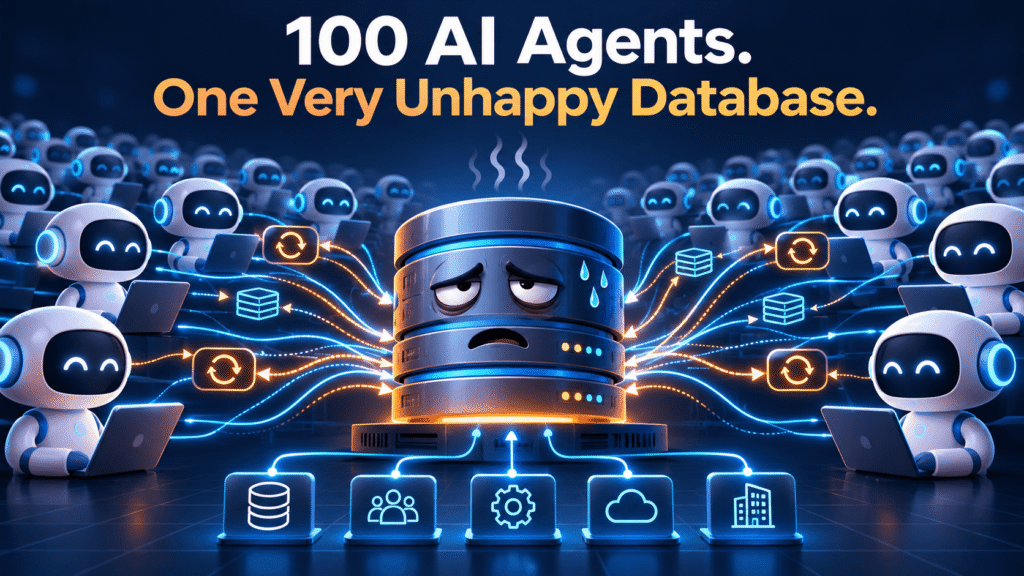
100 AI Agents. One Very Unhappy Database.
There’s an important difference between giving a hundred people access to a database and giving a hundred AI agents access to it.
The people eventually go for lunch.
The agents, bless them, have no such distractions. They’re quite happy interrogating the same systems around the clock, asking increasingly imaginative questions and retrying whenever something takes longer than expected.
Somewhere in the basement, a perfectly respectable operational database that has survived twenty years of enterprise IT is beginning to regret its career choices.
And the uncomfortable part is that none of the agents is necessarily misbehaving. They’re doing exactly what we’ve asked them to do: retrieve information, investigate situations, reason over the results and take action.
We’ve just forgotten to consider what happens when a few hundred of them start doing it simultaneously.
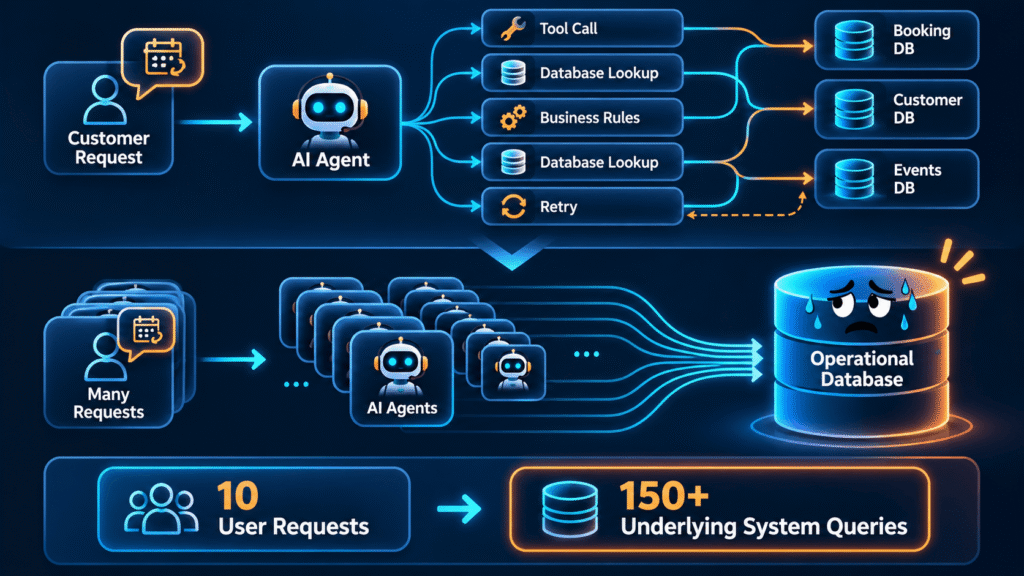
One innocent question. Fifteen database queries.
Imagine a large entertainment company introducing AI assistants across its concert venues.
There’s an agent helping customers change bookings, another coordinating venue operations, another managing staff assignments and several more handling everything from accessibility requests to equipment availability.
All perfectly reasonable applications.
A customer asks whether their booking can be moved to a different performance. The agent checks availability, ticket restrictions, seating arrangements, customer history and perhaps a few alternative dates. Depending on the tools and workflow, one relatively simple question could generate a surprising number of queries.
Now give that capability to every customer service representative. Add autonomous agents working behind the scenes, a few scheduling assistants and whatever the operations team has been experimenting with since discovering Copilot.
Suddenly, our booking database has become the most popular employee in the company. Everybody wants something, nobody thinks their request is particularly demanding, and the poor thing hasn’t had a moment’s peace since Tuesday.
Google has already highlighted this in its research into AI infrastructure. A single agent request can expand into multiple queries and actions across underlying systems, placing demands on infrastructure that traditional applications may not have been designed to handle.
The issue isn’t really the number of agents. It’s the amount of work they generate, how much of it is duplicated and how that workload behaves when something goes wrong.
And when response times start increasing, the retries arrive. Nothing improves an overloaded system quite like several dozen enthusiastic clients asking it to do the same thing again.
AWS’s Well-Architected guidance on retry behaviour explains why uncontrolled retries can turn a temporary slowdown into a much bigger problem.
Backoff, jitter and sensible limits help. But perhaps we should also ask why so many agents need to keep interrogating the same systems in the first place.
What the agent really needs
Let’s go back to our customer trying to change a concert booking.
The agent needs to know what the customer has booked, which alternative performances are available, whether the ticket can be exchanged and what conditions apply.
None of that is particularly mysterious. The difficulty is that the answers may live across several systems, each with its own identifiers, rules and update cycles.
The traditional approach would be to let the agent collect everything, work through the relationships and assemble its own understanding of the booking.
Then repeat the exercise for the next customer.
And the next.
Eventually, we have hundreds of agents independently reconstructing the same business information, rather like asking every new employee to conduct their own archaeological survey of the company before answering the telephone.
Surely we can do better.
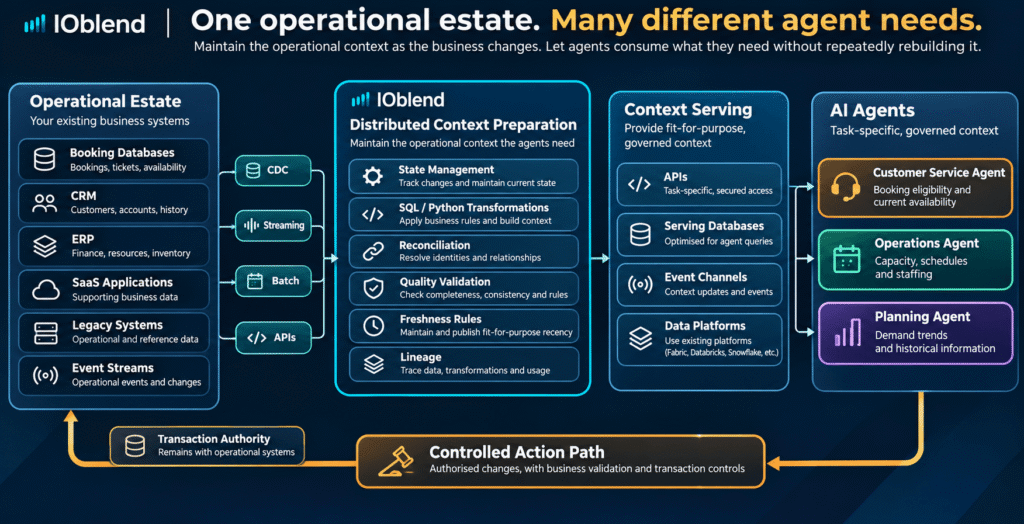
Much of the information an agent needs can be prepared and maintained as operational context before the question arrives.
Booking changes can be captured as they occur. Performance schedules can be synchronised. Ticket restrictions and eligibility rules can be applied consistently. Customer identities and booking references can be reconciled.
The result isn’t simply a collection of records. It’s a usable representation of the situation the agent is trying to understand.
When our customer asks about changing a booking, the agent can receive the relevant booking details, valid alternatives and applicable restrictions without having to interrogate every underlying system individually.
That’s a fairly substantial improvement.
And there’s no reason that prepared information should only serve one agent.
One operational reality. Different questions.
The customer service agent needs to know whether a booking can be changed. The venue operations agent needs to understand capacity, staffing and equipment availability. The planning agent may be interested in demand patterns across several months.
They’re looking at different aspects of the same business.
The underlying source information overlaps, but the context each agent needs is quite different.
That’s an important distinction because the answer isn’t to build one enormous dataset and give every agent unrestricted access to it.
The useful approach is to maintain the common operational relationships, then expose the relevant information according to the task, permissions and freshness requirements of each consumer.
For instance, the customer service agent may need a current list of eligible seats for a particular booking. The operations agent may need aggregated capacity across an entire venue. Neither needs to know the other’s business, and neither should have to reconstruct the underlying booking records from scratch.
This is where our earlier discussion about AI data freshness becomes relevant.
Different decisions operate on different clocks. Ticket availability may need to reflect changes within seconds, while historical attendance patterns can tolerate a much longer refresh cycle.
If the context is being prepared centrally as part of the production dataflow, those requirements can be applied consistently rather than leaving every agent to invent its own interpretation of what “current” means.
And if the required information is unavailable or too old for the decision, that should be known before the agent starts producing an enthusiastic but ultimately useless recommendation.
Keeping that context alive
Of course, there’s a bit of engineering underneath all this.
Someone has to capture changes, maintain the relevant state, resolve identities, apply business rules and deal with information arriving at different times.
Fortunately, none of these are particularly new problems.
For supported databases, log-based change data capture can provide a continuous feed of committed changes without requiring every consumer to keep scanning the same tables. Debezium’s documentation explains how this works.
Other information may arrive through event streams, APIs or scheduled processing. The point isn’t to force every source into the same integration pattern, but to maintain the business context using whichever mechanism makes sense.
This is precisely the sort of work we use IOblend’s production pipelines for.
Its distributed Spark execution can process CDC and streaming changes alongside batch information, with SQL and Python transformations handling the relationships, validation and state required by downstream applications.
In our booking example, we could maintain the relationship between customers, performances, ticket conditions and availability as those underlying records change. Late events, duplicates and inconsistent references can be dealt with during processing rather than becoming separate problems for each agent.
The pipeline doesn’t need to know whether the eventual consumer is a Copilot agent, a custom application or a planning system. It simply maintains the information those consumers depend on, with the appropriate quality and lineage controls.
That also means we can reuse the engineering when the next department introduces another agent.
The context may be different. The underlying integration work doesn’t have to be.
And then we have to serve it
This is another place where the architecture matters.
Preparing context efficiently is one thing. Serving it to hundreds of agents is another.
If we route every agent request synchronously through a Spark processing job, we’ve merely moved the queue from the booking database to somewhere more fashionable.
Not an especially rewarding achievement.
Instead, the processed context can be delivered to infrastructure suited to the way it will be consumed: an operational serving database, an API, an event channel or an existing data platform.
The agent-facing layer can then provide the appropriate information without requiring the original operational systems to repeat all the underlying work.
That leaves us with a useful separation.
The source systems remain responsible for their transactions. Distributed data processing keeps the relevant context synchronised and validated. Serving infrastructure handles the volume and concurrency of agent requests.
And the agents get to concentrate on their actual jobs.
Naturally, these components still require infrastructure and operational management. But the arrangement becomes worthwhile when the maintained context and serving paths replace enough duplicated integration work, expensive source queries and independently managed agent connections.
The objective isn’t to create a new destination for everything. It’s to reuse the information and processing we already need across the applications and AI platforms the organisation has chosen.
Which seems a more sensible proposition than asking the ERP to personally entertain every new agent we deploy.
Knowing something and changing it are different jobs
There’s one final distinction worth making before we declare our booking architecture complete.
Suppose the agent has found a suitable alternative performance and the customer agrees to change their booking.
The agent has the context it needs. The availability information meets its freshness requirements. The alternative looks perfectly valid.
Can it now go ahead?
Well, almost.
Somebody else might have reserved the last seat in the meantime.
This is the problem we explored in The Data Was Right. The Action Was Wrong.
Prepared context helps the agent make an informed proposal. It doesn’t replace the booking system’s responsibility to decide whether the transaction can actually be committed.
So the request goes back through an authorised action path, with the required business validation and the target application’s own transaction controls.
The context can be shared and reused. The final authority to change the booking stays where it belongs.
That same distinction helps us manage the requests that genuinely must reach operational systems directly.
Some will require authoritative checks. Others will involve transactions that cannot sensibly be served from synchronised state. Those requests still need appropriate concurrency limits, timeouts, retries and protection against duplicate execution.
All familiar production engineering. We just need to apply it consistently as agent workloads grow.
There’s a useful number we should probably start measuring
We’ve become fairly good at measuring AI performance.
Response times, model costs, task completion, reasoning quality and various other indicators all have their place.
But I think there’s another metric worth examining as enterprises deploy more agents: how much work does each completed agent task generate for the operational estate?
Not just how many tool calls the agent makes, but how many translate into expensive source queries, how often the same information is retrieved and how much of that work could be served from maintained operational context.
It’s also worth understanding what happens when things slow down. Are retries controlled? Does request traffic increase as source performance deteriorates? Can the serving layer absorb demand without compromising freshness or pushing excessive load back onto operational applications?
An agent might resolve customer enquiries beautifully while being a thoroughly unpleasant neighbour to everything sharing its database.
That’s useful information to have before deploying another five hundred of them.
It also gives us a practical way to evaluate the architecture. If the same business context can support more agents without proportionally increasing load on the underlying systems, we’re heading in the right direction.
Scaling AI shouldn’t mean rebuilding the enterprise around it
I think the interesting opportunity here is much simpler than introducing another grand AI architecture.
Most organisations already have the operational systems, data platforms and applications they intend to keep. What changes is the number of consumers that now want access to the information inside them, and the speed at which those consumers can ask questions.
We could keep building individual integrations and letting every agent assemble its own version of the business.
Or we could maintain the relevant operational context through reusable production pipelines and make it available through serving infrastructure designed for that demand.
The latter gives agents a cleaner, more reliable view of the business while reducing unnecessary work for the applications running it.
And as we bring more agents into production, that distinction becomes increasingly useful.
It’s an architectural conversation we’re having more often at IOblend, particularly with organisations trying to make their existing platforms support growing AI demand without continually extending the integration estate.
If you’re seeing the same thing, I’d be interested in comparing approaches.
Because a hundred AI agents might be very clever, but if they all ask the same database the same question a thousand different ways, the database isn’t going to admire their reasoning.
It’s going to file for early retirement.
