
Your AI Doesn’t Need Real-Time Data. It Needs Data That’s Current Enough.
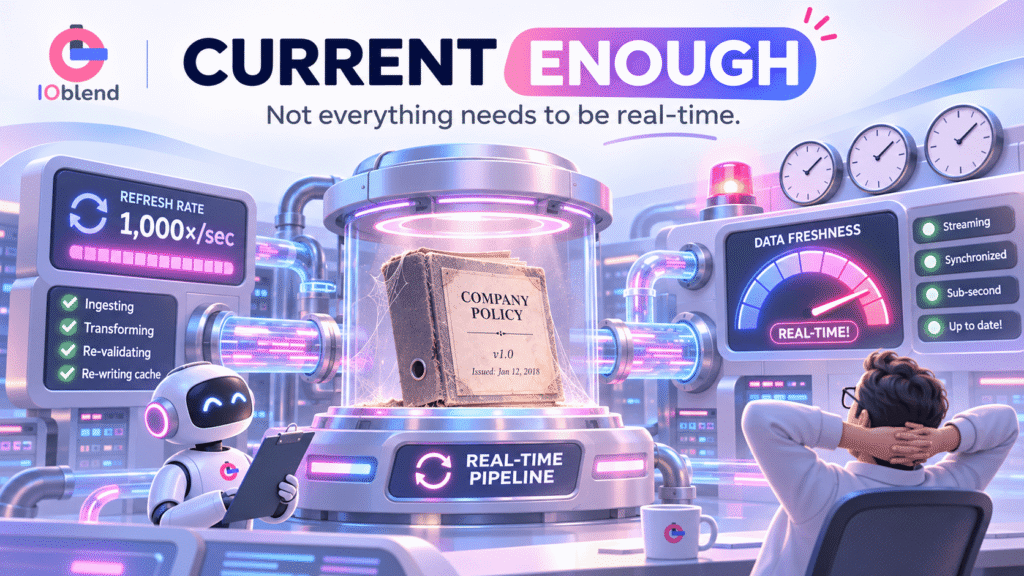
Somewhere in the world, a perfectly respectable PDF from 2019 is about to be connected to a real-time AI pipeline. Apparently, Agentic AI has developed a bit of a data freshness obsession, and no piece of enterprise data is safe.
The PDF, meanwhile, hasn’t changed since 2019.
But at least we’ll know that in real time.
There’s something rather entertaining about the industry’s obsession with making absolutely everything instantaneous. Every conference seems to promise real-time intelligence, real-time context, real-time decisions and, presumably, real-time disappointment when somebody opens the infrastructure bill.
Don’t get me wrong. Real-time data is enormously useful. We’ve spent years working with streaming, CDC and operational data precisely because traditional batch architectures aren’t always adequate.
But as AI agents start making decisions across enterprise systems, I think we’re in danger of confusing two rather different things.
How quickly can we deliver the data?
And how current does the data actually need to be?
Those are not necessarily the same question.
The trouble with making everything real time
Imagine a large ski resort introducing AI agents to help coordinate its operations.
The agent can assess lift availability, weather conditions, maintenance records, visitor demand, piste inspections and staffing. It could make some genuinely useful recommendations about resource allocation and operational planning.
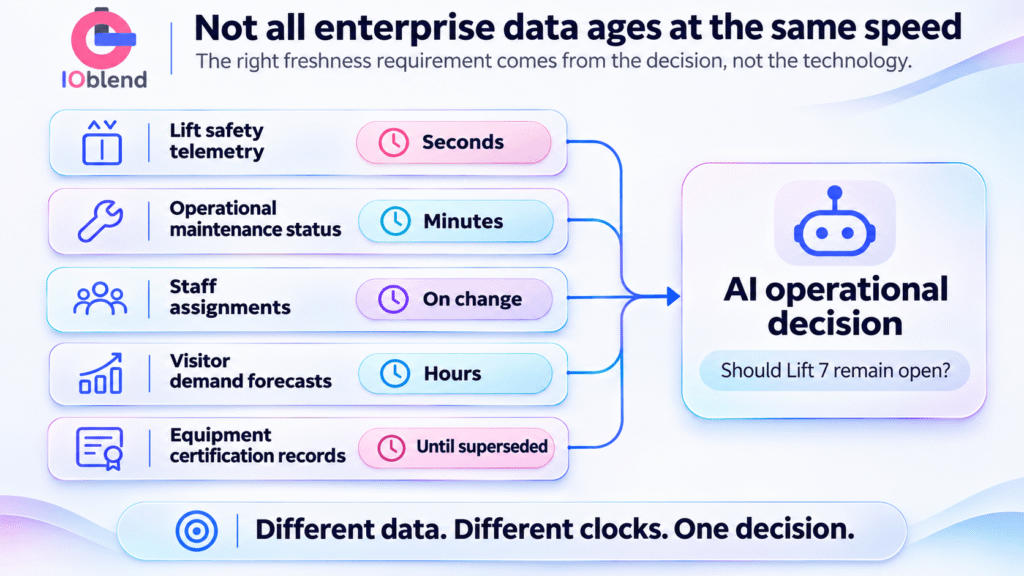
But the information it needs exists on wildly different timescales.
Wind speed and lift safety conditions may require updates within seconds. Staffing availability might be refreshed when shifts or assignments change. Maintenance status needs to reflect the latest completed work and outstanding faults.
The manufacturer’s original technical documentation, however, is unlikely to benefit from being refreshed every three seconds. Unless somebody has invented a particularly ambitious form of spontaneous document revision.
All of this information matters to the agent. It just doesn’t need to arrive at the same speed.
And that is where the architecture gets interesting.
If we demand sub-second freshness for everything, we create an expensive and unnecessarily complicated system. If we rely on daily updates for everything, we risk giving the agent information that is no longer suitable for the decision.
Neither approach is particularly intelligent.
The trick is understanding the freshness requirement of the decision itself.
An agent advising on next season’s equipment replacement programme can reasonably use historical maintenance data. An agent helping an operator decide whether a lift should remain available during rapidly changing weather needs something considerably more current.
Same organisation. Same systems. Completely different freshness requirements.
And I suspect this will become one of the more important disciplines in enterprise AI architecture.
Freshness should be part of the contract
We already have a reasonably mature understanding of data contracts.
A consuming system needs to know what information it’s receiving, how it is structured, what the fields mean and what quality expectations apply.
But for AI agents, I think the contract needs to become more explicit about time.
Not just whether a field exists or contains a valid value, but how old the underlying information is allowed to be before it becomes unsuitable for a particular decision.
This isn’t an entirely new concept. Google Cloud’s data product contracts, for example, support refresh cadence, agreed delivery times and acceptable delay thresholds.
What’s changing is the consumer.
A conventional reporting application might display yesterday’s figures with a helpful timestamp. A human can decide whether that is acceptable.
An autonomous agent may use those figures as part of a larger reasoning process, combine them with other information and produce a recommendation without anyone noticing that one source is considerably older than the rest.
And that is a different proposition.
For an agent, we might want to specify that a particular operational measurement must be no more than a few seconds old, that a planning forecast can be several hours old, and that a certified reference document remains valid until superseded.
Those are illustrative requirements, of course. The actual thresholds should come from the business process, its risks and the behaviour of the source systems.
But once they’re explicit, something useful happens.
Freshness stops being a vague promise made by the data platform and becomes a condition that can be checked.
The agent either receives context that meets the required freshness contract, or the system knows that it doesn’t.
That second outcome is rather important.
A timestamp doesn’t necessarily mean what you think it means
This is where we can get into some slightly awkward engineering territory.
Suppose an agent receives a temperature measurement with a timestamp of 14:32.
Lovely. Very recent.
Except that 14:32 might be the time the record entered the data platform, not the time the measurement was actually taken.
The measurement might have been produced at 14:11, held in a local gateway during a communications outage and delivered 21 minutes later.
The pipeline processed it immediately.
The dashboard looks fresh.
The underlying observation is not.
This is why stream-processing systems distinguish between event time and processing time. Apache Flink’s documentation on timely stream processing provides a useful explanation of how those clocks differ, particularly when events arrive late or out of order.
The distinction isn’t academic.
An AI agent making a decision based on the age of a record needs to understand which clock it’s looking at.
And there is another complication.
Sometimes the absence of new information is perfectly normal.
A reference record may not have changed in six months because there was nothing to change. That doesn’t necessarily make it stale.
On the other hand, a sensor stream that hasn’t reported for ten minutes could indicate a serious communications problem.
Both may show an old timestamp.
Only one necessarily represents a failure of the expected data flow.
So freshness can’t always be determined by checking when the latest row was written.
We also need to know how the source behaves, whether it’s healthy, whether changes are being captured and what the timestamp actually represents.
Otherwise, we end up with a system that declares perfectly valid reference information stale while cheerfully accepting delayed operational measurements as current.
An impressive achievement, albeit not the one we were aiming for.
The agent may be looking at several different versions of Tuesday
There’s another problem that I think is more interesting than individual stale records.
Imagine an AI agent helping an international exhibition organiser coordinate the movement of valuable artworks between museums.
It needs transport schedules, customs clearance, storage conditions, insurance coverage, exhibition dates and the availability of specialist handling teams.
Each system may be working perfectly well.
The transport schedule was updated at 10:00. Customs clearance changed at 10:04. The insurance system still reflects the arrangement agreed at 09:30. The handling team’s allocation was updated at 10:06.
At 10:07, the agent assembles its context.
Every individual record is valid.
Every API call succeeds.
But do these records describe a consistent operational situation?
Perhaps. Perhaps not.
An insurance record from 09:30 may be entirely suitable if it remains legally effective. Or it may refer to a transport arrangement that has subsequently been changed.
The issue isn’t simply that one record is older.
It’s whether the records are valid together for the decision the agent is making.
This is why I think agentic AI will need more than a generic “last refreshed” indicator.
In some cases, it needs a coherent view of the business at a particular point in time. In others, it needs to establish that specific dependencies have been refreshed or revalidated after a material change.
That’s a much more interesting engineering challenge than simply making every API faster.
And it connects naturally with our earlier article, The Data Was Right. The Action Was Wrong.
There we looked at what happens when the business changes between the agent’s decision and its execution.
Here the problem begins earlier.
The agent may never have had a sufficiently current or mutually consistent view of the business in the first place.
Streaming doesn’t automatically guarantee freshness
This is probably where a few data engineers will start nodding.
A streaming pipeline can be running perfectly well while delivering information that is already too old for its intended use.
The source might be delayed. A connector might be lagging. An upstream application might update its own records only periodically. Events might arrive out of order, or one source might be temporarily unavailable while the others continue.
You can have excellent pipeline availability and poor information freshness at the same time.
And there are several different delays hiding inside that one problem.
The time between something happening and the source recording it. The delay before the integration layer sees it. The time spent processing and validating it. The time before the consuming agent receives it.
Optimising one of those stages doesn’t automatically solve the others.
Databricks discusses this distinction in its guidance on diagnosing stale data, where the investigation follows the information back through table updates, producing jobs and upstream dependencies.
It’s sensible advice because a stale result isn’t necessarily caused by the last system that delivered it.
For agentic AI, I think we need to carry that thinking a little further.
If a source fails to meet its freshness requirement, the consuming agent should not have to guess whether that’s important.
The production data architecture should already know.
What happens when the freshness contract fails?
This is where the idea becomes much more useful than another monitoring dashboard.
Imagine our exhibition logistics agent discovers that customs information is current, transport arrangements are current, but the insurance confirmation has not been revalidated since an important change in the itinerary.
What should happen?
Perhaps the agent can continue preparing the logistics plan but should not release the shipment.
Perhaps it should retrieve updated confirmation.
Perhaps the decision should be routed for review.
Or perhaps the information is sufficiently important that the workflow should stop until the relevant source becomes available.
The appropriate response depends on the business consequences.
What we shouldn’t do is quietly feed the old information into the prompt and hope the model notices.
Because the model might produce a beautifully reasoned answer based on information that should never have passed the context-validation stage.
We have spent a lot of effort developing AI guardrails around the output of models. Fair enough.
But the freshness of the data going into the model is also a control worth engineering.
And unlike some of the more ambitious AI governance problems, this one can often be checked with relatively straightforward deterministic logic.
Does the information meet the required freshness threshold? Has the source reported successfully? Is the relevant record version still valid? Are dependent records consistent enough for this workflow?
If not, route the decision accordingly.
No additional philosopher-bot required.
This is where the production data layer earns its keep
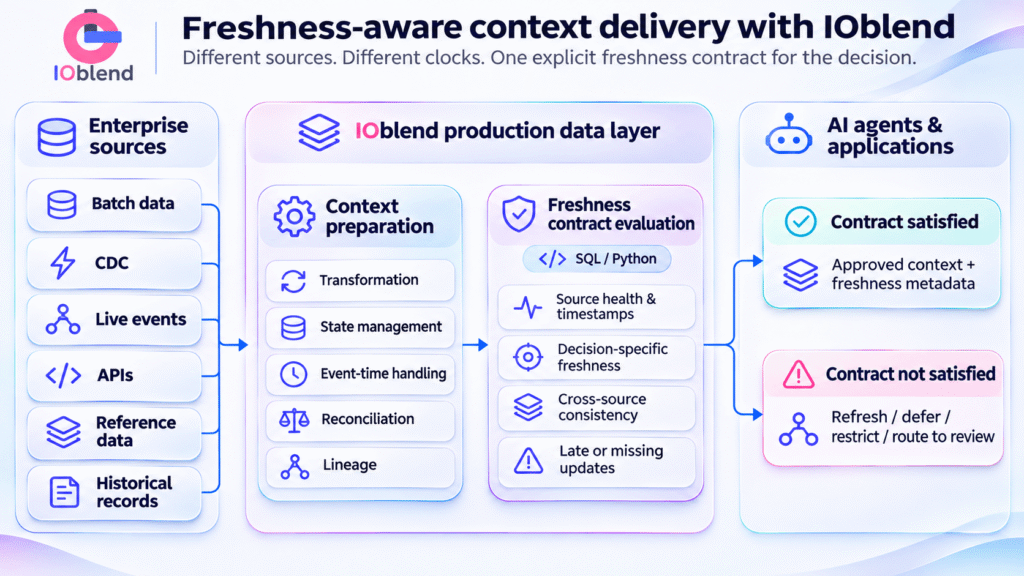
The architecture I have in mind doesn’t require every data source to become a streaming system.
Quite the opposite.
Different sources can continue operating according to their nature and business requirements.
Some might deliver continuous CDC events. Others might use streaming telemetry, scheduled batch processing, APIs or versioned reference information.
The important thing is that the production layer understands what each source contributes, how its changes are captured and whether the resulting context is suitable for the downstream decision.
That’s very much how we think about IOblend.
Our production data architecture already combines batch, CDC and streaming with state management, transformations, validation, windowing, lineage and exception handling.
And because IOblend supports SQL and Python transformations inside portable pipeline playbooks, we can implement business-specific freshness rules without expecting the AI model to interpret every timestamp or invent its own thresholds.
For example, a pipeline can carry source event time, ingestion time and the last verified source state, then evaluate them against the freshness requirements of a particular workflow.
Where necessary, it can maintain current operational state from CDC events, reconcile information arriving at different times, handle late records and route unsuitable context into an exception or review path.
Some of those freshness-policy checks would be customer-specific Python or SQL logic built using IOblend’s existing capabilities, rather than a claim that every possible policy is already a predefined product feature.
But that’s precisely the advantage of an extensible production layer.
The engineering can reflect how the business actually works.
An agent handling a time-sensitive operational decision can receive a different freshness guarantee from one carrying out a longer-term planning exercise, even when both rely on some of the same underlying systems.
And because the logic sits in the pipeline rather than in the agent’s prompt, it can be tested, versioned, reused and monitored.
Our work on Agentic AI inside governed production pipelines follows the same principle: use AI where interpretation is valuable, and conventional data engineering where the conditions can be expressed and checked explicitly.
There is a cost argument here too
One of the less discussed consequences of demanding real-time everything is the amount of unnecessary engineering it can create.
Continuous polling, excessive API requests, repeated transformations and maintaining frequently refreshed copies of information that rarely changes are not particularly attractive uses of infrastructure.
Neither is building a separate freshness mechanism for every AI agent.
We covered that problem more broadly in AI Agents Are About to Recreate the Integration Problem, where the concern was that every new agent could become another integration project.
Freshness requirements could become another version of the same problem.
One agent requests data every second. Another refreshes the same information every five seconds. A third decides it needs an independent copy with its own monitoring and retry logic.
And before long, we’ve built a small industrial complex dedicated to repeatedly confirming that nothing has changed.
There are better ways to spend money.
A shared production layer can capture changes once where appropriate, maintain the relevant state and serve different consumers according to their actual requirements.
Streaming where timeliness justifies it. Batch where it doesn’t. APIs where direct retrieval is appropriate. A mixture where the business requires it.
None of this means cost disappears, or that one centralised service should answer every agent request. The processing still needs to scale, and different workloads may need different serving patterns.
But it does mean we can stop treating the fastest technically possible refresh rate as the default architectural answer.
The SLA should belong to the decision, not just the pipeline
This is the part I would particularly like data leaders to consider.
Today, an integration SLA often tells us whether a pipeline ran successfully, whether delivery happened on schedule and whether processing stayed within an expected window.
Those are important operational measurements.
But they don’t necessarily tell an AI application whether the information is still appropriate for what it is trying to do.
A pipeline can meet its delivery SLA while the original source has stopped updating.
A dataset can be refreshed successfully while one of its upstream dependencies is stale.
An agent can retrieve information in 80 milliseconds that was last valid eight hours ago.
Very fast.
Possibly very wrong.
So perhaps we need to establish a second level of contract, defined around the business decision.
What context does the decision require? How current must each part be? Which sources are authoritative? What consistency conditions matter? What should happen if the contract cannot be met?
And critically, who owns those rules?
I would argue that the business should define the acceptable risk, while the data engineering architecture makes those expectations measurable and enforceable.
The AI platform can then consume the resulting context rather than having to reconstruct all that logic itself.
That feels like a much cleaner division of responsibility.
We don’t need another argument about real time
I should probably clarify something before this sounds like an attack on streaming technology.
It isn’t.
Real-time processing is essential for plenty of operational workloads. And the more deeply AI agents participate in business processes, the more important timely, event-driven information will become.
But real-time is not a universal substitute for understanding the data.
Nor is a low-latency response a guarantee that the information behind it is current, complete or consistent.
What matters is the relationship between the information and the decision.
Some decisions require the latest operational state. Some require a coherent historical snapshot. Others need both, with explicit rules about which parts can be older and which cannot.
The architecture should be able to accommodate those differences without rebuilding the integration estate every time a new agent appears.
That is the direction we’re pursuing with IOblend: maintain the relationship between changing enterprise systems and the AI applications consuming their information, while making the relevant quality, state and freshness requirements part of the production dataflow.
Not another place to put everything.
A way to make the data stack an organisation already owns work more consistently for the decisions it needs to support.
A useful question for your next AI architecture meeting
Before somebody approves another real-time AI initiative, I’d suggest asking a fairly simple question.
For the decision this agent is supposed to make, which information must be current, how current must it be, and what happens if it isn’t?
If the answer is “everything needs to be real time”, I’d probably ask again.
And if the answer is “the model will work it out”, I’d be slightly more concerned.
Because making data travel faster is an engineering problem.
Knowing whether it is suitable for a decision is a business and architecture problem.
We’re interested in working through those questions with teams connecting AI agents to complex operational environments. If that’s something you’re dealing with, bring us the workflow and let’s look at the data architecture.
The future of enterprise AI will undoubtedly involve more real-time information.
It should also involve a little more discrimination about what actually needs to be real time.
After all, delivering yesterday’s data in three milliseconds is still delivering yesterday’s data.
Just with a considerably more expensive stopwatch.
