Put Agentic AI inside governed production data pipelines.
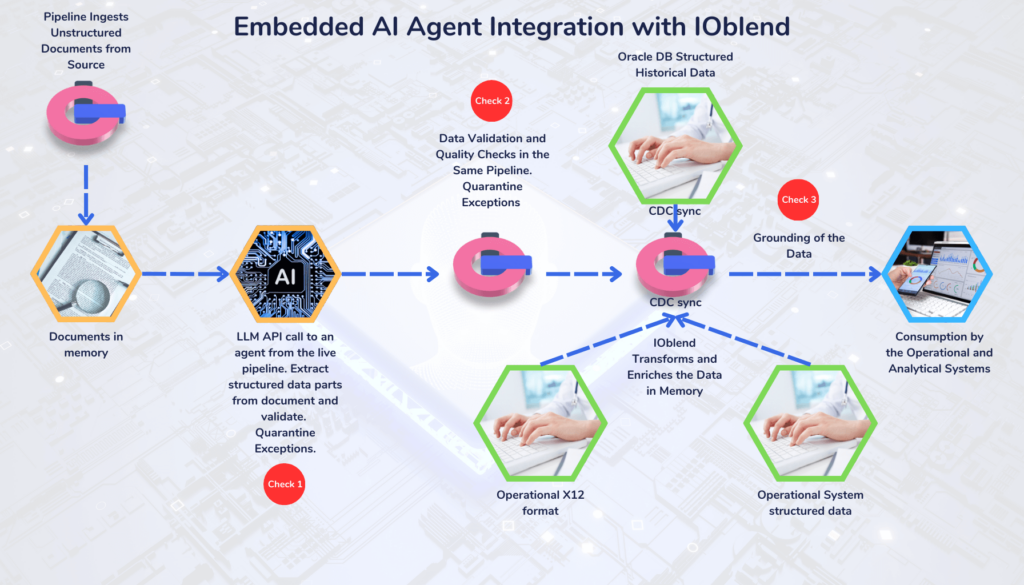
IOblend embeds AI agents, LLM calls and Python-based intelligent steps directly into enterprise ETL and real-time data pipelines. Extract structured information from documents, ground it against live operational data, validate the result, quarantine uncertainty and combine approved AI output with normal SQL, Python, CDC and streaming transformations—all inside one production dataflow.
Deterministic data engineering with intelligent steps where rules alone are not enough.
An Agentic AI data pipeline is a production dataflow that can invoke models or agents as controlled processing steps. Traditional SQL and Python still handle deterministic integration, while AI is used selectively for work such as document extraction, classification, interpretation, validation or decision support. The pipeline then applies normal DataOps controls around the AI output.
Use code where the rule is known.
SQL, Python, mappings, joins, schemas, validation and business rules remain the right choice for predictable transformations.
Use AI where interpretation is required.
An agent or LLM can extract meaning from documents, classify content, compare evidence or make a bounded decision before the pipeline validates what comes back.
Turn documents into data without creating a separate AI side-project.
Contracts, invoices, emails, notes and other unstructured content often contain fields needed by normal enterprise processes. IOblend can invoke an AI step to extract those fields, then immediately pass the result through standard validation, enrichment and transformation logic before the data is allowed into downstream systems.
AI becomes production-ready when uncertainty has somewhere safe to go.
The model call is only one stage. A production Agentic AI pipeline needs trusted context before inference and deterministic controls after inference so uncertain output does not silently become enterprise data.
Ingest
Receive documents, messages, records or events from enterprise sources.
Prepare
Normalise the input and assemble the context required by the AI step.
Invoke
Call the chosen LLM, model, Python agent or intelligent procedure.
Ground
Combine the response with trusted structured or historical enterprise data.
Validate
Apply deterministic schema, data-quality and business checks to the output.
Route
Accept, quarantine or send uncertain results to a human-review path.
Publish
Deliver governed output into analytics, applications, AI or operational systems.
Autonomy should increase only when the evidence supports it.
Some AI outputs can be accepted automatically. Others should be reviewed because the confidence is low, the business consequence is material, or the record fails a deterministic validation. IOblend lets the dataflow branch around those conditions rather than treating every model response as equally trustworthy.
Threshold the response
Use model confidence, structured-output checks or downstream business rules to determine the next path.
Check deterministically
Compare AI output with schemas, reference data and known enterprise constraints.
Quarantine uncertainty
Keep questionable output separate from healthy production data with the original context attached.
Route to a human
Escalate sensitive, ambiguous or high-value cases to an SME instead of automating beyond the available evidence.
Let the agent decide where judgement helps. Keep the pipeline deterministic where certainty matters.
Agentic systems become easier to govern when the model does not own every stage. IOblend lets AI sit inside a larger deterministic workflow, so data movement, schemas, approvals, exception paths and destination writes remain explicitly engineered.
Interpret
Read a contract, classify free text, identify entities, summarise evidence or choose among bounded options.
Control
Enforce schemas, business rules, required fields, routing, retries, state and downstream write behaviour.
Approve
Retain an explicit review point for ambiguity, material decisions or use cases where human authority should remain final.
The model is only as useful as the context arriving before the prompt.
IOblend can combine unstructured content with current structured enterprise data before or after an AI step. That means a document extraction or model decision can be checked against ERP history, customer records, operational data, reference tables or CDC updates rather than operating on a disconnected prompt alone.
Use AI for interpretation and action, not because every data step needs an agent.
The strongest Agentic AI use cases are where conventional data engineering has the inputs but lacks a practical deterministic rule for understanding them. IOblend keeps those intelligent steps connected to the same quality, lineage and production controls as the rest of the dataflow.
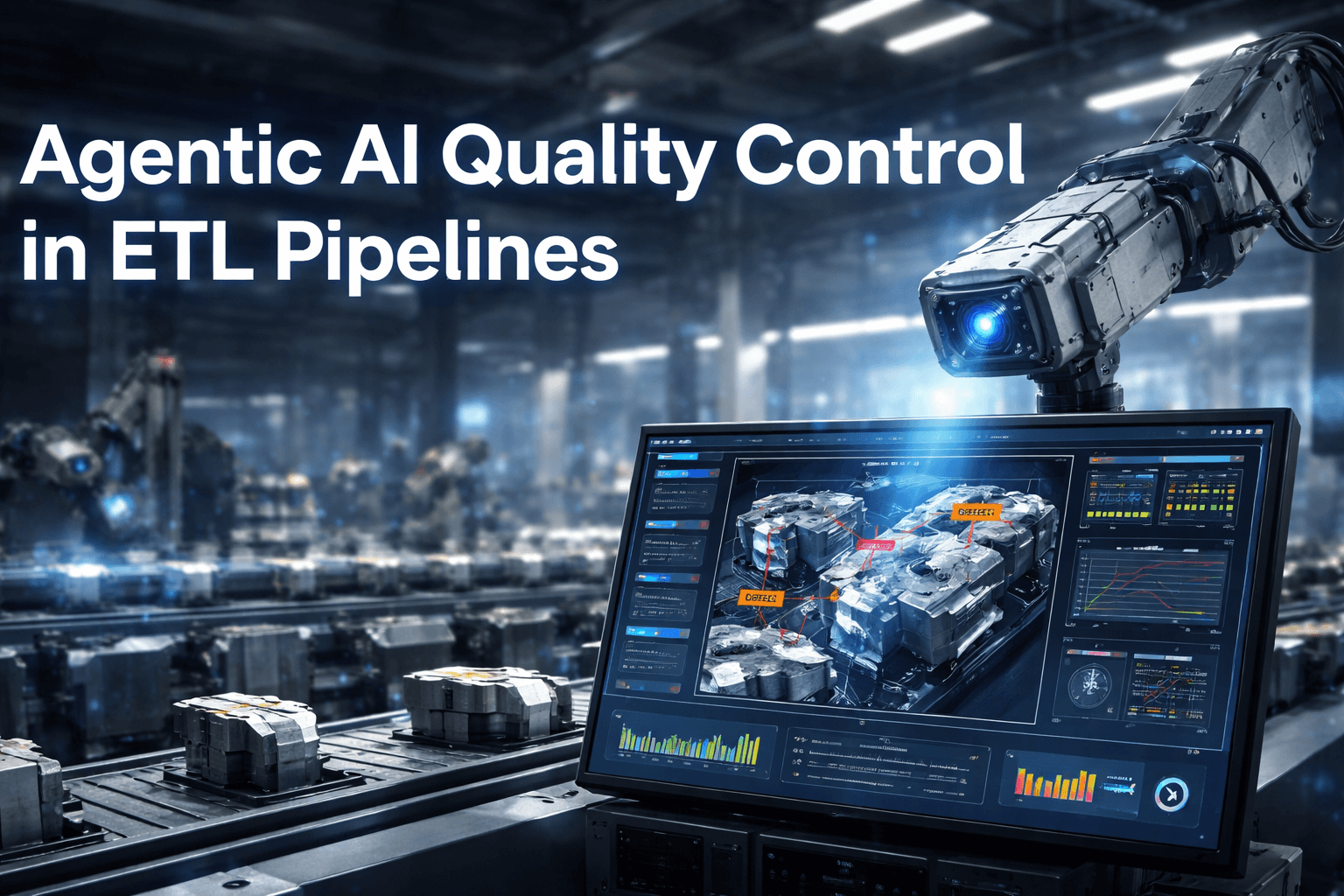
AI-assisted defect classification
Use image or multimodal model logic to classify a defect, combine the result with production and machine context, then validate and route the outcome inside the ETL flow.
Explore the quality-control example →
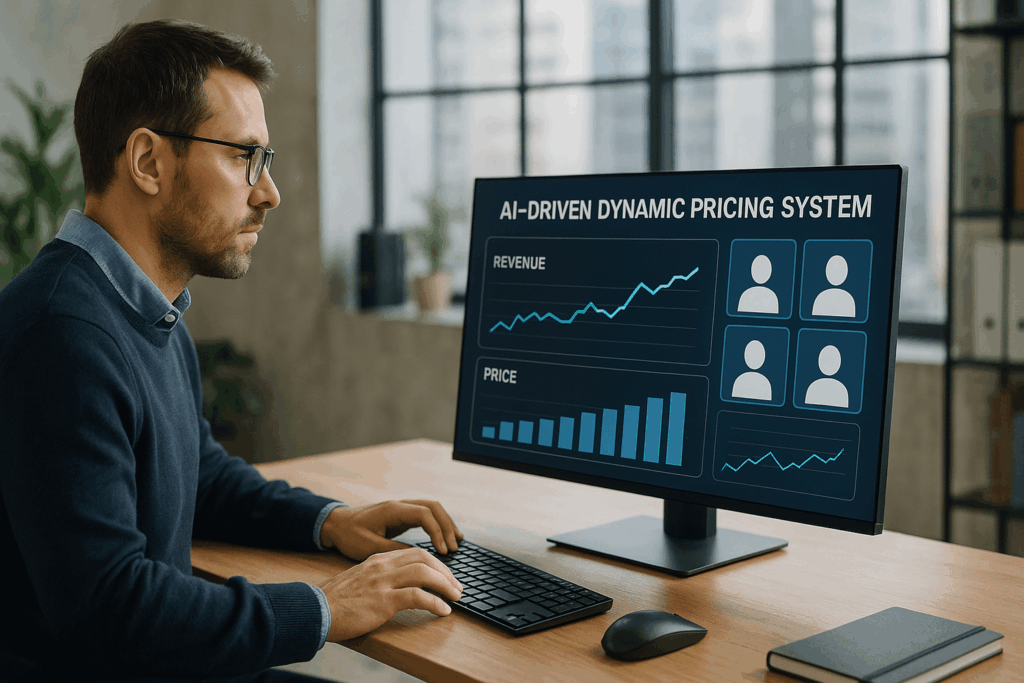
Dynamic pricing + revenue signals
Combine live market signals, operational data and model/agent logic where the decision has to react to new information while preserving data lineage around the inputs.
Explore the dynamic-pricing example →AI output still needs engineering discipline after the demo works.
Moving an AI workflow into production introduces the same questions as any other enterprise data product—plus model uncertainty. IOblend keeps agentic steps inside versioned, testable and observable pipeline logic rather than leaving production behaviour hidden behind a single model call.
Keep the data pipeline independent of whichever AI framework wins next.
IOblend can invoke Python-based agent or model logic as part of the pipeline. That means the enterprise dataflow does not need to become inseparable from one agent runtime, model provider or cloud AI service. Use the AI technology that fits the use case while keeping the surrounding production data logic portable.
Questions data and AI teams ask before an agent enters the production flow.
These answers focus on the production boundary between AI agents and enterprise data engineering: model invocation, grounding, validation, human review, unstructured data and how IOblend fits alongside agent frameworks.
What is an Agentic AI data pipeline?
An Agentic AI data pipeline is a production dataflow that invokes an AI model or agent as one or more controlled processing steps. The agent can interpret unstructured content, classify records, extract information or make bounded decisions, while the wider pipeline handles ingestion, transformation, validation, lineage, exceptions and downstream delivery.
How does IOblend embed AI agents into ETL?
IOblend can invoke Python-based stored procedures and agent/model calls inside the pipeline. The returned result becomes part of the normal dataflow, where it can be transformed, grounded against other enterprise data, validated and routed before being published downstream.
Can IOblend process PDFs, emails and other unstructured data?
Yes. An AI step can extract structured fields or classifications from documents, email, text and similar unstructured sources. IOblend can then combine those outputs with structured database, API, batch, CDC or streaming data inside the same pipeline.
How does IOblend validate AI-generated output?
AI-derived values can be checked using expected schemas, field types, reference datasets, SQL/Python business rules and additional model-based checks. Failed or uncertain results can be quarantined or routed to human review instead of being accepted automatically.
Does IOblend support human-in-the-loop AI workflows?
Yes. The pipeline can branch according to confidence, validation outcome or business rules. Records that require oversight can be routed to a review path while high-confidence, validated output continues automatically.
Does IOblend require one specific LLM or agent framework?
No. IOblend's role is the production data integration and DataOps layer around the AI step. Python-based logic can call the model, service or framework selected for the use case, allowing the surrounding enterprise dataflow to remain more portable as AI technology changes.
How is IOblend different from an agent framework such as LangGraph or CrewAI?
Agent frameworks provide agent runtimes, reasoning loops, tools, memory and orchestration patterns. IOblend focuses on the production enterprise dataflow around those capabilities: ingesting and preparing context, combining structured and unstructured data, applying DataOps controls, maintaining lineage and delivering governed output to operational systems.
Can Agentic AI run inside real-time or CDC pipelines?
Yes. IOblend can combine AI steps with event-driven, streaming and Change Data Capture flows. Whether every event should invoke a model depends on throughput, latency, cost and the use case, so the intelligent step should be applied where it adds enough business value.
How does IOblend ground an AI agent with enterprise data?
The pipeline can retrieve or join trusted operational, historical and reference data before or after the AI call. This lets model output be checked or enriched against live enterprise context rather than relying on a disconnected prompt alone.
How are Agentic AI pipeline failures handled?
IOblend can use retries, exception quarantine, record-level lineage and controlled replay around the wider flow. Deterministic validation can stop malformed or uncertain AI output from progressing even when the model call itself technically succeeded.
Can IOblend run Agentic AI pipelines on our own infrastructure?
Yes. IOblend Enterprise Edition is designed for customer-controlled cloud, on-premises and hybrid Spark infrastructure. The exact model or agent service can be hosted according to the enterprise's chosen architecture and security requirements.
When is Agentic AI inside ETL a strong fit?
It is a strong fit when the integration problem contains interpretation that conventional deterministic rules handle poorly—for example document extraction, complex classification, contextual validation or controlled decision support—and the result still needs normal production data quality, lineage, transformation and delivery.

Bring us the data, the AI task and what must happen when the answer is uncertain.
We can map the workflow into enterprise context, agent/model invocation, deterministic validation, exception handling, human review, lineage and downstream delivery—then identify where IOblend can turn the AI step into a governed production data pipeline.