

AW-10865990051

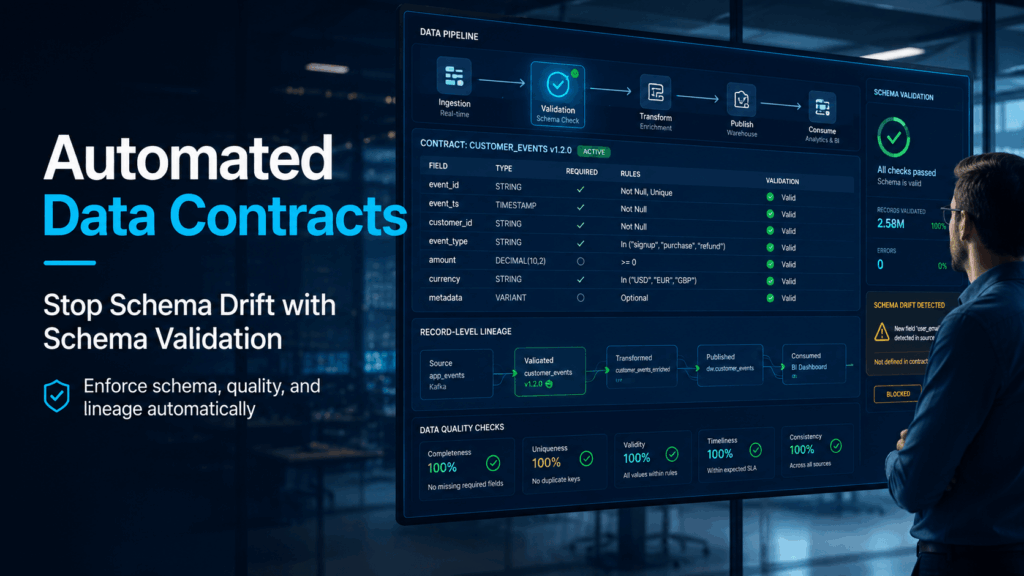
Automated Data Contracts: Stop Schema Drift

Data-contracts-with-IOblend

Data Contracts That Stick: Enforce Schema and Expectations Automatically 

📜 Did You Know? In the early days of big data, a single unannounced column type change in an upstream transactional database could trigger a catastrophic “data graveyard” effect, corrupting millions of analytics records before anyone noticed.

The Concept of Enforceable Data Contracts 

A data contract is an explicit, programmatic agreement between data producers and downstream consumers. It defines expected schemas, data types, freshness, and quality constraints at the pipeline level, guaranteeing that structural evolution occurs safely and predictably without breaking production systems. 

The Brittle Reality of Unenforced Schema Drift 

As software engineering teams update microservices and operational databases, underlying data structures inevitably shift. Without automated enforcement, this schema drift ripples across modern lakehouses with severe consequences: 

  • Silent Data Poisoning: Pipelines often do not crash when a column type changes; instead, they ingest malformed records, poisoning clean target tables and corrupting executive dashboards silently. 
  • Broken Downstream AI/ML Models: In an e-commerce setup, if an upstream team renames `user_zip_code` to `postal_code`, fraud detection algorithms relying on that feature suddenly receive null values, crippling real-time predictions. 
  • Engineering Fatigue: Data engineers spend up to 70% of their time writing defensive error-handling scripts, firefighting broken runs, and running painful manual backfills. 

Automating Contract Enforcement with IOblend  

Managing schema evolution and data contracts manually is an uphill battle, but IOblend completely automates this enterprise challenge through built-in DataOps capabilities: 

  • Dynamic Schema Generation & Versioning: IOblend automatically generates schemas from incoming streams, tracking and versioning structural shifts over time to maintain backward compatibility. 
  • Automatic Schema Validation: Every incoming batch or stream is checked against predefined contracts prior to ingestion. 
  • Automated Error Isolation: Rather than crashing the entire pipeline or ingesting corrupted data, invalid records are channelled into dedicated error tables for isolated debugging while valid data continues to flow. 
  • Record-Level Lineage: In the event of schema drift, IOblend provides complete record-level visibility, letting teams instantly trace what changed, what was impacted, and how to resolve it. 

By abstracting away Apache Spark complexity into drag-and-drop, metadata-driven pipelines, IOblend guarantees production-grade data quality without manual overhead. 

Eliminate pipeline downtime and secure your data estate with IOblend, where data contracts stick automatically. 

IOblend: See more. Do more. Deliver better.

artificial intelligence, robot, ai-2167835.jpg
Data engineering
admin

Data Schema Management with IOblend

Data Schema Management In today’s data-driven world, managing data effectively is crucial for businesses seeking to gain insights and make informed decisions. Data schema management is a fundamental aspect of this process, ensuring that data is organized, structured, and compatible with various applications and systems. In this blog post, we’ll explore the significance of data

Read More »
Data analytics
admin

Smarter office management with real-time analytics

Commercial property Welcome to the next issue of our real-time analytics blog. This time we are taking a detour from the aviation analytics to the world of commercial property management. The topic arose from a use case we are working on now at IOblend. It just shows how broad a scope is for real-time data

Read More »
Airlines
admin

Better airport operations with real-time analytics

Good and bad Welcome to the next issue of our real-time analytics blog. Now that the summer holiday season is upon us, many of us will be using air travel to get to their destinations of choice. This means, we will be going through the airports. As passengers, we have love-hate relationships with airports. Some

Read More »
Airlines
admin

The making of a commercial flight

What makes a flight Welcome to the next leg of our airline data blog journey. In this article, we will be looking at what happens behind the scenes to make a single commercial flight, well, take flight. We will again consider how processes and data come together in (somewhat of a) harmony to bring your

Read More »
Airlines
admin

Enhance your airline’s analytics with a data mesh

Building a flying program In the last blog, I have covered how airlines plan their route networks using various strategies, data sources and analytical tools. Today, we will be covering how the network plan comes to life. Once the plans are developed, they are handed over to “production”. Putting a network plan into production is

Read More »
Airlines
admin

Planning an airline’s route network with deep data insights

What makes an airline Commercial airlines are complex beasts. They comprise of multiple intertwined (and siloed!) functions that make the business work. As passengers, we see a “tip of the iceberg” when we fly. A lot of work goes into making that flight happen, which starts well in advance. Let’s distil the complexity into something

Read More »
Scroll to Top