
AW-10865990051

Automated Data Contracts: Stop Schema Drift

Data-contracts-with-IOblend

Data Contracts That Stick: Enforce Schema and Expectations Automatically 

📜 Did You Know? In the early days of big data, a single unannounced column type change in an upstream transactional database could trigger a catastrophic “data graveyard” effect, corrupting millions of analytics records before anyone noticed.
The Concept of Enforceable Data Contracts 

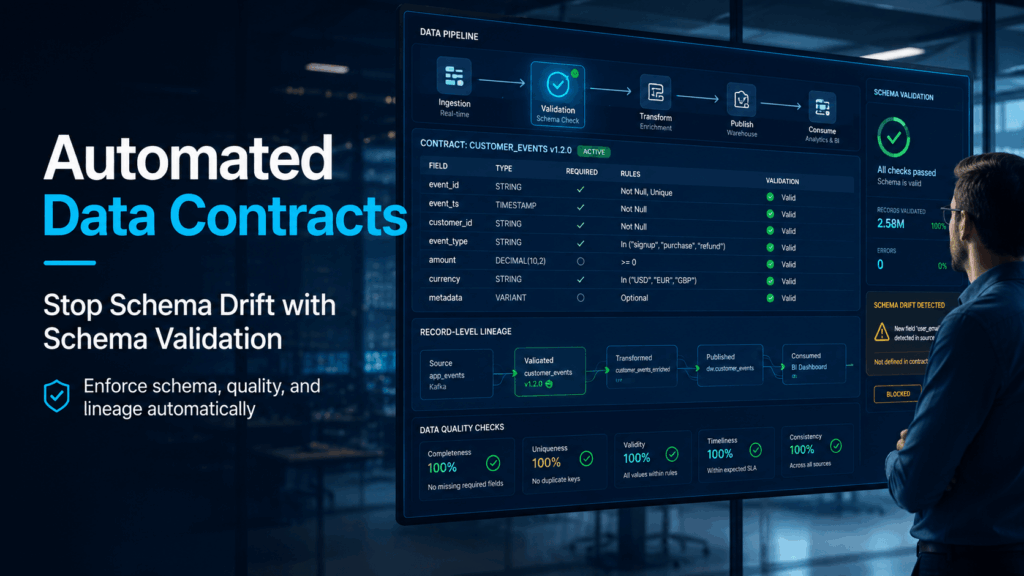
A data contract is an explicit, programmatic agreement between data producers and downstream consumers. It defines expected schemas, data types, freshness, and quality constraints at the pipeline level, guaranteeing that structural evolution occurs safely and predictably without breaking production systems. 

The Brittle Reality of Unenforced Schema Drift 

As software engineering teams update microservices and operational databases, underlying data structures inevitably shift. Without automated enforcement, this schema drift ripples across modern lakehouses with severe consequences: 

  • Silent Data Poisoning: Pipelines often do not crash when a column type changes; instead, they ingest malformed records, poisoning clean target tables and corrupting executive dashboards silently. 
  • Broken Downstream AI/ML Models: In an e-commerce setup, if an upstream team renames `user_zip_code` to `postal_code`, fraud detection algorithms relying on that feature suddenly receive null values, crippling real-time predictions. 
  • Engineering Fatigue: Data engineers spend up to 70% of their time writing defensive error-handling scripts, firefighting broken runs, and running painful manual backfills. 

Automating Contract Enforcement with IOblend  

Managing schema evolution and data contracts manually is an uphill battle, but IOblend completely automates this enterprise challenge through built-in DataOps capabilities: 

  • Dynamic Schema Generation & Versioning: IOblend automatically generates schemas from incoming streams, tracking and versioning structural shifts over time to maintain backward compatibility. 
  • Automatic Schema Validation: Every incoming batch or stream is checked against predefined contracts prior to ingestion. 
  • Automated Error Isolation: Rather than crashing the entire pipeline or ingesting corrupted data, invalid records are channelled into dedicated error tables for isolated debugging while valid data continues to flow. 
  • Record-Level Lineage: In the event of schema drift, IOblend provides complete record-level visibility, letting teams instantly trace what changed, what was impacted, and how to resolve it. 

By abstracting away Apache Spark complexity into drag-and-drop, metadata-driven pipelines, IOblend guarantees production-grade data quality without manual overhead. 

Eliminate pipeline downtime and secure your data estate with IOblend, where data contracts stick automatically. 

IOblend: See more. Do more. Deliver better.

Logistics operator at a workstation using a tablet with holographic screens showing live ETA, weather, and a route map at a busy distribution hub.
AI
admin

Building Live ETA Pipelines for Fleet Operations

Logistics: Live ETA Prediction Pipelines from Fleet + Orders  🚚 Did you know? The “Last Mile” is famously the most expensive and inefficient part of the supply chain, often accounting for up to 53% of total shipping costs.  The Evolution of Real-Time Logistics  Live ETA (Estimated Time of Arrival) prediction pipelines represent the shift from reactive

Read More »
DB2-to-Lakehouse-with-CDC-IOblend
AI
admin

DB2 CDC to Lakehouse Without Re-Platforming

From DB2 to Lakehouse: Real-Time CDC Without Re-Platforming  💻 Did you know? Mainframe systems like DB2 still process approximately 30 billion business transactions every single day. Despite the rush toward modern cloud architectures, the world’s most critical financial and logistical data often resides in these “legacy” environments, making them the silent engines of the global economy. 

Read More »
Real-time-data-processing-with-deduplication
AI
admin

Real-Time Upserts: Deduping and Idempotency

Streaming Upserts Done Right: Deduping and Idempotency at Scale  💻 Did you know? In many high-velocity streaming environments, the “same” event can be sent or processed multiple times due to network retries or distributed system failures.  The Art of the Upsert  At its core, a streaming upsert (a portmanteau of “update” and “insert”) is the process of synchronising incoming data with an existing

Read More »
Optimising-data-streams-and-analytics-with-IOblend
AI
admin

Streaming Data Quality That Won’t Break Pipelines

Streaming Without the Sting: Data Quality Rules That Never Break the Flow  💻 Did you know? A single minute of downtime in a high-velocity streaming environment can result in the loss of millions of data points, potentially costing a business thousands of pounds in missed opportunities or regulatory fines. —  Defining Resilient Streaming Quality  Data quality in

Read More »
schema-drift-handling-with-IOblend
AI
admin

Schema Drift: The Silent Killer of Data Pipelines

The Silent Pipeline Killer: Surviving Schema Drift in the Wild  📊 Did you know? In the early days of big data, a single column change in a source database could trigger a “data graveyard” effect, where downstream analytics remained broken for weeks.  The silent pipeline killer  Schema drift occurs when the structure of source data changes

Read More »
Drift-detection-in-data-systems-IOblend
AI
admin

Preventing Data Drift in Modern Data Systems

The Invisible Erosion: Detecting and Managing Data Drift in Modern Architectures  📊 Did you know? According to recent industry surveys, over 70% of organisations experience significant data drift within the first six months of deploying a production system.  The Concept of Data Drift  Data drift occurs when the statistical properties or the underlying structure of incoming data change

Read More »
Scroll to Top