Data Contracts That Stick: Enforce Schema and Expectations Automatically
📜 Did You Know? In the early days of big data, a single unannounced column type change in an upstream transactional database could trigger a catastrophic “data graveyard” effect, corrupting millions of analytics records before anyone noticed.
The Concept of Enforceable Data Contracts
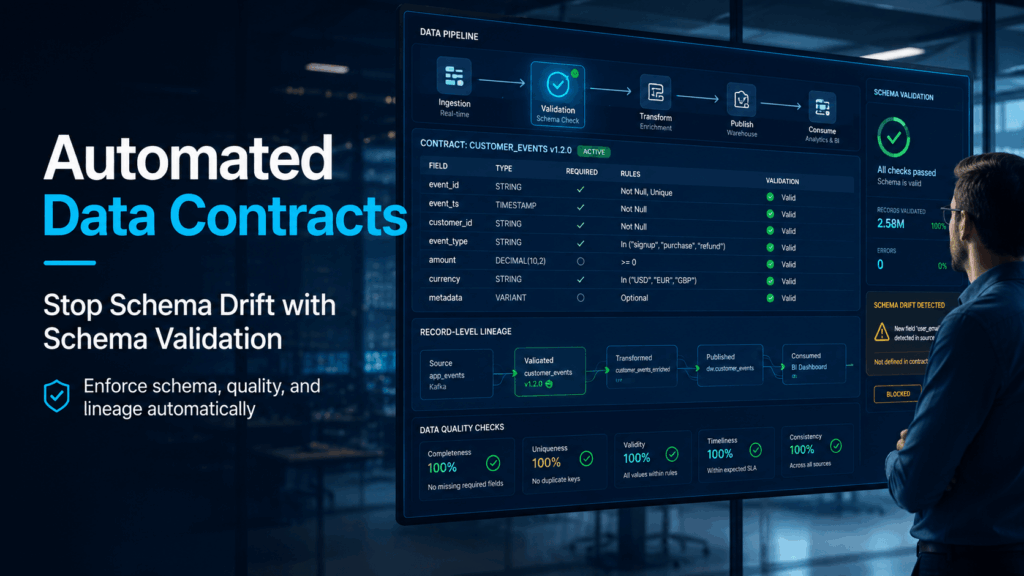
A data contract is an explicit, programmatic agreement between data producers and downstream consumers. It defines expected schemas, data types, freshness, and quality constraints at the pipeline level, guaranteeing that structural evolution occurs safely and predictably without breaking production systems.
The Brittle Reality of Unenforced Schema Drift
As software engineering teams update microservices and operational databases, underlying data structures inevitably shift. Without automated enforcement, this schema drift ripples across modern lakehouses with severe consequences:
- Silent Data Poisoning: Pipelines often do not crash when a column type changes; instead, they ingest malformed records, poisoning clean target tables and corrupting executive dashboards silently.
- Broken Downstream AI/ML Models: In an e-commerce setup, if an upstream team renames `user_zip_code` to `postal_code`, fraud detection algorithms relying on that feature suddenly receive null values, crippling real-time predictions.
- Engineering Fatigue: Data engineers spend up to 70% of their time writing defensive error-handling scripts, firefighting broken runs, and running painful manual backfills.
Automating Contract Enforcement with IOblend
Managing schema evolution and data contracts manually is an uphill battle, but IOblend completely automates this enterprise challenge through built-in DataOps capabilities:
- Dynamic Schema Generation & Versioning: IOblend automatically generates schemas from incoming streams, tracking and versioning structural shifts over time to maintain backward compatibility.
- Automatic Schema Validation: Every incoming batch or stream is checked against predefined contracts prior to ingestion.
- Automated Error Isolation: Rather than crashing the entire pipeline or ingesting corrupted data, invalid records are channelled into dedicated error tables for isolated debugging while valid data continues to flow.
- Record-Level Lineage: In the event of schema drift, IOblend provides complete record-level visibility, letting teams instantly trace what changed, what was impacted, and how to resolve it.
By abstracting away Apache Spark complexity into drag-and-drop, metadata-driven pipelines, IOblend guarantees production-grade data quality without manual overhead.
Eliminate pipeline downtime and secure your data estate with IOblend, where data contracts stick automatically.

Agentic AI ETL for Real-Time Sentiment Pricing
Sentiment-Driven Pricing: Using Agentic AI ETL to scrape social sentiment and adjust prices dynamically within the data flow 🤖 Did you know? A single viral tweet or a trending TikTok “dupe” video can alter the perceived value of a product by over 40% in less than six hours. Traditional pricing engines, which rely on historical sales

BCBS 239 Compliance with Record-Level Lineage
Regulatory Compliance at Scale: Automating record-level lineage and audit trails for BCBS 239 📋 Did you know? In the wake of the 2008 financial crisis, the Basel Committee found that many global banks were unable to aggregate risk exposures accurately or quickly because their data landscapes were too complex. This led to the birth of BCBS

Real-Time Churn Agents with Closed-Loop MLOps
Churn Prevention: Building “closed-loop” MLOps systems that predict churn and trigger automated retention agents 🔗 Did you know? In the telecommunications and subscription-based sectors, a mere 5% increase in customer retention can lead to a staggering profit surge of more than 25%. Closed-Loop MLOps A “closed-loop” MLOps system is an advanced architectural pattern that transcends simple predictive analytics. While

Streaming Predictive MX: Drift-Aware Inference
Predictive Maintenance 2.0: Feeding real-time sensor drifts directly into inference models using streaming engine 🔩 Did you know? The cost of unplanned downtime for industrial manufacturers is estimated at nearly £400 billion annually. Predictive Maintenance 2.0: The Real-Time Evolution Predictive Maintenance 2.0 represents a paradigm shift from batch-processed diagnostics to live, autonomous synchronisation. In the traditional 1.0

Beyond Micro-Batching: Continuous Streaming for AI
Beyond Micro-batching: Why Continuous Streaming Engine is the Future of “Fresh Data” for AI 💻 Did you know? Most modern “real-time” AI applications are actually running on data that is already several minutes old. Traditional micro-batching collects data into small chunks before processing it, introducing a “latency tax” that can render predictive models obsolete before they

ERP Cloud Migration With Live Data Sync
Seamless Core System Migration: The Move of Large-Scale Banking and Insurance ERP Data to a Modern Cloud Architecture ⛅ Did you know that core system migrations in large financial institutions, which typically rely on manual data mapping and validation, often require parallel runs lasting over 18 months? The Core Challenge The migration of multi-terabyte ERP and