
Data Contracts That Stick: Enforce Schema and Expectations Automatically
📜 Did You Know? In the early days of big data, a single unannounced column type change in an upstream transactional database could trigger a catastrophic “data graveyard” effect, corrupting millions of analytics records before anyone noticed.
The Concept of Enforceable Data Contracts
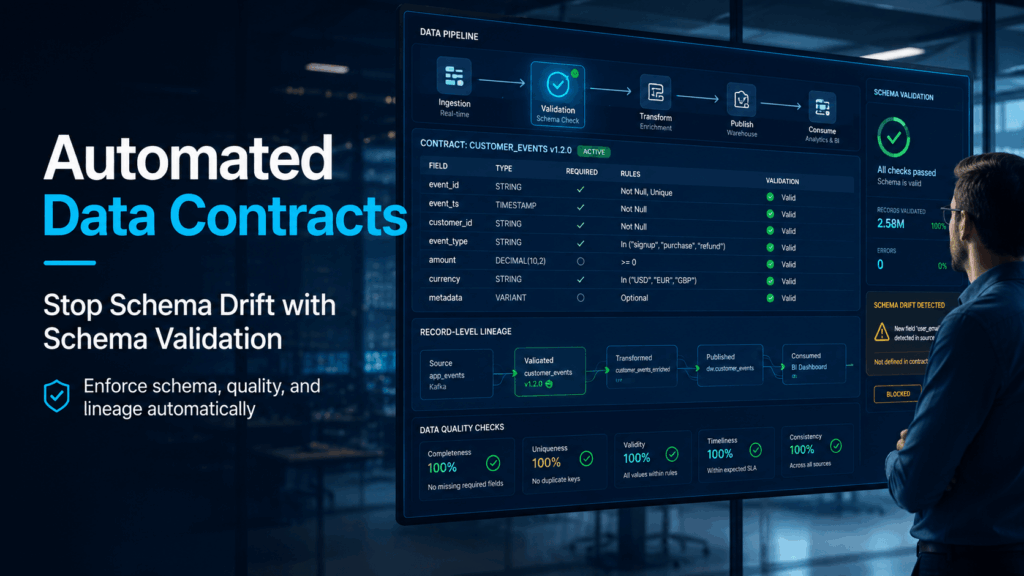
A data contract is an explicit, programmatic agreement between data producers and downstream consumers. It defines expected schemas, data types, freshness, and quality constraints at the pipeline level, guaranteeing that structural evolution occurs safely and predictably without breaking production systems.
The Brittle Reality of Unenforced Schema Drift
As software engineering teams update microservices and operational databases, underlying data structures inevitably shift. Without automated enforcement, this schema drift ripples across modern lakehouses with severe consequences:
- Silent Data Poisoning: Pipelines often do not crash when a column type changes; instead, they ingest malformed records, poisoning clean target tables and corrupting executive dashboards silently.
- Broken Downstream AI/ML Models: In an e-commerce setup, if an upstream team renames `user_zip_code` to `postal_code`, fraud detection algorithms relying on that feature suddenly receive null values, crippling real-time predictions.
- Engineering Fatigue: Data engineers spend up to 70% of their time writing defensive error-handling scripts, firefighting broken runs, and running painful manual backfills.
Automating Contract Enforcement with IOblend
Managing schema evolution and data contracts manually is an uphill battle, but IOblend completely automates this enterprise challenge through built-in DataOps capabilities:
- Dynamic Schema Generation & Versioning: IOblend automatically generates schemas from incoming streams, tracking and versioning structural shifts over time to maintain backward compatibility.
- Automatic Schema Validation: Every incoming batch or stream is checked against predefined contracts prior to ingestion.
- Automated Error Isolation: Rather than crashing the entire pipeline or ingesting corrupted data, invalid records are channelled into dedicated error tables for isolated debugging while valid data continues to flow.
- Record-Level Lineage: In the event of schema drift, IOblend provides complete record-level visibility, letting teams instantly trace what changed, what was impacted, and how to resolve it.
By abstracting away Apache Spark complexity into drag-and-drop, metadata-driven pipelines, IOblend guarantees production-grade data quality without manual overhead.
Eliminate pipeline downtime and secure your data estate with IOblend, where data contracts stick automatically.

Unify Clinical & Financial Data to Cut Readmissions
Clinical-Financial Synergy: The Seamless Integration of Clinical and Financial Data to Minimise Readmissions 🚑 Did You Know? Unnecessary hospital readmissions within 30 days represent a colossal financial burden, often reflecting suboptimal transitional care. Clinical-Financial Synergy: The Seamless Integration of Clinical and Financial Data to Minimise Readmissions The Convergence of Clinical and Financial Data The convergence of clinical and financial

Agentic Pipelines and Real-Time Data with Guardrails
The New Era of ETL: Agentic Pipelines and Real-Time Data with Guardrails For years, ETL meant one thing — moving and transforming data in predictable, scheduled batches, often using a multitude of complementary tools. It was practical, reliable, and familiar. But in 2025, well, that’s no longer enough. Let’s have a look at the shift

Real-Time Insurance Claims with CDC and Spark
From Batch to Real-Time: Accelerating Insurance Claims Processing with CDC and Spark 💼 Did you know? In the insurance sector, the move from overnight batch processing to real-time stream processing has been shown to reduce the average claims settlement time from several days to under an hour in highly automated systems. Real-Time Data and Insurance

Agentic AI: The New Standard for ETL Governance
Autonomous Finance: Agentic AI as the New Standard for ETL Governance and Resilience 📌 Did You Know? Autonomous data quality agents deployed by leading financial institutions have been shown to proactively detect and correct up to 95% of critical data quality issues. The Agentic AI Concept Agentic Artificial Intelligence (AI) represents the progression beyond simple prompt-and-response

IOblend: Simplifying Feature Stores for Modern MLOps
IOblend: Simplifying Feature Stores for Modern MLOps Feature stores emerged to solve a real challenge in machine learning: managing features across models, maintaining consistency between training and inference, and ensuring proper governance. To meet this need, many solutions introduced new infrastructure layers—Redis, DynamoDB, Feast-style APIs, and others. While these tools provided powerful capabilities, they also

Rethinking the Feature Store concept for MLOps
Rethinking the Feature Store concept for MLOps Today we talk about Feature Stores. The recent Databricks acquisition of Tecton raised an interesting question for us: can we make a feature store work with any infra just as easily as a dedicated system using IOblend? Let’s have a look. How a Feature Store Works Today Machine