Regulatory Compliance at Scale: Automating record-level lineage and audit trails for BCBS 239
📋 Did you know? In the wake of the 2008 financial crisis, the Basel Committee found that many global banks were unable to aggregate risk exposures accurately or quickly because their data landscapes were too complex. This led to the birth of BCBS 239. Today, non-compliance isn’t just a legal risk; it is a financial one.
The Scale Challenge: Why Traditional Methods Fail
For Tier-1 banks, data is not a stream; it is an ocean. The primary issue businesses face is granularity at scale. Most legacy tools provide “object-level” lineage. However, BCBS 239 demands “record-level” transparency. When a regulator asks why a specific risk metric jumped by 2%, a bank must identify the exact underlying transactions that caused the shift.
Manual documentation and metadata-only mapping fall apart under this pressure. Siloed environments lead to “black boxes” where transformations happen in hidden scripts, making it impossible to reconstruct an audit trail during a crisis. Furthermore, the sheer volume of data often results in “lineage lag,” where the documentation is weeks behind the actual data flows, rendering it useless for real-time risk management.
Precision Engineering with IOblend
IOblend redefines regulatory compliance by automating the heavy lifting of data engineering. Unlike traditional middleware, IOblend focuses on DataOps automation, providing a seamless way to generate record-level lineage without the manual overhead.
How IOblend Solves the Issue:
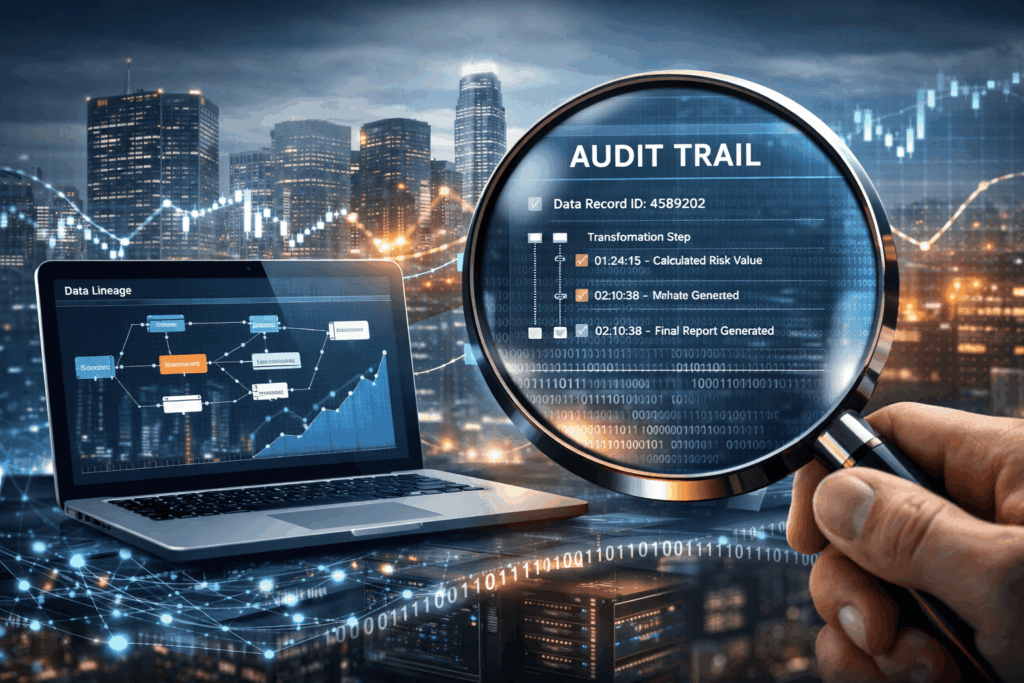
- Automated Lineage: It builds a living map of your data ecosystem. Every move and change is logged automatically, ensuring the lineage is always “as-run” and not just “as-designed.”
- Immutable Audit Trails: IOblend creates a tamper-proof history of data movements. This provides the “integrity” required by BCBS 239, proving that data hasn’t been surreptitiously altered.
- High-Performance Engine: Designed for scale, IOblend handles massive datasets without bottlenecks, ensuring that auditability doesn’t come at the cost of processing speed.
- End-to-End Visibility: By integrating with various sources and targets, it eliminates data silos, providing a “single pane of glass” for compliance officers and data engineers alike.
Transform your regulatory framework into a competitive advantage with IOblend.

Digital Twin Evolution: Big Data & AI with
The Industrial Renaissance: How Agentic AI and Big Data Power the Self-Optimising Digital Twin 🏭 Did You Know? A fully realised industrial Digital Twin, underpinned by real-time data, has been proven to reduce unplanned production downtime by up to 20%. The Digital Twin Evolution The Digital Twin is a sophisticated, living, virtual counterpart of a physical production system. It

Real-Time Risk Modelling with Legacy & Modern Data
Risk Modelling in Real-time: Integrating Legacy Oracle/HP Underwriting Data with Modern External Datasets 💼 Did you know that in the time it takes to brew a cup of tea, a real-time risk model could have processed enough data to flag over 60 million potential fraudulent insurance claims? The Real-Time Risk Modelling Imperative Real-time risk modelling is

Unify Clinical & Financial Data to Cut Readmissions
Clinical-Financial Synergy: The Seamless Integration of Clinical and Financial Data to Minimise Readmissions 🚑 Did You Know? Unnecessary hospital readmissions within 30 days represent a colossal financial burden, often reflecting suboptimal transitional care. Clinical-Financial Synergy: The Seamless Integration of Clinical and Financial Data to Minimise Readmissions The Convergence of Clinical and Financial Data The convergence of clinical and financial

Agentic Pipelines and Real-Time Data with Guardrails
The New Era of ETL: Agentic Pipelines and Real-Time Data with Guardrails For years, ETL meant one thing — moving and transforming data in predictable, scheduled batches, often using a multitude of complementary tools. It was practical, reliable, and familiar. But in 2025, well, that’s no longer enough. Let’s have a look at the shift

Real-Time Insurance Claims with CDC and Spark
From Batch to Real-Time: Accelerating Insurance Claims Processing with CDC and Spark 💼 Did you know? In the insurance sector, the move from overnight batch processing to real-time stream processing has been shown to reduce the average claims settlement time from several days to under an hour in highly automated systems. Real-Time Data and Insurance

Agentic AI: The New Standard for ETL Governance
Autonomous Finance: Agentic AI as the New Standard for ETL Governance and Resilience 📌 Did You Know? Autonomous data quality agents deployed by leading financial institutions have been shown to proactively detect and correct up to 95% of critical data quality issues. The Agentic AI Concept Agentic Artificial Intelligence (AI) represents the progression beyond simple prompt-and-response