Regulatory Compliance at Scale: Automating record-level lineage and audit trails for BCBS 239
📋 Did you know? In the wake of the 2008 financial crisis, the Basel Committee found that many global banks were unable to aggregate risk exposures accurately or quickly because their data landscapes were too complex. This led to the birth of BCBS 239. Today, non-compliance isn’t just a legal risk; it is a financial one.
The Scale Challenge: Why Traditional Methods Fail
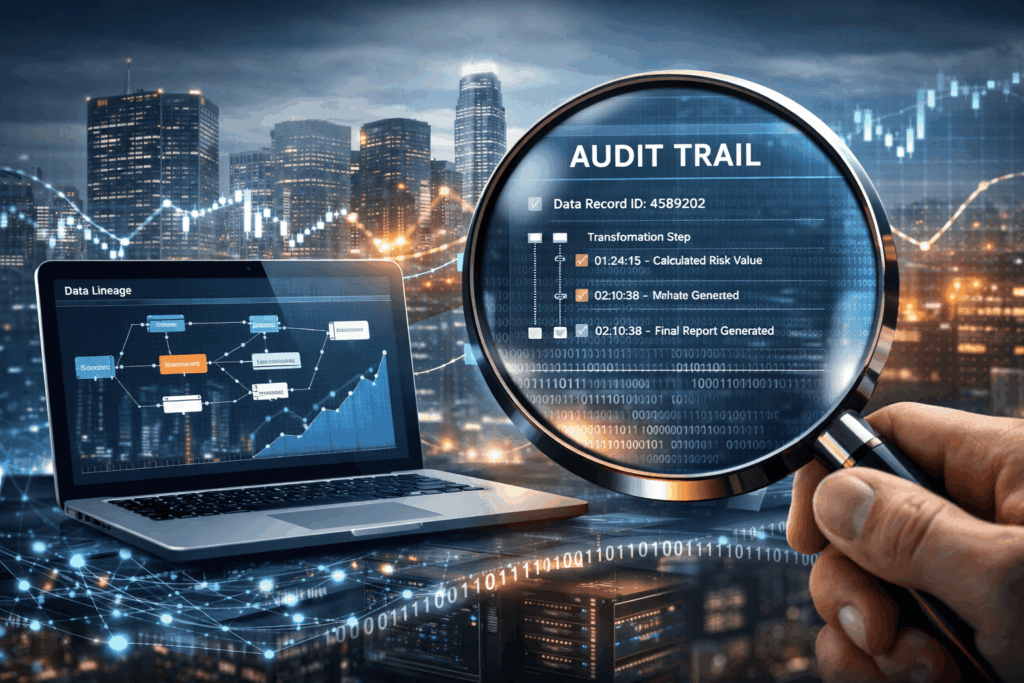
For Tier-1 banks, data is not a stream; it is an ocean. The primary issue businesses face is granularity at scale. Most legacy tools provide “object-level” lineage. However, BCBS 239 demands “record-level” transparency. When a regulator asks why a specific risk metric jumped by 2%, a bank must identify the exact underlying transactions that caused the shift.
Manual documentation and metadata-only mapping fall apart under this pressure. Siloed environments lead to “black boxes” where transformations happen in hidden scripts, making it impossible to reconstruct an audit trail during a crisis. Furthermore, the sheer volume of data often results in “lineage lag,” where the documentation is weeks behind the actual data flows, rendering it useless for real-time risk management.
Precision Engineering with IOblend
IOblend redefines regulatory compliance by automating the heavy lifting of data engineering. Unlike traditional middleware, IOblend focuses on DataOps automation, providing a seamless way to generate record-level lineage without the manual overhead.
How IOblend Solves the Issue:
- Automated Lineage: It builds a living map of your data ecosystem. Every move and change is logged automatically, ensuring the lineage is always “as-run” and not just “as-designed.”
- Immutable Audit Trails: IOblend creates a tamper-proof history of data movements. This provides the “integrity” required by BCBS 239, proving that data hasn’t been surreptitiously altered.
- High-Performance Engine: Designed for scale, IOblend handles massive datasets without bottlenecks, ensuring that auditability doesn’t come at the cost of processing speed.
- End-to-End Visibility: By integrating with various sources and targets, it eliminates data silos, providing a “single pane of glass” for compliance officers and data engineers alike.
Transform your regulatory framework into a competitive advantage with IOblend.

The AI Hype Trap: Why Overblown Promises Backfire
AI and GenAI adoption must make a visible and material positive impact on the business or it’s a waste of money.

The Art of Assembly: Where Data Meets Conveyors
Manufacturing is all about getting the most out of automation, skilled workforce, and data. Data helps drive the decisions that keep everything running smoothly

Saving Cents on Data Sense: Less Cost, More Value
No company is immune from the pains of data integration. It is one of the top IT cost items. Companies must get on top of their integration effort.

Operational Analytics: Real-Time Insights That Matter
Operational analytics involves processing and analysing operational data in “real-time” to gain insights that inform immediate and actionable decisions.

Deciphering the True Cost of Your Data Investment
Many data teams aren’t aware of the concept of Total Ownership Cost or its importance. Getting it right in planning will save you a massive headache later.

When Data Science Meets Domain Expertise
In the modern days of GenAI and advanced analytics, businesses need to bring domain expertise and data knowledge together in an effective manner.