AW-10865990051

Building Live ETA Pipelines for Fleet Operations

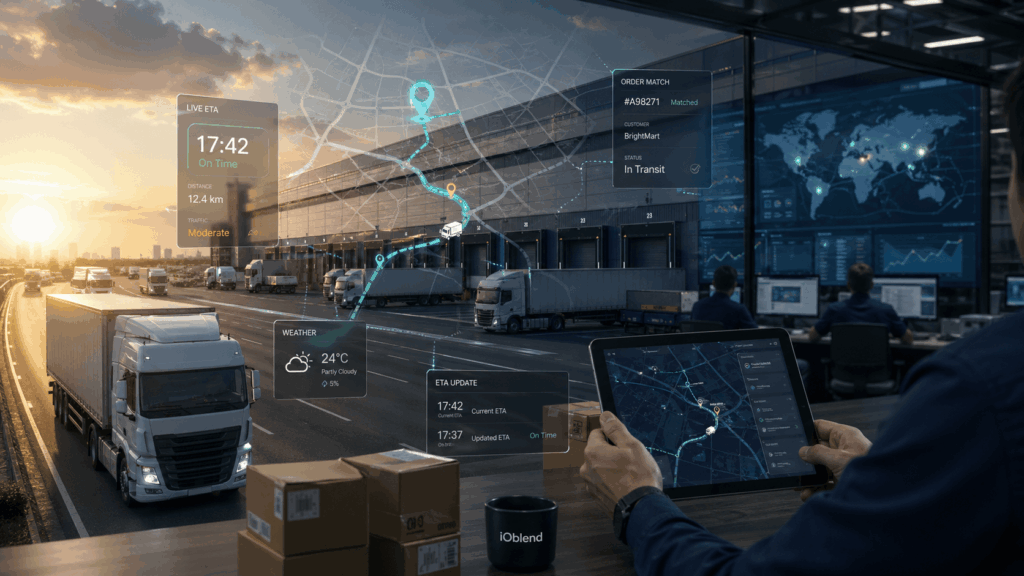
Logistics operator at a workstation using a tablet with holographic screens showing live ETA, weather, and a route map at a busy distribution hub.

Logistics: Live ETA Prediction Pipelines from Fleet + Orders 

🚚 Did you know? The “Last Mile” is famously the most expensive and inefficient part of the supply chain, often accounting for up to 53% of total shipping costs. 

The Evolution of Real-Time Logistics 

Live ETA (Estimated Time of Arrival) prediction pipelines represent the shift from reactive tracking to proactive orchestration. By fusing high-frequency telemetry data from vehicle fleets, such as GPS coordinates, engine diagnostics, and fuel consumption, with transactional order data and external variables like live traffic and weather, firms can create a dynamic digital twin of their entire logistics network. For data experts, this isn’t just about a timestamp; it’s about a continuous stream of state updates that allow for millisecond-level recalculations of delivery windows. 

The Friction in the Pipeline 

Building these systems is notoriously difficult due to the “velocity-variety” trap. Logistics data is inherently messy. Fleet telemetry often arrives via asynchronous MQTT streams, while order data might sit in a legacy SQL database or a modern ERP. 

Common hurdles include: 

  • Schema Drift: When a telematics provider updates their sensor payload without notice, downstream prediction models often break silently. 
  • Late-Arriving Data: Handling out-of-order events from drivers moving through “dead zones” requires complex watermarking and state management. 
  • Feature Engineering at Scale: Calculating a “rolling average speed over the last 10 minutes” for 10,000 trucks simultaneously creates immense computational overhead. 
  • The Integration Gap: Most businesses struggle to join the inflight stream of a truck with the static metadata of the 500 parcels inside it, leading to “stale” predictions that frustrate end customers. 

Synchronising the Stream with IOblend 

This is where IOblend transforms the architectural approach. Rather than duct-taping disparate tools together, IOblend provides a unified environment to build robust DataOps pipelines that handle the rigours of live logistics.  

IOblend’s platform excels at managing the complexity of real-time ETA engines: 

  • Unified Streaming & Batch: It seamlessly blends high-speed fleet telemetry with heavy-duty order history, ensuring your models always have the full context. 
  • Late Arriving Data: IOblend handles late arriving data automatically through metadata-driven rules for event time, watermarks, deduplication, controlled upserts, and selective reprocessing. 
  • Automated Schema Evolution: IOblend detects and manages changes in data structures automatically, preventing the pipeline failures that typically plague IoT-heavy sectors. 
  • Record-Level Lineage: In logistics, knowing why a prediction was wrong is as vital as the prediction itself. IOblend provides granular visibility into every data point’s journey. 
  • Resilient Data Engineering: By simplifying the deployment of complex transformations, IOblend allows data teams to focus on refining their ML models rather than managing infrastructure. 

Stop chasing the clock and start commanding your data, deliver certainty at scale with IOblend. 

IOblend: See more. Do more. Deliver better.

AI
admin

Unify Clinical & Financial Data to Cut Readmissions

Clinical-Financial Synergy: The Seamless Integration of Clinical and Financial Data to Minimise Readmissions   🚑 Did You Know? Unnecessary hospital readmissions within 30 days represent a colossal financial burden, often reflecting suboptimal transitional care.  Clinical-Financial Synergy: The Seamless Integration of Clinical and Financial Data to Minimise Readmissions  The Convergence of Clinical and Financial Data  The convergence of clinical and financial

Read More »
AI_agents_langchain_ETL_IOblend
AI
admin

Agentic Pipelines and Real-Time Data with Guardrails

The New Era of ETL: Agentic Pipelines and Real-Time Data with Guardrails For years, ETL meant one thing — moving and transforming data in predictable, scheduled batches, often using a multitude of complementary tools. It was practical, reliable, and familiar. But in 2025, well, that’s no longer enough. Let’s have a look at the shift

Read More »
real time CDC and SPARK IOblend
AI
admin

Real-Time Insurance Claims with CDC and Spark

From Batch to Real-Time: Accelerating Insurance Claims Processing with CDC and Spark 💼 Did you know? In the insurance sector, the move from overnight batch processing to real-time stream processing has been shown to reduce the average claims settlement time from several days to under an hour in highly automated systems. Real-Time Data and Insurance 

Read More »
AI
admin

Agentic AI: The New Standard for ETL Governance

Autonomous Finance: Agentic AI as the New Standard for ETL Governance and Resilience  📌 Did You Know? Autonomous data quality agents deployed by leading financial institutions have been shown to proactively detect and correct up to 95% of critical data quality issues.  The Agentic AI Concept Agentic Artificial Intelligence (AI) represents the progression beyond simple prompt-and-response

Read More »
feaute_store_mlops_ioblend
AI
admin

IOblend: Simplifying Feature Stores for Modern MLOps

IOblend: Simplifying Feature Stores for Modern MLOps Feature stores emerged to solve a real challenge in machine learning: managing features across models, maintaining consistency between training and inference, and ensuring proper governance. To meet this need, many solutions introduced new infrastructure layers—Redis, DynamoDB, Feast-style APIs, and others. While these tools provided powerful capabilities, they also

Read More »
feature_store_value_ioblend
AI
admin

Rethinking the Feature Store concept for MLOps

Rethinking the Feature Store concept for MLOps Today we talk about Feature Stores. The recent Databricks acquisition of Tecton raised an interesting question for us: can we make a feature store work with any infra just as easily as a dedicated system using IOblend? Let’s have a look. How a Feature Store Works Today Machine

Read More »
Scroll to Top