
Logistics: Live ETA Prediction Pipelines from Fleet + Orders
🚚 Did you know? The “Last Mile” is famously the most expensive and inefficient part of the supply chain, often accounting for up to 53% of total shipping costs.
The Evolution of Real-Time Logistics
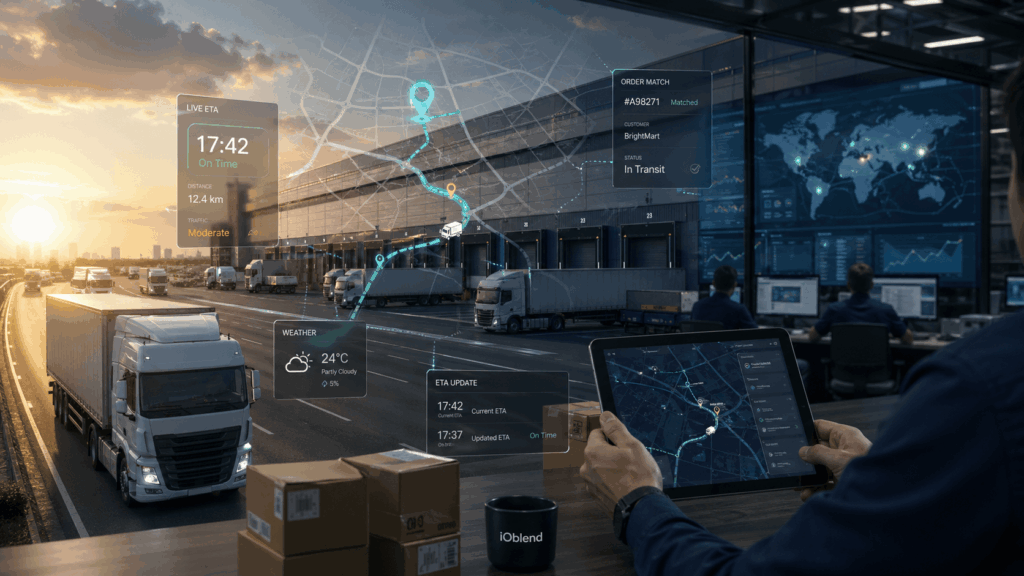
Live ETA (Estimated Time of Arrival) prediction pipelines represent the shift from reactive tracking to proactive orchestration. By fusing high-frequency telemetry data from vehicle fleets, such as GPS coordinates, engine diagnostics, and fuel consumption, with transactional order data and external variables like live traffic and weather, firms can create a dynamic digital twin of their entire logistics network. For data experts, this isn’t just about a timestamp; it’s about a continuous stream of state updates that allow for millisecond-level recalculations of delivery windows.
The Friction in the Pipeline
Building these systems is notoriously difficult due to the “velocity-variety” trap. Logistics data is inherently messy. Fleet telemetry often arrives via asynchronous MQTT streams, while order data might sit in a legacy SQL database or a modern ERP.
Common hurdles include:
- Schema Drift: When a telematics provider updates their sensor payload without notice, downstream prediction models often break silently.
- Late-Arriving Data: Handling out-of-order events from drivers moving through “dead zones” requires complex watermarking and state management.
- Feature Engineering at Scale: Calculating a “rolling average speed over the last 10 minutes” for 10,000 trucks simultaneously creates immense computational overhead.
- The Integration Gap: Most businesses struggle to join the inflight stream of a truck with the static metadata of the 500 parcels inside it, leading to “stale” predictions that frustrate end customers.
Synchronising the Stream with IOblend
This is where IOblend transforms the architectural approach. Rather than duct-taping disparate tools together, IOblend provides a unified environment to build robust DataOps pipelines that handle the rigours of live logistics.
IOblend’s platform excels at managing the complexity of real-time ETA engines:
- Unified Streaming & Batch: It seamlessly blends high-speed fleet telemetry with heavy-duty order history, ensuring your models always have the full context.
- Late Arriving Data: IOblend handles late arriving data automatically through metadata-driven rules for event time, watermarks, deduplication, controlled upserts, and selective reprocessing.
- Automated Schema Evolution: IOblend detects and manages changes in data structures automatically, preventing the pipeline failures that typically plague IoT-heavy sectors.
- Record-Level Lineage: In logistics, knowing why a prediction was wrong is as vital as the prediction itself. IOblend provides granular visibility into every data point’s journey.
- Resilient Data Engineering: By simplifying the deployment of complex transformations, IOblend allows data teams to focus on refining their ML models rather than managing infrastructure.
Stop chasing the clock and start commanding your data, deliver certainty at scale with IOblend.

Rapid AI Implementation: Moving Beyond Proof of Concept
Rapid AI Implementation: Moving Beyond Proof of Concept 💻 Did you know that in 2024, the average time it took for a business to deploy an AI model from the experimental stage to full production was approximately six months? Bringing AI Experiments to Life The journey of an AI project typically begins with a “proof

Agentic AI ETL: The Future of Data Integration
Agentic AI ETL: The Future of Data Integration 📓 Did you know? By 2025, the volume of data generated globally is projected to reach 175 zettabytes? That’s a truly enormous number, highlighting the ever-increasing importance of efficient data management. What is Agentic AI ETL? Agentic AI ETL represents a transformative evolution in data integration. Traditional

Break Down the Data Walls with IOblend
Break Down the Data Walls with IOblend 📑 Did you know? It’s estimated that a whopping 80% of business data is just floating about, unstructured and stuck in siloed systems. Siloed data only brings value (if at all!) to the domain it belongs to. But the true value lies in the insights in brings to

Put a Stop to Data Chaos with IOblend Governed Integration
Put a Stop to Data Chaos with IOblend Governed Integration 🤯💥Did you know? By 2025, the global datasphere is projected to grow to 175 zettabytes? This staggering figure underscores the sheer scale of data businesses must manage, making simplification not just a luxury, but a necessity. Today, businesses don’t have a shortage of data. What

Optimising Customer Experience Through Real Time Data Sync
Optimising Customer Experiences Through Real Time Data Sync 🧠 Fun Fact: Did you know that 90% of the world’s data has been created in just the past two years? That’s a lot of information to manage – and a massive opportunity for businesses that know how to use it wisely. Understanding your customers is the

How Poor Data Integration Drains Productivity & Profits
How Poor Data Integration Drains Productivity & Profits Data is one of the most valuable assets a company can possess. We all know that (and if you still do not, god help you). Businesses rely on data to make informed decisions, optimise operations, drive customer engagement, etc. Data is everywhere and it’s waiting for us