AW-10865990051

Data Migration QA: Checksums & Audit Trails

Migration-QA-at-Scale-Reconciliation-Checksums-and-Audit-Trails

Migration QA at Scale: Reconciliation, Checksums, and Audit Trails 

📂 Did you know that during enterprise database migrations, as much as 20% of quiet data corruption goes entirely unnoticed until post-cutover operational failures occur? 

Understanding migration QA at scale 

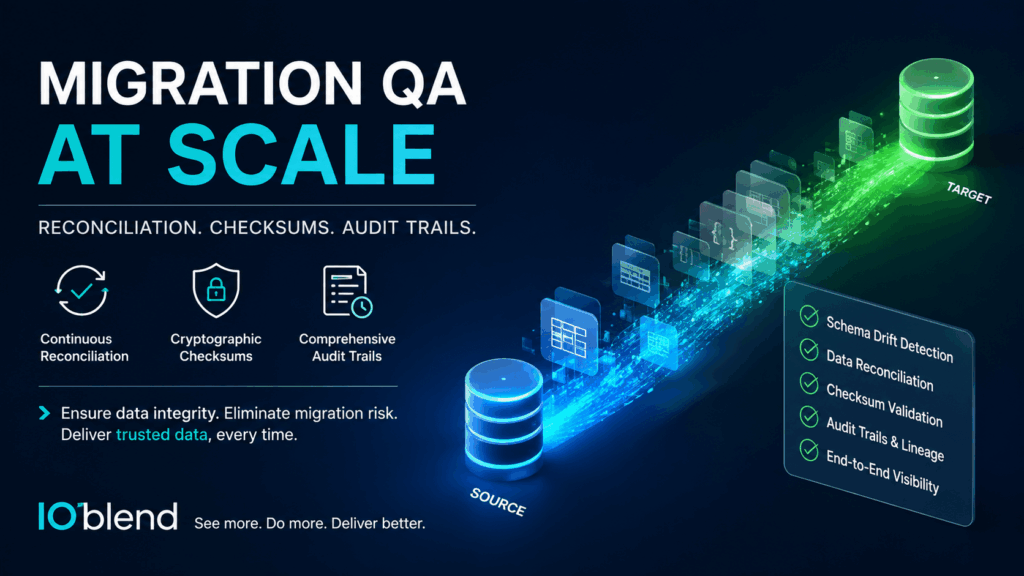
Migration QA at scale refers to the systematic validation of volume, structure, and integrity when shifting enterprise data across heterogeneous environments. Rather than relying on simple row counts, modern reconciliation demands three core pillars: continuous reconciliation to guarantee record symmetry, cryptographic checksums to verify payload fidelity down to individual byte values, and comprehensive audit trails to record end-to-end lineage and schema evolution. 

The operational bottlenecks in enterprise migrations 

Engineering teams undertaking complex migrations regularly encounter severe operational hurdles: 

  • Silent schema drift and field truncation: Unannounced schema changes or subtle precision losses (e.g. timestamp truncation or numeric overflow) in active source pipelines corrupt target datasets quietly without throwing fatal job errors. 
  • Prohibitive compute overhead: Executing full-table hashing or cell-by-cell row comparisons across billions of records introduces unsustainable latency and spikes warehouse consumption costs. 
  • Lack of record-level lineage: When discrepancies emerge, pinpointing whether the fault stemmed from network drops, transformation logic, or late-arriving CDC records requires painstaking manual log analysis. 
  • Multi-tool stack complexity: Orchestrating separate tools for batch extracts, streaming CDC, data quality assertions, and logging creates fragile pipelines that fail unexpectedly under high throughput. 

Eliminating migration risks with IOblend 

IOblend solves these migration QA challenges by standardising production data pipelines on Apache Spark through portable JSON playbooks and native Python/SQL logic. 

  • Automated continuous reconciliation and line-level lineage: IOblend tracks schema evolution and change data capture in real time (including late-arriving data), delivering record-level lineage so you can trace, debug, and replay discrepancies instantly. 
  • Cryptographic integrity and high-throughput validation: Capable of processing over 1 million transactions per second with ultra-low P99 latency, IOblend executes validation rules and custom checksum checks directly on Spark infrastructure without heavy warehouse compute costs. 
  • Unified governance and auditability: Built-in audit trails, automated data quality controls, and drift handling ensure full end-to-end compliance from source to sink across cloud and on-premises environments. 

Eliminate migration anxiety and streamline your data pipeline testing. Supercharge your enterprise data migrations with IOblend. 

IOblend: See more. Do more. Deliver better.

feaute_store_mlops_ioblend
AI
admin

IOblend: Simplifying Feature Stores for Modern MLOps

IOblend: Simplifying Feature Stores for Modern MLOps Feature stores emerged to solve a real challenge in machine learning: managing features across models, maintaining consistency between training and inference, and ensuring proper governance. To meet this need, many solutions introduced new infrastructure layers—Redis, DynamoDB, Feast-style APIs, and others. While these tools provided powerful capabilities, they also

Read More »
feature_store_value_ioblend
AI
admin

Rethinking the Feature Store concept for MLOps

Rethinking the Feature Store concept for MLOps Today we talk about Feature Stores. The recent Databricks acquisition of Tecton raised an interesting question for us: can we make a feature store work with any infra just as easily as a dedicated system using IOblend? Let’s have a look. How a Feature Store Works Today Machine

Read More »
IOblend_ERP_CRM_data_integration
AI
admin

CRM + ERP: Powering Predictive Analytics

The Data-Driven Value Chain: Predictive Analytics with CRM and ERP  📊 Did you know? A study on real-time data integration platforms revealed that organisations can reduce their average response time to supply chain disruptions from 5.2 hours to just 37 minutes.  A Unified Data Landscape  The modern value chain is a complex ecosystem where every component is interconnected,

Read More »
agentic AI data migrations
AI
admin

Enhancing Data Migrations with IOblend Agentic AI ETL

LeanData Optimising Cloud Migration: for Telecoms with Agentic AI ETL  📡 Did you know? The global telecommunications industry is projected to create over £120 billion in value from agentic AI by 2026.  The Dawn of Agentic AI ETL  For data experts in the telecoms sector, the term ETL—Extract, Transform, Load—is a familiar, if often laborious, process. It’s

Read More »
data integration IOblend
AI
admin

LeanData: Reduce Data Waste & Boost Efficiency

LeanData Strategy: Reduce Data Waste & Boost Efficiency | IOblend 📊 Did you know? Globally, we generate around 50 million tonnes of e-waste every year.  What is LeanData? LeanData is more than a passing trend — it’s a disciplined, results-focused approach to data management.At its core, LeanData means shifting from a “collect everything, sort it later” mentality to

Read More »
AI
admin

The Data Deluge: Are You Ready?

The Data Deluge: Are You Ready? 📰 Did you know? Some modern data centres are being designed with modularity in mind, allowing them to expand upwards – effectively “raising the roof” – to accommodate future increases in data demand without significant structural overhauls. — Raising the data roof refers to designing and implementing a data

Read More »
Scroll to Top