
De-Risk Your Migration: Run Legacy and New Systems in Parallel
💻 Did you know? An alarming 83% of data migrations either fail outright or drastically overrun their budgets. When management loses patience with mounting technical friction, entire digital transformations are written off.
Minimising the migration gamble
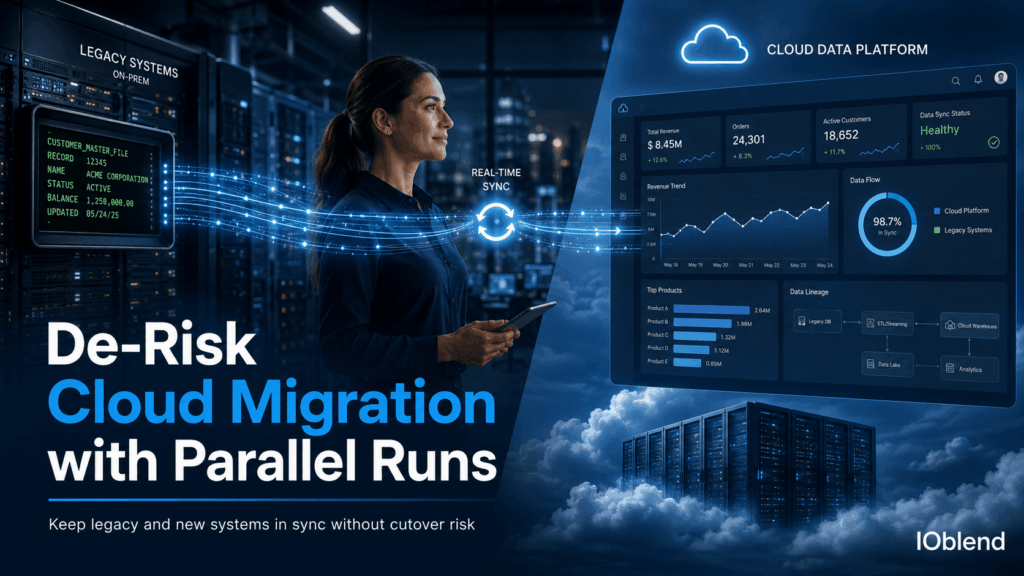
To eliminate this operational hazard, running legacy and new systems in parallel has become the preferred methodology for data experts. Instead of risking a single, catastrophic cutover, you replicate business logic in the new cloud environment and synchronise data flows across both systems. By operating both platforms simultaneously, you create a safety net. This allows you to validate data consistency, test performance under real-world loads, and ensure continuity without interrupting daily business operations.
The friction of double maintenance
While parallel runs dramatically lower operational risk, they introduce distinct architectural challenges. Data engineers face the immense burden of maintaining data integrity across disparate system vintages.
Businesses commonly struggle with several critical issues:
- Logic Drift: Replicating complex, shifting business rules between on-prem systems and modern cloud architectures often results in data discrepancies.
- Dual-Write Complexity: Building custom Change Data Capture (CDC) and bi-directional synchronization to keep multiple databases aligned in real-time requires immense developer resources.
- Pipeline Bloat: Engineers routinely end up “babysitting” a fragmented five-tool stack just to handle streaming, data quality checks, and schema evolution.
How IOblend turns months into weeks
This is where IOblend completely alters the migration paradigm. As a next-generation data integration application, IOblend abstracts away the architectural complexity of parallel runs, allowing you to build production-grade pipelines in minutes rather than quarters.
By standardising pipelines on Apache Spark™ as portable JSON playbooks, IOblend delivers the tools needed to execute a seamless, risk-free parallel migration:
- Real-Time Synchronisation: With built-in, log-based CDC and bi-directional data mirroring, IOblend keeps your legacy and new platforms perfectly in sync, automatically eliminating manual updates and data errors.
- Out-of-the-Box DataOps: Every pipeline automatically manages record-level lineage, Slowly Changing Dimensions (SCD Types I and II), data quality checks, and schema drift, ensuring absolute trust in your new data asset.
- Unprecedented Time-to-Value: In a recent enterprise use case involving complex legacy systems, IOblend safely compressed a traditional nine-month migration scope down to just six weeks.
You no longer have to choose between project speed and operational safety.
De-risk your enterprise migration and run your systems in perfect harmony.

Smarter office management with real-time analytics
Commercial property Welcome to the next issue of our real-time analytics blog. This time we are taking a detour from the aviation analytics to the world of commercial property management. The topic arose from a use case we are working on now at IOblend. It just shows how broad a scope is for real-time data

Better airport operations with real-time analytics
Good and bad Welcome to the next issue of our real-time analytics blog. Now that the summer holiday season is upon us, many of us will be using air travel to get to their destinations of choice. This means, we will be going through the airports. As passengers, we have love-hate relationships with airports. Some

The making of a commercial flight
What makes a flight Welcome to the next leg of our airline data blog journey. In this article, we will be looking at what happens behind the scenes to make a single commercial flight, well, take flight. We will again consider how processes and data come together in (somewhat of a) harmony to bring your

Enhance your airline’s analytics with a data mesh
Building a flying program In the last blog, I have covered how airlines plan their route networks using various strategies, data sources and analytical tools. Today, we will be covering how the network plan comes to life. Once the plans are developed, they are handed over to “production”. Putting a network plan into production is

Planning an airline’s route network with deep data insights
What makes an airline Commercial airlines are complex beasts. They comprise of multiple intertwined (and siloed!) functions that make the business work. As passengers, we see a “tip of the iceberg” when we fly. A lot of work goes into making that flight happen, which starts well in advance. Let’s distil the complexity into something

Flying smarter with real-time analytics
Dynamic decisioning We continue exploring the topics of operational analytics (OA) in the aviation industry. Data plays a crucial role in flight performance analytics, operational decisioning and risk management. Real-time data enhances them. The aviation industry uses real-time data for a multitude of operational analytics cases: monitor operational systems, measure wear and tear of equipment,