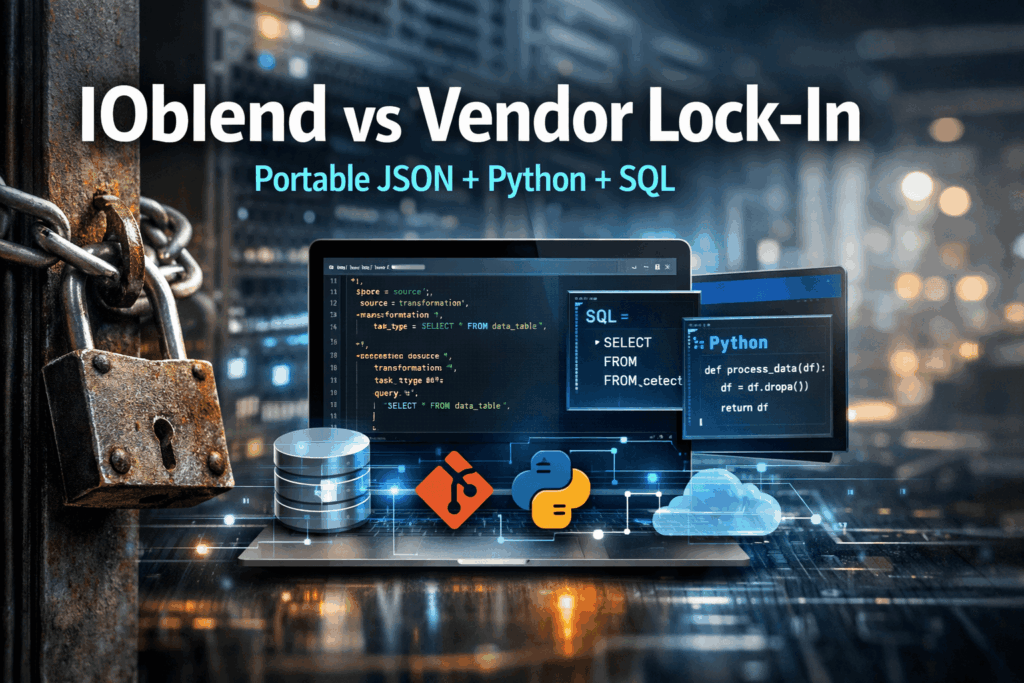

IOblend vs Vendor Lock-In: Portable JSON + Python + SQL

IOblend-portable-JSON-SQL-and-Python

The End of Vendor Lock-in: Keeping your logic portable with IOblend’s JSON-based playbooks and Python/SQL

 💾 Did you know? The average enterprise now uses over 350 different data sources, yet nearly 70% of data leaders feel “trapped” by their infrastructure. Recent industry reports suggest that migrating a legacy data warehouse to a new provider can cost up to five times the original implementation price, primarily due to proprietary code conversion.

The Concept of Portable Logic

In the modern data stack, “vendor lock-in” is the invisible tether that binds your intellectual property, your business logic, to a specific service provider’s proprietary format. IOblend disrupts this cycle by decoupling the execution engine from the logic itself. By using a combination of universal SQL, standard Python, and JSON-based playbooks, IOblend ensures that your data pipelines remain platform-agnostic. Essentially, it treats your data integration as “living code” that can be moved, audited, and executed across different environments without a total rewrite.

The High Cost of Architectural Rigidity

For many organisations, the initial ease of “drag-and-drop” ETL tools eventually turns into a technical debt nightmare. When logic is stored in a vendor’s proprietary binary format or hidden behind a “black-box” GUI, the business loses its agility.

Data experts frequently encounter these friction points:

The Migration Tax: Switching from one cloud provider to another often requires manual translation of thousands of stored procedures.

Skill Gaps: Teams become specialists in a specific tool’s interface rather than the data itself, making it difficult to hire or pivot.

Opaque Version Control: Proprietary tools often struggle with Git integration, making CI/CD pipelines fragile and difficult to peer-review.

The IOblend Solution: Portability by Design

IOblend solves these challenges by providing a developer-centric framework that prioritises transparency.

JSON-Based Playbooks: Instead of opaque configurations, IOblend uses human-readable JSON playbooks to define pipeline stages. This means your entire workflow is documented in a standard format that can be version-controlled in Git and reviewed by any engineer.

Python & SQL Core: By sticking to the industry-standard languages of data, SQL for transformations and Python for complex logic, IOblend ensures that your code remains your own. If you want to run a specific transformation elsewhere, the SQL block remains valid.

Seamless Integration: IOblend’s approach allows you to build, run, and monitor pipelines at scale. By leveraging advanced metadata-driven automation, it eliminates the need for manual plumbing, allowing your team to focus on extracting value rather than managing infrastructure.

Future-proof your data strategy and break free from the shackles of legacy lock-in with IOblend.

IOblend: See more. Do more. Deliver better.

ioblend_predicitive_maintenance_ai
AI
admin

Predictive Aircraft Maintenance with Agentic AI

Predictive Aircraft Maintenance: Consolidating Data from Engine Sensors and MRO Systems  🛫 Did you know that leveraging Big Data analytics for predictive aircraft maintenance can reduce unscheduled aircraft downtime by up to 30%  Predictive Maintenance: The Core Concept  Predictive Maintenance (PdM) in aviation is the strategic shift from a time-based or reactive approach to an ‘as-needed’ model,

Read More »
AI
admin

Digital Twin Evolution: Big Data & AI with

The Industrial Renaissance: How Agentic AI and Big Data Power the Self-Optimising Digital Twin  🏭 Did You Know? A fully realised industrial Digital Twin, underpinned by real-time data, has been proven to reduce unplanned production downtime by up to 20%.  The Digital Twin Evolution  The Digital Twin is a sophisticated, living, virtual counterpart of a physical production system. It

Read More »
real-time_risk_insurance_ioblend
AI
admin

Real-Time Risk Modelling with Legacy & Modern Data

Risk Modelling in Real-time: Integrating Legacy Oracle/HP Underwriting Data with Modern External Datasets  💼 Did you know that in the time it takes to brew a cup of tea, a real-time risk model could have processed enough data to flag over 60 million potential fraudulent insurance claims?  The Real-Time Risk Modelling Imperative  Real-time risk modelling is

Read More »
AI
admin

Unify Clinical & Financial Data to Cut Readmissions

Clinical-Financial Synergy: The Seamless Integration of Clinical and Financial Data to Minimise Readmissions   🚑 Did You Know? Unnecessary hospital readmissions within 30 days represent a colossal financial burden, often reflecting suboptimal transitional care.  Clinical-Financial Synergy: The Seamless Integration of Clinical and Financial Data to Minimise Readmissions  The Convergence of Clinical and Financial Data  The convergence of clinical and financial

Read More »
AI_agents_langchain_ETL_IOblend
AI
admin

Agentic Pipelines and Real-Time Data with Guardrails

The New Era of ETL: Agentic Pipelines and Real-Time Data with Guardrails For years, ETL meant one thing — moving and transforming data in predictable, scheduled batches, often using a multitude of complementary tools. It was practical, reliable, and familiar. But in 2025, well, that’s no longer enough. Let’s have a look at the shift

Read More »
real time CDC and SPARK IOblend
AI
admin

Real-Time Insurance Claims with CDC and Spark

From Batch to Real-Time: Accelerating Insurance Claims Processing with CDC and Spark 💼 Did you know? In the insurance sector, the move from overnight batch processing to real-time stream processing has been shown to reduce the average claims settlement time from several days to under an hour in highly automated systems. Real-Time Data and Insurance 

Read More »
Scroll to Top