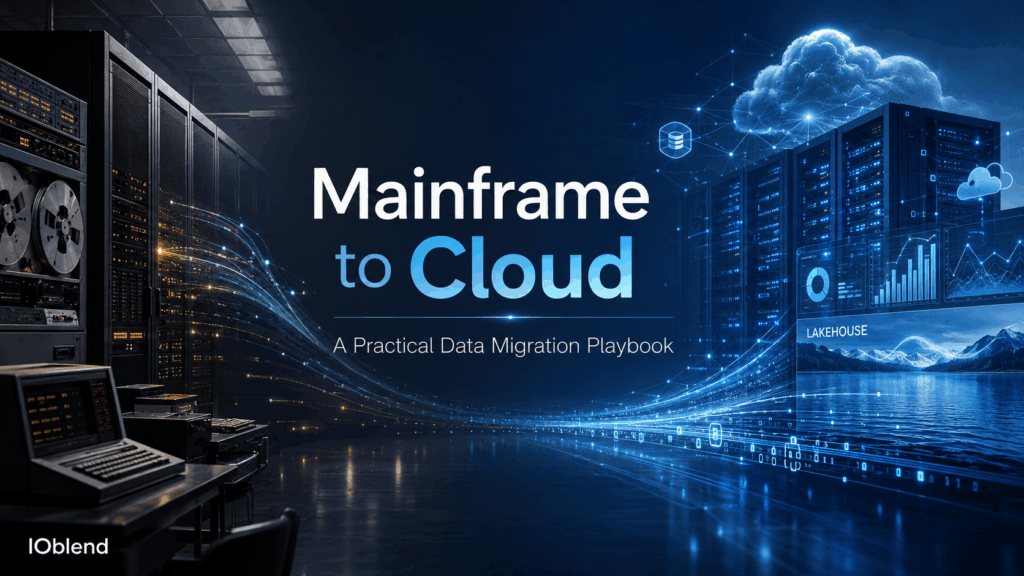
Mainframe to Cloud: A Practical Data Migration Playbook
💾 Did you know? An alarming 83% of data migrations fail outright or drastically overrun their budgets.
Shifting Mainframe Heavyweights to the Cloud
Mainframe-to-cloud data migration is the process of moving core legacy data assets, often stored in rigid formats like DB2, VSAM, or IMS, into modern cloud environments such as Databricks, Snowflake, or AWS. At its heart, this migration is not merely about moving storage bytes; it requires replicating complex, decades-old business logic and converting EBCDIC encodings into cloud-native formats without disrupting daily operational workflows.
The Friction Points of Legacy Architecture
When engineering a mainframe migration, teams consistently face severe bottlenecks. Legacy environments are notoriously opaque, making schema mapping and dependency tracking a manual nightmare. Furthermore, traditional migrations often rely on massive “big bang” cutovers that introduce unacceptable operational risks and system downtime.
Conversely, trying to run legacy and cloud systems in parallel usually triggers massive infrastructure costs and complex data drift, as standard ETL tools struggle to maintain real-time bidirectional synchronisation or handle high-throughput Change Data Capture (CDC) streams without crippling mainframe performance.
How IOblend Smooths the Migration Journey
This is where IOblend completely alters the migration playbook. Instead of forcing you to build a fragile, multi-tool stack, IOblend delivers a single, unified data integration application that standardises production pipelines on Apache Spark as portable JSON playbooks.
- Risk-Free Parallel Execution: IOblend allows you to de-risk your cloud migration by effortlessly running legacy and new systems in parallel. It handles real-time CDC and continuous data replication seamlessly, ensuring both systems remain synchronised without operational hitches.
- High-Throughput, Low-Latency Engine: Proven to handle over 1 million transactions per second with ultra-low P99 latency, IOblend processes massive mainframe batch runs and real-time streams without breaking a sweat.
- No Coding or Lock-In: Data teams can use a drag-and-drop designer to build event-driven pipelines. The system automatically generates optimised Spark jobs, using standard SQL or Python for complex transformations, ensuring your core logic remains entirely portable.
- End-to-End Observability: With record-level lineage, automated error handling, and visual debugging built in, you can trace data from its raw legacy roots right into the cloud lakehouse.
Don’t let legacy friction stall your modernisation strategy, turn your messy, scattered mainframe data into governed, cloud-ready gold by launching your migration with IOblend.

SCADA Streams to Reliability Analytics
Energy: SCADA Streams to Reliability Analytics 🔌 Did you know? The average modern wind turbine or smart substation generates roughly 1 to 2 terabytes of data every month. However, historically, less than 5% of that sensor data was actually used for decision-making. Most of it was simply discarded or “siloed” in SCADA systems, serving as a

Building Live ETA Pipelines for Fleet Operations
Logistics: Live ETA Prediction Pipelines from Fleet + Orders 🚚 Did you know? The “Last Mile” is famously the most expensive and inefficient part of the supply chain, often accounting for up to 53% of total shipping costs. The Evolution of Real-Time Logistics Live ETA (Estimated Time of Arrival) prediction pipelines represent the shift from reactive

DB2 CDC to Lakehouse Without Re-Platforming
From DB2 to Lakehouse: Real-Time CDC Without Re-Platforming 💻 Did you know? Mainframe systems like DB2 still process approximately 30 billion business transactions every single day. Despite the rush toward modern cloud architectures, the world’s most critical financial and logistical data often resides in these “legacy” environments, making them the silent engines of the global economy.

Real-Time Upserts: Deduping and Idempotency
Streaming Upserts Done Right: Deduping and Idempotency at Scale 💻 Did you know? In many high-velocity streaming environments, the “same” event can be sent or processed multiple times due to network retries or distributed system failures. The Art of the Upsert At its core, a streaming upsert (a portmanteau of “update” and “insert”) is the process of synchronising incoming data with an existing

Streaming Data Quality That Won’t Break Pipelines
Streaming Without the Sting: Data Quality Rules That Never Break the Flow 💻 Did you know? A single minute of downtime in a high-velocity streaming environment can result in the loss of millions of data points, potentially costing a business thousands of pounds in missed opportunities or regulatory fines. — Defining Resilient Streaming Quality Data quality in

Schema Drift: The Silent Killer of Data Pipelines
The Silent Pipeline Killer: Surviving Schema Drift in the Wild 📊 Did you know? In the early days of big data, a single column change in a source database could trigger a “data graveyard” effect, where downstream analytics remained broken for weeks. The silent pipeline killer Schema drift occurs when the structure of source data changes