The Invisible Erosion: Detecting and Managing Data Drift in Modern Architectures
📊 Did you know? According to recent industry surveys, over 70% of organisations experience significant data drift within the first six months of deploying a production system.
The Concept of Data Drift
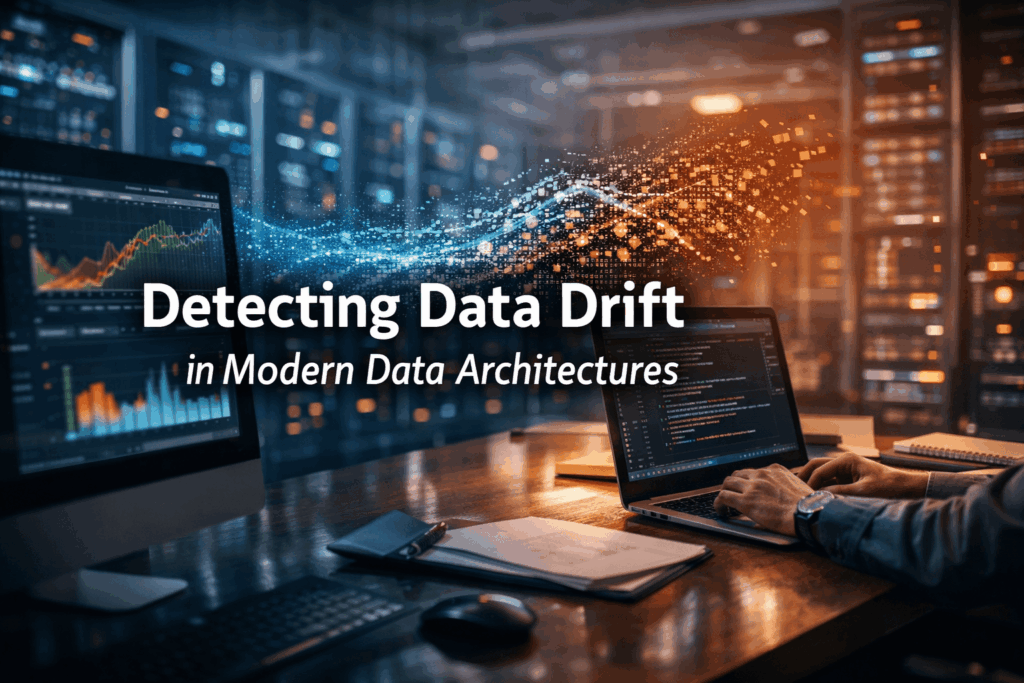
Data drift occurs when the statistical properties or the underlying structure of incoming data change over time. In a production pipeline, this isn’t necessarily a “bug” in the code; rather, it’s a shift in the reality the data represents. Imagine a retail pipeline where a “category” field suddenly receives new, undefined values because a supplier changed their system. The pipeline might continue to run, but your downstream analytics will now be missing crucial segments. Unlike a schema break, which crashes a job, drift is a sub-perceptual erosion of data quality that happens while your monitors are still showing “green”.
Issues Faced by Modern Businesses
For data-driven firms, undetected drift leads to “silent failures” that carry heavy costs.
- Decision Corruption: Executive dashboards might show a dip in performance that isn’t real, it’s just a change in how a source system labels “pending” versus “completed” transactions.
- Operational Friction: Automated supply chain triggers might fail to fire because the distribution of “stock levels” has shifted beyond the hard-coded thresholds set by engineers months ago.
- Resource Drain: Data teams often spend 80% of their time “firefighting”, manually tracing back data discrepancies to a source change that happened weeks prior.
How IOblend Solves the Drift Dilemma
Traditional tools treat drift as an afterthought, but IOblend embeds drift handling and technical governance into the very fabric of the pipeline. Built on a powerful Apache Spark™ engine and a Kappa architecture, IOblend provides a production-grade environment where data is managed throughout its entire journey.
- In-flight Quality Checks: IOblend applies data quality rules and statistical profiling in real-time. It doesn’t just move data; it validates it as it flows, catching anomalies before they land in your warehouse.
- Schema & Metadata Evolution: With built-in schema drift detection and automated metadata cataloguing, IOblend alerts you the moment a source structure changes, preventing downstream “data debt.”
- Record-Level Lineage: If drift is detected, IOblend’s automatic record-level lineage allows engineers to trace exactly where the deviation started, making debugging a matter of minutes rather than days.
- Agentic AI Integration: By embedding AI agents directly into the ETL stream, IOblend can intelligently validate and enrich data, identifying “visual drift” or conceptual shifts that traditional threshold-based monitors would miss.
Stop flying blind and start trusting your data again with IOblend.

Continuous Data Replication for DR and Continuity
Continuous Data Replication: for Business Continuity and DR 📝 Did you know? According to industry studies, the average cost of IT downtime is approximately £4,500 per minute. For a large enterprise, a single hour of data loss or system unavailability can translate into millions in lost revenue, legal penalties, and irreparable brand damage. The Pulse of

Smart Meter Data: Billing to Forecasting
Utilities: Smart Meter Data to Billing and Demand Forecasting 📋 Did You Know? The global roll-out of smart meters generates more data in a single day than most utility companies used to collect in an entire decade. While traditional meters were read once a month, or even once a quarter, smart meters transmit data at intervals

SCADA Streams to Reliability Analytics
Energy: SCADA Streams to Reliability Analytics 🔌 Did you know? The average modern wind turbine or smart substation generates roughly 1 to 2 terabytes of data every month. However, historically, less than 5% of that sensor data was actually used for decision-making. Most of it was simply discarded or “siloed” in SCADA systems, serving as a

Building Live ETA Pipelines for Fleet Operations
Logistics: Live ETA Prediction Pipelines from Fleet + Orders 🚚 Did you know? The “Last Mile” is famously the most expensive and inefficient part of the supply chain, often accounting for up to 53% of total shipping costs. The Evolution of Real-Time Logistics Live ETA (Estimated Time of Arrival) prediction pipelines represent the shift from reactive

DB2 CDC to Lakehouse Without Re-Platforming
From DB2 to Lakehouse: Real-Time CDC Without Re-Platforming 💻 Did you know? Mainframe systems like DB2 still process approximately 30 billion business transactions every single day. Despite the rush toward modern cloud architectures, the world’s most critical financial and logistical data often resides in these “legacy” environments, making them the silent engines of the global economy.

Real-Time Upserts: Deduping and Idempotency
Streaming Upserts Done Right: Deduping and Idempotency at Scale 💻 Did you know? In many high-velocity streaming environments, the “same” event can be sent or processed multiple times due to network retries or distributed system failures. The Art of the Upsert At its core, a streaming upsert (a portmanteau of “update” and “insert”) is the process of synchronising incoming data with an existing