
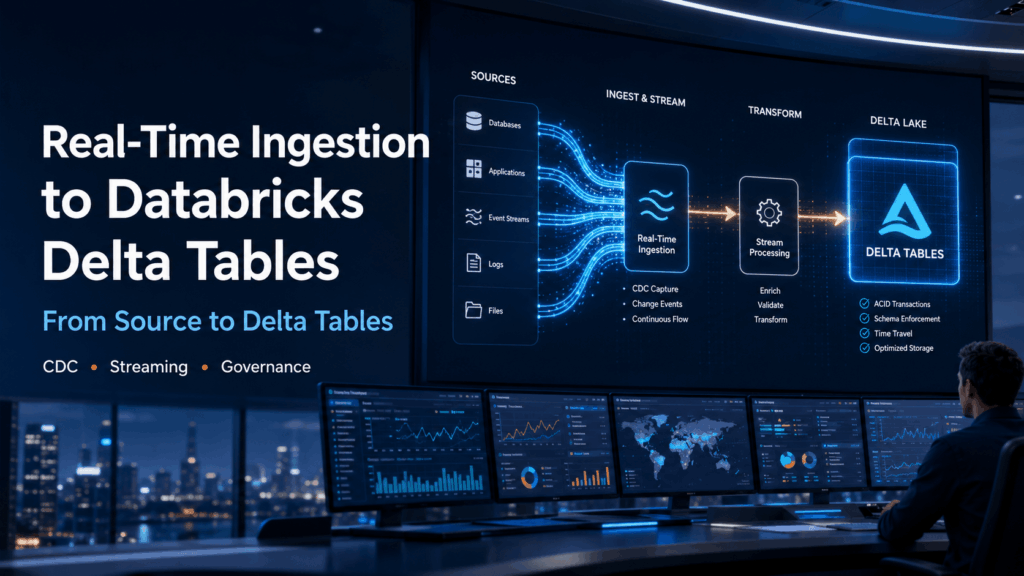

Realtime Ingestion to Databricks: From Source to Delta TablesÂ
💽 Did you know? According to industry surveys, nearly eighty per cent of an enterprise’s data budget is consumed purely by data integration and upfront data wrangling rather than actual analytics.Â
Defining real-time ingestionÂ
Real-time ingestion to Databricks represents the technical evolution from rigid scheduled batch processing to continuous, event-driven data streaming. At its core, the architecture involves capturing high-velocity data from sources, such as transactional databases via Change Data Capture (CDC), IoT sensors, or application log streams, and immediately driving it into Databricks Delta Tables.Â
The friction points for modern businessÂ
Data teams migrating to continuous lakehouse replication face steep operational hurdles. Traditional ETL stacks rely on multiple disjointed tools to stitch together ingestion, storage, and processing, which creates brittle pipelines that are a nightmare to manage.Â
The primary business pain points include:Â
- The “Five-Tool Stack” Complexity: Constantly babysitting separate tools for CDC, stream ingestion, schema drift tracking, and orchestration.Â
- Schema Drift and Failures: Quiet changes in source database schemas frequently break downstream pipelines, resulting in data downtime.Â
- Prohibitive Cloud Compute Costs: Poorly optimised Apache Spark clusters running 24/7 to process streaming workloads can cause cloud bills to skyrocket out of control.Â
Consider a fleet operations enterprise trying to build a live ETA pipeline. If sensor schemas mutate slightly, or if out-of-order data arrives during network drops, manual coding interventions are required, stalling operations.Â
The IOblend Solution
IOblend redefines this architecture by standardising real-time production pipelines into a single, unified DataOps application built on Kappa architecture. Instead of managing a bloated stack, data experts use the low-code IOblend Designer to build pipelines that automatically generate highly optimised, pure Apache Spark code running behind the scenes.
IOblend directly solves enterprise challenges through:
Massive Performance: Achieving throughput speeds exceeding 1 million transactions per second (TPS) on modest infrastructure, slashing Databricks compute costs by up to seventy per cent.
Built-In Data Governance: Automating record-level lineage, data quality checks, de-duplication, and advanced Change Data Capture (log, trigger, or query-based) within every single flight.
No Vendor Lock-In: Pipelines are stored as portable JSON playbooks, keeping your core SQL and Python business logic independent.
Whether replicating over 400 MySQL tables via continuous CDC or syncing complex smart meter streams to Databricks, IOblend removes the coding burden entirely.
Accelerate your real-time Databricks pipelines from quarters to days with the power of IOblend.

Flying smarter with real-time analytics
Dynamic decisioningWe continue exploring the topics of operational analytics (OA) in the aviation industry.Data plays a crucial role in flight performance analytics, operational decisioning and risk management. Real-time data enhances them.The aviation industry uses real-time data for a multitude of operational analytics cases: monitor operational systems, measure wear and tear of equipment, power dynamic product

How Operational Analytics power Ground Handling
The Ground Handling journey – today and tomorrow In today’s blog we are discussing how Operational Analytics (OA) enables the aviation Ground Handling industry to deliver their services to airlines. Aviation is one of the most complex industries out there, so it offers a wealth of examples (plus it’s also close to our hearts). OA

Airline safety management: enhance your SMS with IOblend
Today we are looking at the data aspect of flight safety management in the aviation industry.

Unlock new capabilities with real time ACARS data
In this short article we are looking at one of the key data sources for the aviation industry – ACARS – and how IOblend helps to unlock new analytical capabilities from it.

Time to automate your airline’s DOC data
How to automate Direct Operating Cost (DOC) data collection, processing and serving with IOblend.

Automate airline fuel data collection & management
Collecting and managing airline fuel data is complex and time consuming. IOblend can greatly streamline the process and enable real-time decisioning.