
Dynamic Pricing with Agentic AI
The Agentic Edge: Real-Time Dynamic Pricing through AI-Driven Cloud Data Integration 📊 Did You Know? The most sophisticated dynamic pricing systems can process and react to market signals in under 100 milliseconds. The Evolution of Value Optimisation Dynamic Pricing and Revenue Management (DPRM) is a complex computational science. At its core, DPRM aims to sell the right

Smarter Quality Control with Cloud + IOblend
Quality Control Reimagined: Cloud, the Fusion of Legacy Data and Vision AI 🏭 Did You Know? Over 80% of manufacturing and quality data is considered ‘dark’ inaccessible or siloed within legacy on-premises systems, dramatically hindering the deployment of real-time, predictive Quality Control (QC) systems like Vision AI. Quality Control Reimagined The core concept of modern quality

Predictive Aircraft Maintenance with Agentic AI
Predictive Aircraft Maintenance: Consolidating Data from Engine Sensors and MRO Systems 🛫 Did you know that leveraging Big Data analytics for predictive aircraft maintenance can reduce unscheduled aircraft downtime by up to 30% Predictive Maintenance: The Core Concept Predictive Maintenance (PdM) in aviation is the strategic shift from a time-based or reactive approach to an ‘as-needed’ model,

Digital Twin Evolution: Big Data & AI with
The Industrial Renaissance: How Agentic AI and Big Data Power the Self-Optimising Digital Twin 🏭 Did You Know? A fully realised industrial Digital Twin, underpinned by real-time data, has been proven to reduce unplanned production downtime by up to 20%. The Digital Twin Evolution The Digital Twin is a sophisticated, living, virtual counterpart of a physical production system. It

Real-Time Risk Modelling with Legacy & Modern Data
Risk Modelling in Real-time: Integrating Legacy Oracle/HP Underwriting Data with Modern External Datasets 💼 Did you know that in the time it takes to brew a cup of tea, a real-time risk model could have processed enough data to flag over 60 million potential fraudulent insurance claims? The Real-Time Risk Modelling Imperative Real-time risk modelling is

Unify Clinical & Financial Data to Cut Readmissions
Clinical-Financial Synergy: The Seamless Integration of Clinical and Financial Data to Minimise Readmissions 🚑 Did You Know? Unnecessary hospital readmissions within 30 days represent a colossal financial burden, often reflecting suboptimal transitional care. Clinical-Financial Synergy: The Seamless Integration of Clinical and Financial Data to Minimise Readmissions The Convergence of Clinical and Financial Data The convergence of clinical and financial

When Enterprise Data Platforms Become Too Complex
When Enterprise Data Platforms Become Too Complex Enterprise data platforms usually start with a sensible goal: Connect the data Make it trustworthy Make it useful The problem is that, over time, the platform itself can become part of the complexity. More services are added. More specialist skills are needed. More workloads become dependent on one
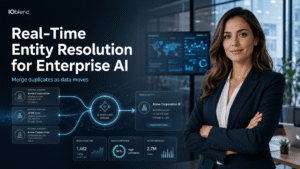
Real-Time Entity Resolution for Enterprise Data and AI
Entity Resolution at Scale: Merge Duplicates as Data Moves Enterprise data rarely arrives clean. The same customer, supplier or product can exist across multiple systems under different names, IDs or formats. For reporting, this creates inconsistency. For AI and automation, it creates unreliable context. Entity resolution has traditionally been handled through batch processing. But when
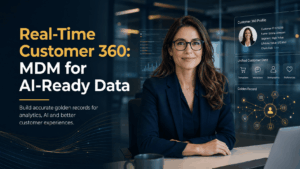
Real-Time Customer 360: MDM for AI-Ready Data
Real-Time Customer 360: MDM That Keeps Data Current A Customer 360 view is only useful if the data behind it is current. Many organisations still rely on batch integration, which means customer profiles can quickly fall behind reality. As businesses adopt AI, copilots and real-time analytics, that gap becomes harder to ignore. Real-time Master Data
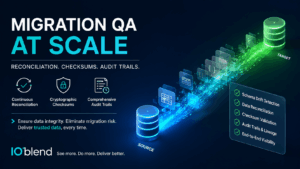
Data Migration QA: Checksums & Audit Trails
Migration QA at Scale: Reconciliation, Checksums, and Audit Trails 📂 Did you know that during enterprise database migrations, as much as 20% of quiet data corruption goes entirely unnoticed until post-cutover operational failures occur? Understanding migration QA at scale Migration QA at scale refers to the systematic validation of volume, structure, and integrity when shifting enterprise
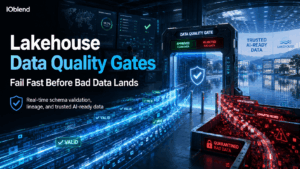
Lakehouse Data Quality Gates: Stop Bad Data Fast
Lakehouse Quality Gates: Fail Fast Before Bad Data Lands 📋 Did You Know? Up to 20% of real-time event streams suffer from schema drift, duplicate payloads, or corrupted records, costing global organisations billions each year in wasted compute, broken analytical models, and polluted reporting layers. The Concept: Stopping Bad Data at the Border Lakehouse Quality Gates are automated,
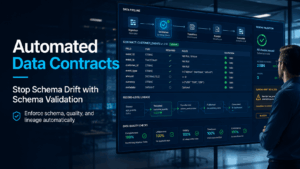
Automated Data Contracts: Stop Schema Drift
Data Contracts That Stick: Enforce Schema and Expectations Automatically 📜 Did You Know? In the early days of big data, a single unannounced column type change in an upstream transactional database could trigger a catastrophic “data graveyard” effect, corrupting millions of analytics records before anyone noticed. The Concept of Enforceable Data Contracts A data contract is
