


BCBS 239 Compliance with Record-Level Lineage
Regulatory Compliance at Scale: Automating record-level lineage and audit trails for BCBS 239 📋 Did you know? In the wake of the 2008 financial crisis, the Basel Committee found that many global banks were unable to aggregate risk exposures accurately or quickly because their data landscapes were too complex. This led to the birth of BCBS
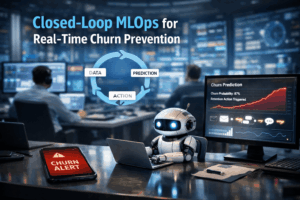
Real-Time Churn Agents with Closed-Loop MLOps
Churn Prevention: Building “closed-loop” MLOps systems that predict churn and trigger automated retention agents 🔗 Did you know? In the telecommunications and subscription-based sectors, a mere 5% increase in customer retention can lead to a staggering profit surge of more than 25%. Closed-Loop MLOps A “closed-loop” MLOps system is an advanced architectural pattern that transcends simple predictive analytics. While
Streaming Predictive MX: Drift-Aware Inference
Predictive Maintenance 2.0: Feeding real-time sensor drifts directly into inference models using streaming engine 🔩 Did you know? The cost of unplanned downtime for industrial manufacturers is estimated at nearly £400 billion annually. Predictive Maintenance 2.0: The Real-Time Evolution Predictive Maintenance 2.0 represents a paradigm shift from batch-processed diagnostics to live, autonomous synchronisation. In the traditional 1.0
Beyond Micro-Batching: Continuous Streaming for AI
Beyond Micro-batching: Why Continuous Streaming Engine is the Future of “Fresh Data” for AI 💻 Did you know? Most modern “real-time” AI applications are actually running on data that is already several minutes old. Traditional micro-batching collects data into small chunks before processing it, introducing a “latency tax” that can render predictive models obsolete before they

ERP Cloud Migration With Live Data Sync
Seamless Core System Migration: The Move of Large-Scale Banking and Insurance ERP Data to a Modern Cloud Architecture ⛅ Did you know that core system migrations in large financial institutions, which typically rely on manual data mapping and validation, often require parallel runs lasting over 18 months? The Core Challenge The migration of multi-terabyte ERP and

Legacy ERP Integration to Modern Data Fabric
Warehouse Automation Efficiency: Migrating and Integrating Legacy ERP Data into a Modern Big Data Ecosystem 📦 Did you know? Analysts estimate that warehouses leveraging robust, real-time data integration see inventory accuracy improvements of up to 99%. The Convergence of WMS and Big Data Data professionals in logistics face a profound challenge extracting mission-critical operational data such

When Enterprise Data Platforms Become Too Complex
When Enterprise Data Platforms Become Too Complex Enterprise data platforms usually start with a sensible goal: Connect the data Make it trustworthy Make it useful The problem is that, over time, the platform itself can become part of the complexity. More services are added. More specialist skills are needed. More workloads become dependent on one
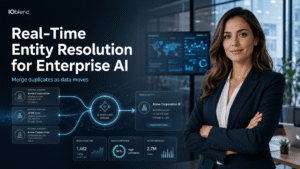
Real-Time Entity Resolution for Enterprise Data and AI
Entity Resolution at Scale: Merge Duplicates as Data Moves Enterprise data rarely arrives clean. The same customer, supplier or product can exist across multiple systems under different names, IDs or formats. For reporting, this creates inconsistency. For AI and automation, it creates unreliable context. Entity resolution has traditionally been handled through batch processing. But when
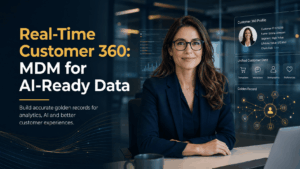
Real-Time Customer 360: MDM for AI-Ready Data
Real-Time Customer 360: MDM That Keeps Data Current A Customer 360 view is only useful if the data behind it is current. Many organisations still rely on batch integration, which means customer profiles can quickly fall behind reality. As businesses adopt AI, copilots and real-time analytics, that gap becomes harder to ignore. Real-time Master Data
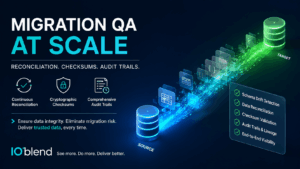
Data Migration QA: Checksums & Audit Trails
Migration QA at Scale: Reconciliation, Checksums, and Audit Trails 📂 Did you know that during enterprise database migrations, as much as 20% of quiet data corruption goes entirely unnoticed until post-cutover operational failures occur? Understanding migration QA at scale Migration QA at scale refers to the systematic validation of volume, structure, and integrity when shifting enterprise
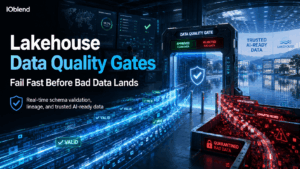
Lakehouse Data Quality Gates: Stop Bad Data Fast
Lakehouse Quality Gates: Fail Fast Before Bad Data Lands 📋 Did You Know? Up to 20% of real-time event streams suffer from schema drift, duplicate payloads, or corrupted records, costing global organisations billions each year in wasted compute, broken analytical models, and polluted reporting layers. The Concept: Stopping Bad Data at the Border Lakehouse Quality Gates are automated,
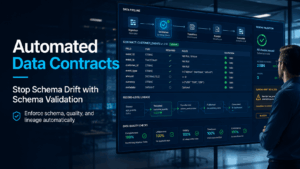
Automated Data Contracts: Stop Schema Drift
Data Contracts That Stick: Enforce Schema and Expectations Automatically 📜 Did You Know? In the early days of big data, a single unannounced column type change in an upstream transactional database could trigger a catastrophic “data graveyard” effect, corrupting millions of analytics records before anyone noticed. The Concept of Enforceable Data Contracts A data contract is
