
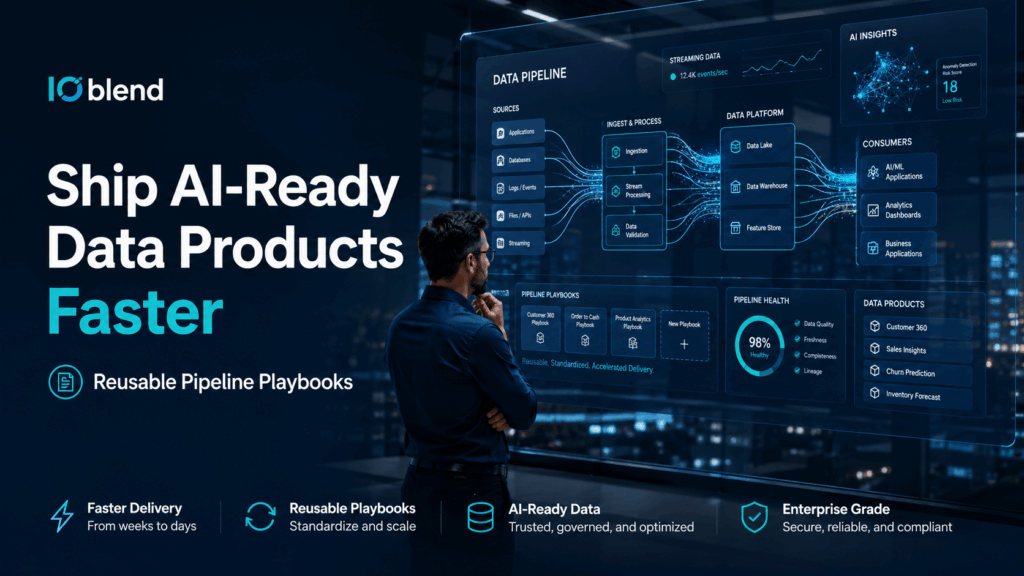

Build a “Data Product” in Days: Reusable Pipeline Playbooks
📝 Did you know? According to industry research, over 75% of the enterprise data budget is swallowed by repetitive data integration tasks. Rather than delivering high-value analytical models, engineers spend the majority of their time building the same structural boilerplate over and over again.
What are reusable pipeline playbooks?
A data product treats data as a curated, standalone asset designed for immediate business consumption. Historically, shipping a new data product meant writing bespoke, monolithic Extract, Transform, Load (ETL) code. Reusable pipeline playbooks flip this model. They decouple infrastructure and orchestration from business rules by storing dataflows as modular, metadata-driven configuration files (like JSON). This means you can standardise ingestion, cleaning, and delivery into plug-and-play templates. Data teams can instantiate a robust, production-grade data product in days by simply feeding new schemas or parameters into an existing playbook.
Common architectural bottlenecks
Most enterprises suffer from brittle, hand-coded pipelines that cannot scale. When a source schema changes unexpectedly, downstream systems break silently, causing data drift chaos.
Consider a financial services firm trying to create an emergency risk-analytics data product. The engineering team has to stitch together historical batch databases and real-time streaming feeds. They spend weeks writing complex Apache Spark™ logic, managing Slowly Changing Dimensions (SCD), tracking record-level lineage, and tuning infrastructure. By the time the code is tested and deployed, the business opportunity has passed, and the team is trapped under a mountain of maintenance technical debt.
Accelerating data products with IOblend
This is precisely where IOblend eliminates friction. IOblend standardises production data pipelines on Spark as portable, lightweight JSON playbooks. It provides a low-code, drag-and-drop interface that abstracts the engineering complexity while autogenerating highly optimised distributed compute code behind the scenes.
- Seamless Kappa Architecture: Easily mix real-time streaming and batch sources dynamically without writing disparate pipelines.
- Built-in DataOps & Governance: Out-of-the-box features automatically handle Change Data Capture (CDC), Type I and II SCD regressions, deduplication, and record-level lineage.
- Resilience to Drift: Schema evolution is managed safely via strong data contracts, ensuring pipelines never fail quietly.
With IOblend, you build your core dataflow logic once and run it anywhere, across multi-cloud, on-prem, or hybrid environments.
Stop wasting quarters hand-coding brittle pipelines; accelerate your modern data estate and ship production-ready data products in days with IOblend.

Predictive Aircraft Maintenance with Agentic AI
Predictive Aircraft Maintenance: Consolidating Data from Engine Sensors and MRO Systems 🛫 Did you know that leveraging Big Data analytics for predictive aircraft maintenance can reduce unscheduled aircraft downtime by up to 30% Predictive Maintenance: The Core Concept Predictive Maintenance (PdM) in aviation is the strategic shift from a time-based or reactive approach to an ‘as-needed’ model,

Digital Twin Evolution: Big Data & AI with
The Industrial Renaissance: How Agentic AI and Big Data Power the Self-Optimising Digital Twin 🏭 Did You Know? A fully realised industrial Digital Twin, underpinned by real-time data, has been proven to reduce unplanned production downtime by up to 20%. The Digital Twin Evolution The Digital Twin is a sophisticated, living, virtual counterpart of a physical production system. It

Real-Time Risk Modelling with Legacy & Modern Data
Risk Modelling in Real-time: Integrating Legacy Oracle/HP Underwriting Data with Modern External Datasets 💼 Did you know that in the time it takes to brew a cup of tea, a real-time risk model could have processed enough data to flag over 60 million potential fraudulent insurance claims? The Real-Time Risk Modelling Imperative Real-time risk modelling is

Unify Clinical & Financial Data to Cut Readmissions
Clinical-Financial Synergy: The Seamless Integration of Clinical and Financial Data to Minimise Readmissions 🚑 Did You Know? Unnecessary hospital readmissions within 30 days represent a colossal financial burden, often reflecting suboptimal transitional care. Clinical-Financial Synergy: The Seamless Integration of Clinical and Financial Data to Minimise Readmissions The Convergence of Clinical and Financial Data The convergence of clinical and financial

Agentic Pipelines and Real-Time Data with Guardrails
The New Era of ETL: Agentic Pipelines and Real-Time Data with Guardrails For years, ETL meant one thing — moving and transforming data in predictable, scheduled batches, often using a multitude of complementary tools. It was practical, reliable, and familiar. But in 2025, well, that’s no longer enough. Let’s have a look at the shift

Real-Time Insurance Claims with CDC and Spark
From Batch to Real-Time: Accelerating Insurance Claims Processing with CDC and Spark 💼 Did you know? In the insurance sector, the move from overnight batch processing to real-time stream processing has been shown to reduce the average claims settlement time from several days to under an hour in highly automated systems. Real-Time Data and Insurance